New construction homes in Tarrant County come with big sliding glass doors and, often, blinds that don't fit them. Here's what actually works.
Share:

You moved in a few months ago. The house is great. But the blinds that came with the sliding glass door — the ones the builder included — are already sagging, won’t close all the way, or let in a strip of afternoon sun that heats up the entire living room.
This is one of the most common frustrations we hear from new homeowners across Tarrant County, and it’s not a fluke. It’s a pattern. Builder-grade window treatments aren’t designed for the wide, statement sliding glass doors that are standard in today’s new construction floor plans. They’re a placeholder. What you actually need is something built for the door you have — and the Texas heat that comes with it.
Production builders developing communities across Mansfield, Keller, Aledo, and North Richland Hills often include window treatments as a sales incentive. What that usually means in practice is a set of thin horizontal mini-blinds that were never engineered for a six-foot or eight-foot sliding glass door. They’re cut from standard sizes, not built to your door’s actual dimensions, which leaves gaps at the edges, uneven coverage, and a finished look that doesn’t match the home you paid for.
The materials compound the problem. Lightweight slats warp in Texas heat, cords tangle under daily use, and vanes that fall off their carriers become a regular annoyance within the first year. For a door that gets opened and closed multiple times a day, that wear happens fast.

Here’s the core issue: most retail blinds max out around 96 inches wide. Many sliding glass doors in new Tarrant County construction are wider than that — and even when the dimensions are close, “close” isn’t the same as correct. A blind that’s a half-inch short on each side leaves a visible gap where light pours through and where anyone walking past can see directly into your home.
Custom fit blinds are fabricated to your door’s exact measurements — not trimmed down from a standard size, not approximated. That distinction matters more on a sliding glass door than almost any other window in the house, because the door is large, prominent, and central to the living space. It’s usually the first thing you see when you walk into the main living area, and it’s the primary connection between your indoor space and the backyard or covered patio.
Beyond the aesthetics, fit affects function. A blind that doesn’t cover the full width of the door frame won’t give you real privacy. One that hangs too low will catch on the door handle or drag on the track. Getting the measurement right requires accounting for the door’s operational clearance — how far the panel slides, where the handle sits, and whether the treatment needs to stack clear of the opening when the door is in use.
We come from a construction background, which means we measure sliding glass doors the way a builder would — with an eye toward how the door actually operates, not just its nominal dimensions. That approach eliminates the most common failure point before installation even begins.
Open-concept floor plans are essentially the default in new Tarrant County construction. The kitchen, dining area, and living room flow together, and the sliding glass door sits at the end of that space — often the visual anchor of the entire main level. Whatever goes on that door will be visible from most of the house, so the choice matters.
Vertical blinds are the most common builder-installed option, and they work — up to a point. They cover wide openings, they’re easy to operate, and they’re inexpensive. But the vanes are fragile, they don’t insulate well, and the look is dated in a way that conflicts with the cleaner, more contemporary aesthetic of most new construction interiors.
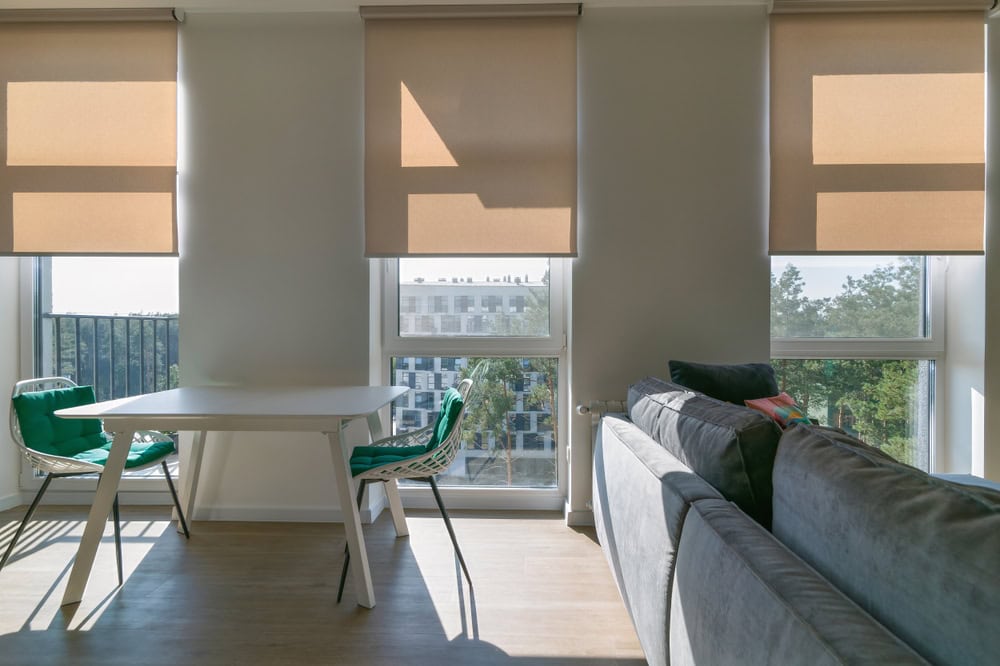
Panel track blinds are the modern alternative. Wide fabric panels slide smoothly along a track, creating a clean, architectural look that reads more like a design choice than a functional afterthought. They’re available in a range of opacities — from sheer to room-darkening — and they handle wide openings elegantly. For new construction homes in Southlake, Colleyville, or the newer subdivisions in Fort Worth’s southwest corridor, panel track blinds are one of the most popular upgrades we install.
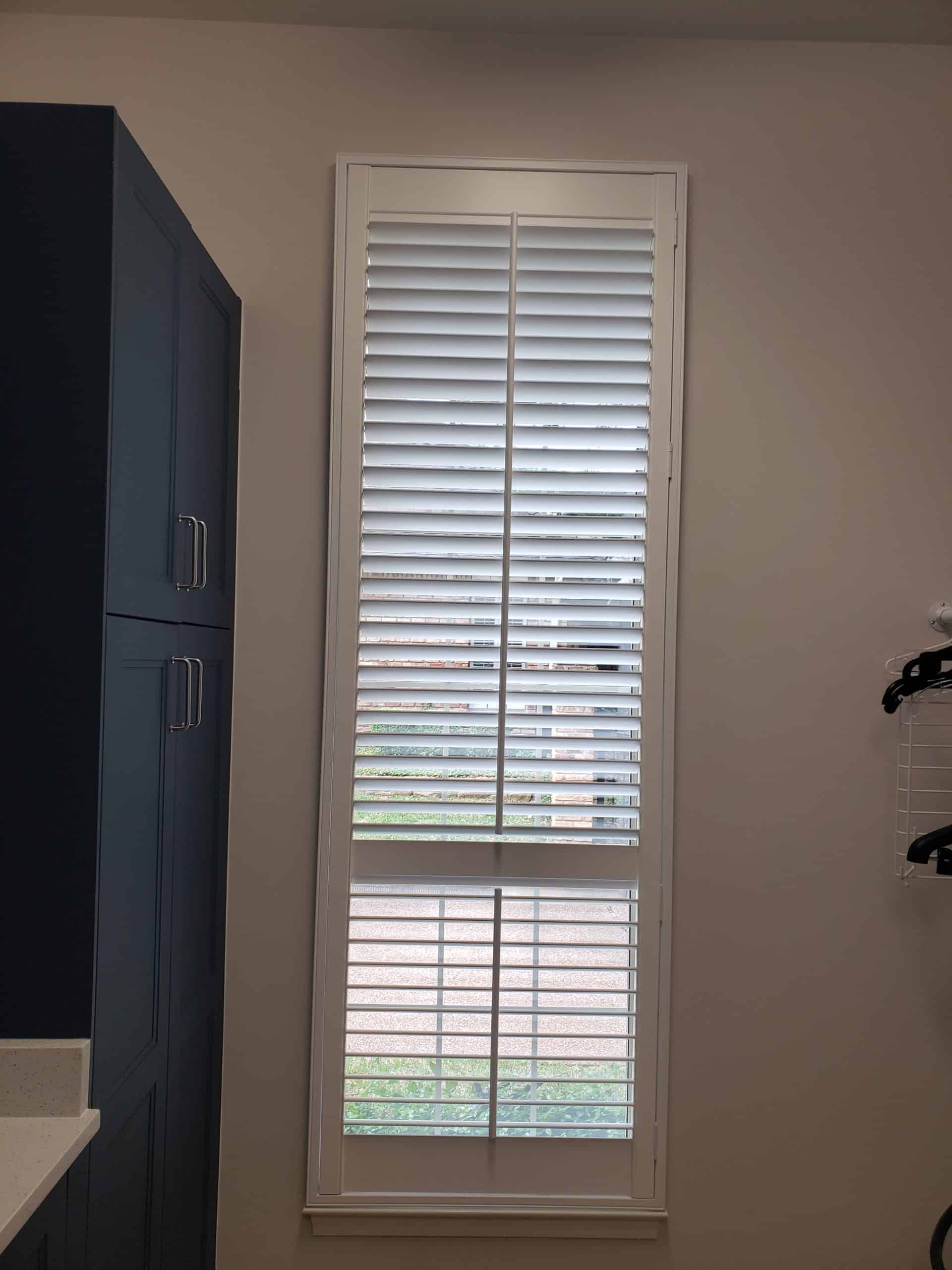
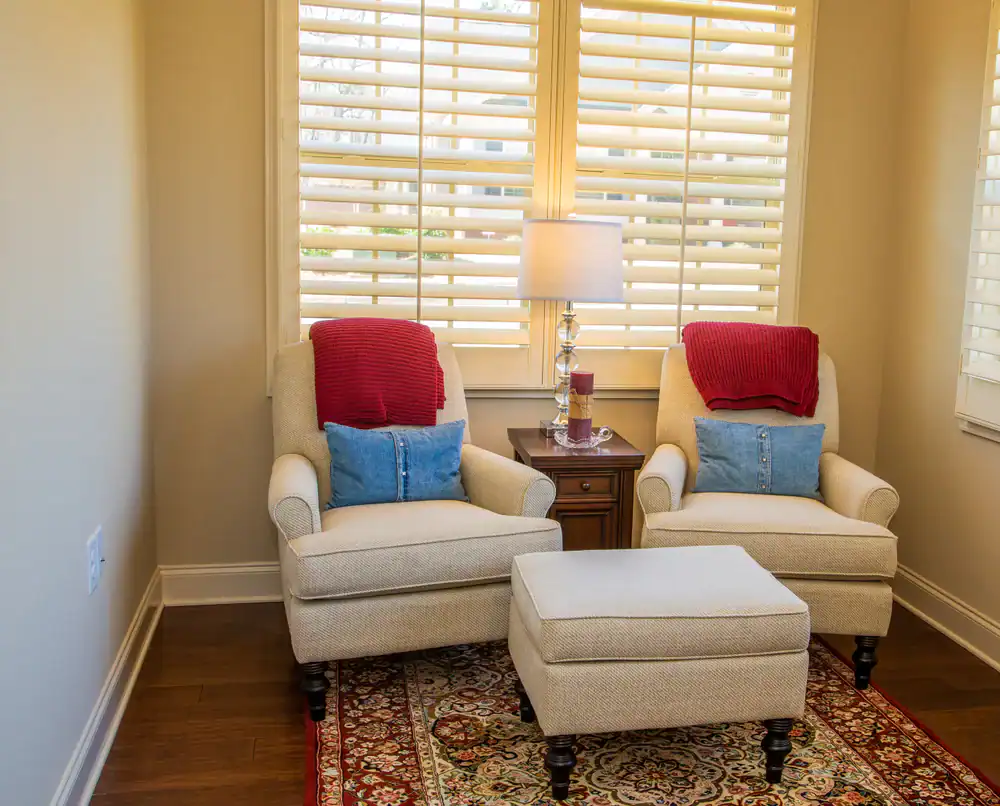
Plantation shutters are another option worth considering for sliding glass doors. Bypass shutters — panels that slide past each other on a track — and bifold shutters that fold accordion-style to stack at the side of the opening are both designed for this application. They add thermal insulation over the large glass panels, which is a meaningful benefit when your sliding glass door faces south or west and the afternoon sun is working directly against your air conditioner. Every shutter we install for a sliding glass door in Tarrant County is custom-built to exact measurements, in faux wood or vinyl that holds up to the humidity and temperature swings that come with living in North Texas.
If there’s one window in the house where motorization makes the most practical sense, it’s the sliding glass door. It’s a high-traffic opening that gets used constantly — which means you’re operating the window treatment constantly. Motorized blinds eliminate that friction. You control them from your phone, set a schedule, or connect them to a smart home system so they respond automatically.
For new construction specifically, the timing matters. Installing motorized window treatments while the home is still being finished — or early in the move-in window — means the wiring can be integrated cleanly, without the cost and disruption of retrofitting later. That’s a detail most national guides don’t mention, but it’s one we think about because we work on both sides of the construction process.
We offer PowerView motorization, which integrates with major smart home platforms and allows your sliding glass door blinds to be controlled via app, voice command, or automated schedule. In practical terms, that means you can program the blinds to close at two in the afternoon — when the west-facing glass is at its worst — and open again in the evening without touching them.
For a busy household in Tarrant County where the afternoon sun turns the living room into a greenhouse every summer, that kind of automation isn’t a luxury. It’s a daily quality-of-life improvement.
Motorized options also address a concern that comes up frequently for families with young children: cord safety. Motorized blinds are cordless by design, which removes the hazard entirely. That’s increasingly important as awareness around window covering safety has grown, and it’s one of the reasons motorized treatments make particular sense for new construction homes where young families are often the buyers.
The cost premium for motorization is real, and it’s worth understanding before you decide. Adding motorization runs approximately $100 to $300 per shade over a comparable manual option, depending on the product and configuration. For a single sliding glass door, that’s a manageable addition — especially when you factor in the energy savings from being able to schedule the blinds around peak heat hours, and the convenience of not having to think about it at all.
We work with both residential and commercial clients, which means we’ve handled motorized installations at scale. That experience carries over directly to the residential side, particularly for homes with multiple large windows or whole-home automation goals.
Tarrant County gets genuinely hot. June through August brings 100-degree days with regularity, and a sliding glass door that faces south or west becomes one of the largest heat gain surfaces in the house. If your HVAC is running harder than you expected in your first Texas summer, the glass is a likely contributor.
Cellular shades — also called honeycomb shades — address this directly. Their structure traps air inside a series of cells, creating an insulating layer between the glass and the room. Research from Oak Ridge National Laboratory has shown that cellular shades can reduce heating costs by up to 24% compared to standard blinds. In a climate like Tarrant County’s, the cooling-season equivalent is equally significant: less heat transfer through the glass means your air conditioner isn’t fighting as hard to maintain a comfortable temperature.
For sliding glass doors, the relevant product is vertical cellular shades — a configuration that operates side to side rather than up and down, matching how the door itself works. They combine the energy performance of cellular construction with the practical operation a sliding door requires. Single-cell, double-cell, and triple-cell builds are available, with each additional layer increasing insulation and R-value. Some configurations reach R-4, which is a meaningful thermal upgrade at the glass surface.
The other advantage of cellular shades that doesn’t get discussed enough is light diffusion. Unlike blackout options that simply block everything, cellular shades in lighter fabrics filter sunlight softly — reducing glare and UV exposure without making the room feel closed off. That matters in an open-concept floor plan where the sliding glass door is also a major source of natural light. You can reduce heat gain and UV damage to your floors and furniture without losing the brightness that made the floor plan appealing in the first place.
We use Texas-made products, which means shorter lead times and a level of accountability that comes with sourcing locally. For cellular shades specifically, that translates to precise fabrication for your door’s exact dimensions — not a standard size trimmed to fit.
The sliding glass door is one of the most used and most visible features in a new construction home. Getting the window treatment right — fit, function, and material — makes a real difference in how the space looks and feels, and in what you pay to cool it every summer.
Builder-grade blinds are a starting point, not a solution. Whether you’re replacing something that’s already failing or planning ahead before the first Texas summer hits, the options available to you — panel track, cellular shades, motorized systems, plantation shutters — are genuinely better in every way that matters.
If you’re in Tarrant County and want to talk through what makes sense for your home, reach out to A Plus Shutters & Shades. We’ll measure the door correctly, walk you through the options that fit your floor plan and your budget, and handle the installation from start to finish.
Article details:
Share:
Continue learning: