
Honeycomb Shades Tarrant County TX

Stop Paying to Cool the Outdoors

Custom cellular shades that block heat before it hits your windows, cut energy waste by up to 30%, and keep your home comfortable year-round without cranking the AC.
A home office with a wooden desk, laptop, potted plant, and bookshelves. Three large windows with beige blinds partially closed let in filtered light, and greenery is visible outside.

Custom Cellular Shades Tarrant County

What Honeycomb Shades Actually Do

Honeycomb shades trap air inside their cellular structure, creating an insulating barrier between your window and your room. That’s not marketing talk—it’s how they work. The hexagonal cells you see when looking at them from the side act like tiny pockets that slow down heat transfer. In summer, they block solar heat before it turns your living room into an oven. In winter, they keep your expensive heated air from escaping through the glass. The result is lower energy bills, more consistent indoor temperatures, and rooms that actually feel comfortable instead of fighting against whatever’s happening outside.

Energy Efficient Cellular Shades Texas

What You Get With Proper Cellular Shades

These aren’t just window coverings. They’re climate control that works whether you’re home or not, cutting waste and improving how your space actually feels.

Texas-Made Products Only

We use shades manufactured locally in Texas, engineered specifically to handle 100-degree summers and extreme temperature swings without warping or failing.

Decade of Installation Expertise

Our construction background means precise measurements, proper mounting, and installations that perform exactly as intended from day one through years of use.

Custom-Fit Every Time

No gaps, no guesswork. Every honeycomb shade is built to your exact window specifications for maximum insulation and the clean look you're after.

Owner-Involved Service

You work directly with the owner throughout the process, not different reps who don't communicate. One point of contact from consultation through final installation.
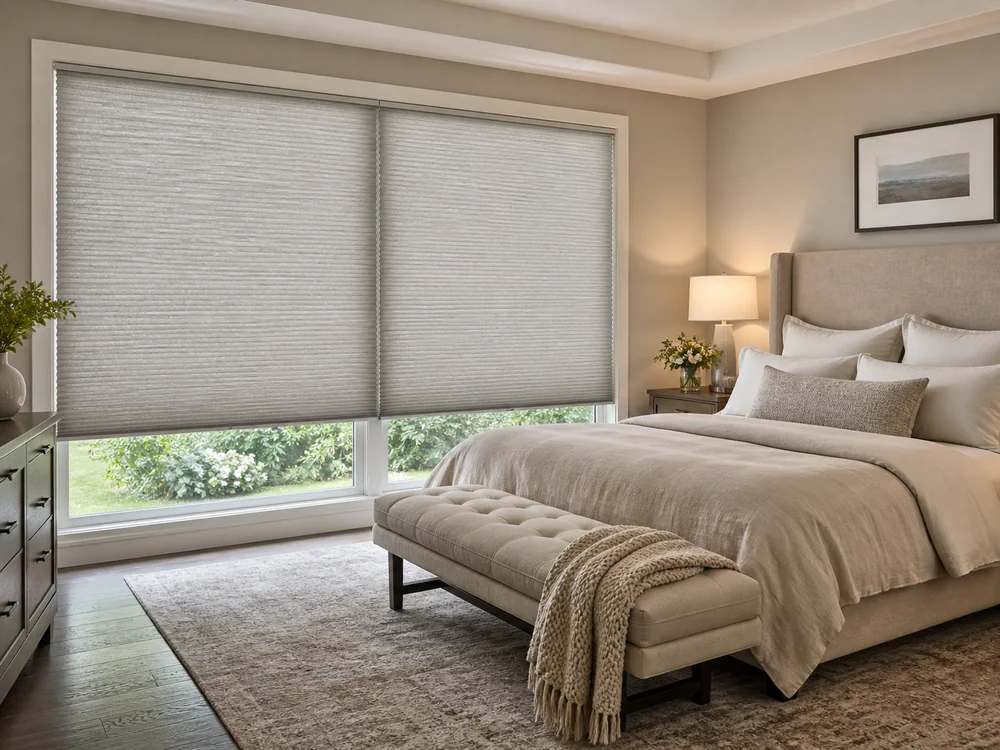
A modern bedroom with a large window covered by gray blinds, a beige upholstered bed with pillows and a throw blanket, a bench at the foot of the bed, a nightstand with a lamp, and neutral-colored decor.

Honeycomb Shade Installation Tarrant County

Why the Honeycomb Design Works in Texas

The cellular construction isn’t just for looks. Those air pockets create what’s called an R-value—a measurement of thermal resistance. A standard double-pane window has an R-value around 1.8. Add properly fitted cellular shades and you can boost that to 4.0 or higher, depending on whether you choose single-cell or double-cell construction. That’s significant insulation without replacing your windows. Here’s what matters in Tarrant County specifically: up to 76% of sunlight hitting your windows turns into heat inside your home. Standard blinds or thin curtains don’t stop that. But honeycomb shades with their trapped air layers block solar heat gain by up to 60%, according to Department of Energy field studies. You’re stopping the problem at the source instead of just trying to cool down air that’s already been heated. The double-cell versions add even more insulation with their honeycomb-within-a-honeycomb design. More air pockets mean better performance during those stretches where it’s 105 degrees outside for days straight. And when winter hits and we get those surprise freezes, the same shades keep your heated air from escaping through the glass.

Cordless Cellular Shades Child Safety

Cordless Options That Actually Make Sense

Cordless cellular shades aren’t just safer for homes with kids and pets—they’re also cleaner looking and easier to operate. The lift mechanism is built into the shade itself. You raise or lower them by hand, and they stay wherever you position them. No cords to tangle, no loops hanging down, and no strangulation hazards that keep you up at night worrying. Federal safety standards changed in 2018 specifically because of the risks corded window treatments posed to children. Cordless options became the requirement, not just a nice feature. For honeycomb shades, that works especially well because the lightweight cellular construction makes them easy to lift even on larger windows. You’re not fighting against heavy fabric or awkward mechanisms. If you’ve got windows that are hard to reach—high up, over furniture, or in rooms where you’re constantly adjusting light throughout the day—motorized cellular shades are worth considering. Remote control or smart home integration means you can adjust them without getting up. Some systems even have scheduling, so your shades automatically close during the hottest part of the afternoon and open when temperatures drop. It’s convenience that also maximizes your energy savings because the shades are always in the optimal position.
A bright dining area with a wooden table, black chairs, a white pendant light, plants, and large windows covered with white blinds, letting in filtered natural light.

Experience the A Plus Difference

See firsthand why we're Arlington's preferred choice for custom shutters and shades. Schedule your free consultation today and let's create something beautiful together.

Experience the A Plus Difference

See firsthand why we're Arlington's preferred choice for custom shutters and shades. Schedule your free consultation today and let's create something beautiful together.

Honeycomb Shades FAQs

Common questions about Honeycomb Shades

There’s no difference—they’re the same product with two names. The term “honeycomb” comes from how the shades look from the side, with hexagonal cells that resemble a honeycomb structure. “Cellular” refers to those same air-trapping cells. The window treatment industry uses both terms interchangeably. Some manufacturers prefer one name over the other for branding reasons, but functionally you’re looking at identical products. What matters more than the name is whether you’re getting single-cell or double-cell construction, what opacity level you choose, and whether the shades are properly fitted to your windows for maximum insulation.
Based on Department of Energy field studies and what we see with local installations, properly fitted cellular shades typically reduce cooling costs by 20-30% during Texas summers. The exact savings depend on your window size, how many windows you cover, whether you choose single or double-cell construction, and how consistently you use the shades during peak heat hours. For context, the average Tarrant County home spends around $231 per month on electricity. A 20-30% reduction in cooling costs can mean $40-70 back in your pocket monthly during summer, which adds up to $240-420 over a cooling season. The shades also reduce heating costs in winter by preventing heat loss through windows—studies show up to 40% reduction in window heat loss. The investment typically pays for itself within a few years just through energy savings, not counting the comfort improvement and UV protection benefits.
Yes, and it’s not just marketing—it’s why federal safety standards changed in 2018 to eliminate accessible cords on window coverings. Corded window treatments were responsible for child strangulation incidents, which led to the industry-wide shift to cordless systems. Cordless cellular shades use a spring-loaded mechanism built into the headrail. You simply lift or lower the bottom rail by hand, and the shade stays in position. There are no loops, no pull cords, and no dangling strings for children or pets to get caught in. The mechanism is enclosed within the shade fabric itself. For families with young children, this isn’t optional—it’s essential. And the cordless operation actually works better with cellular shades than many other window treatments because the lightweight honeycomb construction makes them easy to raise and lower without cords for leverage.
Absolutely. Blackout cellular shades use opaque fabric, often with a Mylar or aluminum backing inside the cells, that blocks 99% of light. This makes them ideal for bedrooms, nurseries, media rooms, or any space where you need complete darkness. The blackout versions also provide superior insulation compared to light-filtering options because the reflective lining bounces heat back outside during summer. Keep in mind that like all cellular shades, small light gaps may appear at the sides or bottom depending on how the shades are mounted and your window frame. For maximum darkness, we recommend inside mounting with the shade fitted as close to the window frame as possible. You can also combine blackout cellular shades with the top-down/bottom-up feature, which lets you lower the shade from the top for privacy while still allowing light through the bottom portion—useful for street-facing windows where you want privacy without making the room completely dark during daytime.
Quality cellular shades built for our climate hold up well, but material selection matters. Texas heat won’t warp or damage properly manufactured honeycomb shades the way it can with cheaper vinyl blinds or thin fabrics. The cellular construction actually helps because the air pockets distribute heat rather than concentrating it in one spot. However, cellular shades aren’t recommended for high-moisture areas like bathrooms or kitchens because the fabric can absorb moisture and odors over time. For most living spaces, bedrooms, and offices, they perform excellently in Texas conditions. We use Texas-made products specifically because they’re engineered for the temperature extremes we deal with—100+ degree summers, sudden storms, and the kind of UV exposure that destroys inferior materials within months. The key is professional installation that accounts for thermal expansion during extreme heat, proper mounting that can handle our wind loads, and fabrics with UV-resistant treatments that won’t fade or deteriorate under constant sun exposure.
Single-cell shades have one layer of honeycomb cells, while double-cell shades feature a honeycomb-within-a-honeycomb design with two layers of air pockets. The double-cell construction provides superior insulation—think of it as adding an extra blanket to your window. For energy efficiency, double-cell blackout shades offer the highest R-value, often reaching 4.0 or higher compared to single-cell options around 2.8. In Tarrant County’s climate, the extra insulation of double-cell shades makes a noticeable difference during peak summer heat and winter cold snaps. However, single-cell shades are lighter weight, stack more compactly when raised, and cost less while still providing significant energy savings over standard blinds or no window treatment at all. The choice depends on your priorities: maximum energy efficiency and insulation versus a slimmer profile and lower cost. For large windows or rooms with intense sun exposure, double-cell is usually worth the investment. For smaller windows or moderate climate control needs, single-cell performs well.

Free In-Home Consultation

We measure your windows, discuss fabric options and light control needs, and show you exactly what cordless, motorized, and custom features are available.

Custom Manufacturing

Your shades are built to exact specifications using Texas-made materials designed for our climate, not mass-produced overseas and shipped months later.

Professional Installation

We install with precision mounting and proper tensioning, test every shade's operation, and make sure you're comfortable with how everything works before we leave.