Cellular blinds trap heat through physics, not marketing. Here's what actually makes them work — and what most buyers never get told.
Share:
Most people researching cellular blinds already know the basic pitch — honeycomb structure, trapped air, energy savings. What they don’t find is an honest explanation of how that actually works in practice, what variables affect real-world performance, and why two homes can install the same product and get completely different results.
If you’re in Fort Worth, Arlington, Mansfield, or anywhere else in Tarrant County, those details matter more than they do in most markets. The heat here is relentless, the winters surprise you, and your electric bill doesn’t lie. Let’s get into it.
The core principle is straightforward: still air is a poor conductor of heat. When air can’t move, it can’t carry thermal energy from one side of a window to the other efficiently. Cellular shades exploit this by creating small, enclosed pockets of air between the window glass and your room — pockets that stay still because they’re sealed inside the honeycomb cells.
What makes this different from a curtain or a standard blind is the architecture. A curtain creates a general air gap, but that air can circulate freely, which limits how much insulation it actually provides. The honeycomb cells in a cellular shade lock that air in place. That’s the mechanism. That’s why the Department of Energy’s own research found that cellular shades outperform every other common window covering type for energy savings.

Cell count is where a lot of buyers get lost, and it’s worth being direct about: for Tarrant County’s climate, single-cell shades are undersized for the job.
A single-cell shade has one layer of honeycomb pockets. It provides some insulation — roughly R-1.6 to R-2.0 — which is a modest improvement over an uncovered window. A double-cell shade stacks two layers of those air pockets, one inside the other, and the insulation value jumps to R-2.5 or higher, with quality sealed models reaching R-3.5 and above. For context, a standard double-pane window sits at around R-2 on its own. Adding a quality double-cell shade can effectively double the thermal resistance of that window assembly.
That gap matters here. Fort Worth averages more than 100 days above 90°F every year. The cooling season runs from May through October — nearly half the calendar. West-facing windows in neighborhoods across Arlington and Fort Worth are taking direct afternoon sun at the worst possible time of day. A single-cell shade softens that slightly. A double-cell shade makes a real, measurable difference.
And it’s not just summer. Tarrant County winters are unpredictable in a way that gets overlooked. Most years are mild, but February 2021 reminded everyone in the region what happens when temperatures drop into the single digits and windows become the weakest point in your home’s envelope. Anyone who sat near a window during that storm and felt the cold radiating off the glass understands what window insulation actually means in practice. A double-cell cellular shade slows heat loss in both directions — it doesn’t care whether the temperature differential is hot outside or cold outside. The physics work the same way.
Triple-cell shades exist and do offer marginally higher R-values, but the performance jump from single to double is far more significant than from double to triple. For most Tarrant County homes, double-cell is the right call.
This is one of the questions we hear most often, and it’s worth clearing up because there’s a real performance difference — not just an aesthetic one.
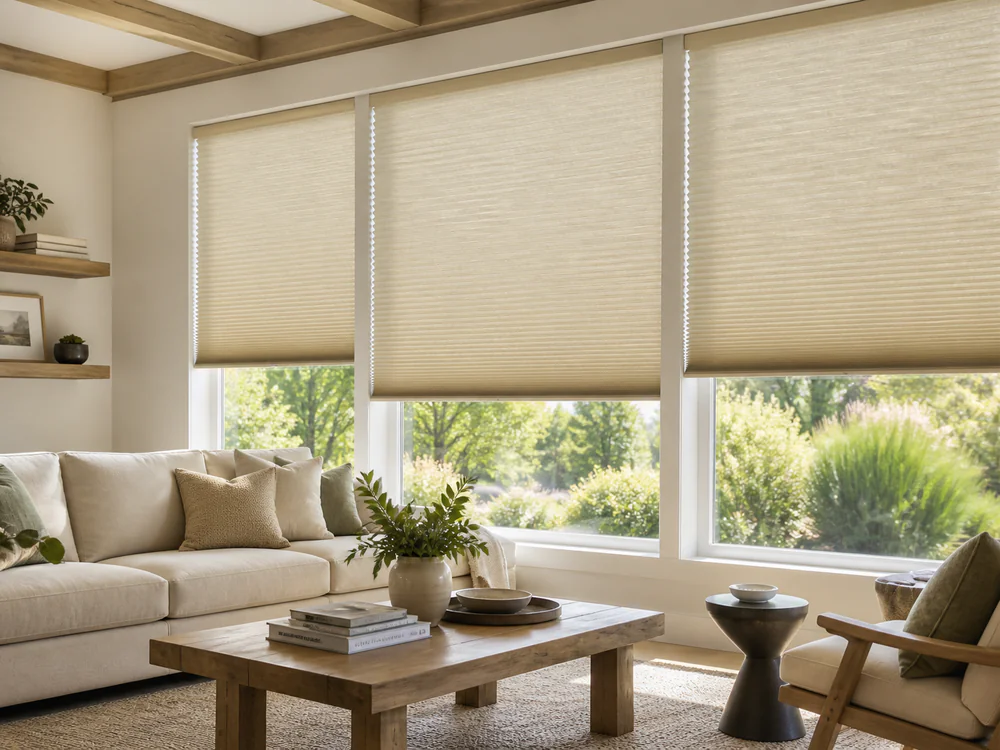
Light-filtering cellular shades allow diffused natural light through the fabric while still providing the full honeycomb insulation structure. They soften direct sunlight without blocking it entirely, which makes them a popular choice for living rooms and common areas where people want daylight without glare. The insulation performance is solid — you’re getting the full benefit of the air-pocket architecture.
Blackout cellular shades add a denser, opaque fabric layer on top of that structure. That extra material isn’t just for darkness — it adds another physical barrier to heat transfer, which pushes the shade’s effective R-value higher. Sealed double-cell blackout models can reach R-5.0 and above. For west-facing rooms in Fort Worth or Arlington that are genuinely unbearable by mid-afternoon, or for bedrooms where both darkness and temperature control matter, blackout double-cell shades are the highest-performing option available in this product category.
The choice between the two isn’t about which is “better” in the abstract — it’s about what a specific room needs. A kitchen or living area facing east might do well with light-filtering. A west-facing bedroom in a home in Southlake or Keller, where afternoon sun pours in from 2 PM onward, is a different situation entirely. The right answer depends on the window’s orientation, the room’s function, and how much temperature control matters in that particular space.
Modern cellular shades don’t make rooms feel dark or institutional. Our fabrics come in a wide range of colors and textures that integrate seamlessly into contemporary and traditional homes alike.
Here’s something the product spec sheets don’t tell you: a cellular shade’s rated R-value is a laboratory measurement under ideal conditions. In real-world installation, that number is a ceiling — not a guarantee.
The reason comes down to fit. A shade that is even slightly too narrow creates edge gaps along the sides of the window frame. Air can move through those gaps freely, bypassing the thermal barrier the shade is supposed to create. The honeycomb cells are doing their job, but the air is routing around them. The result is a shade that looks correct but performs well below its rated value.
This is the gap between buying a cellular shade and having one properly installed — and it’s the part of the conversation that almost never comes up.

Mounting method is one of the most consequential decisions in a cellular shade installation, and most buyers don’t know it exists until someone brings it up.
An inside mount positions the shade within the window frame itself. It creates a clean, recessed look that works well aesthetically, but it requires precise clearance depth and leaves the shade slightly inset from the frame edges. Done correctly, it performs well. Done with even minor measurement error, the edge gaps undermine the insulation value significantly.
An outside mount positions the shade so it covers the window frame entirely and extends beyond it on all sides. Because the shade overlaps the frame rather than sitting inside it, it naturally eliminates the edge gaps that allow convective air movement around the shade. For windows where maximum thermal performance is the priority — large picture windows in newer Mansfield or Colleyville construction, for example, or older single-pane windows in established Fort Worth neighborhoods — outside mount is typically the better insulating choice.
Neither option is universally correct. Inside mount works well when the window has adequate depth and the measurement is precise. Outside mount works well when the priority is sealing the window as completely as possible, or when the window frame depth doesn’t accommodate a clean inside mount. The point is that this decision matters, and it should be made deliberately based on the specific window — not defaulted to whatever is easiest.
This is also where professional measurement earns its value. A shade built to exact window dimensions, mounted correctly for that window’s specific situation, delivers its rated performance. A shade cut from a standard retail size, trimmed down, and mounted without accounting for edge gaps does not — regardless of how many cells it has or what the label says.
The short answer is yes — but the reason is less about the motorization itself and more about consistent operation.
The energy savings from cellular shades are cumulative. A shade that’s closed during peak heat hours every afternoon delivers measurably better results than a shade that’s manually operated inconsistently. In Tarrant County, peak solar gain through west- and south-facing windows typically runs from around 2 PM to 5 PM during summer months. That’s the window where your AC is working hardest and your cooling costs are highest. If shades are closed reliably during that period, the impact on your energy bill is real. If they’re closed sometimes — when someone remembers, when the room is occupied — the benefit is partial.
Motorized cellular shades, particularly those running on systems like PowerView, can be programmed to close automatically at set times. That removes the inconsistency entirely. The shades close at 1:45 PM whether anyone is home or not. They open again in the evening when the sun has moved. For homeowners in Keller, Grand Prairie, Pantego, or anywhere else in Tarrant County with a predictable afternoon sun problem, that kind of automation turns a good product into a consistently performing one.
Motorization also has practical value beyond energy management. Top-down/bottom-up configurations — where the shade can be opened from the top, the bottom, or both — allow natural light in from the upper portion of the window while the lower half stays closed for privacy or heat control. That flexibility is harder to use effectively with manual cords and easier to integrate into a daily routine when it’s programmable.
The upfront cost of motorized cellular shades is higher than manual options. Whether that premium makes sense depends on the home, the window count, and how much you value automation versus manual control. What it doesn’t do is change the underlying insulation performance of the shade itself — that’s determined by cell count, fabric, and fit.
The science behind insulated cellular blinds is real — the DOE research backs it up, the R-values are measurable, and the performance difference compared to standard blinds is significant. But the product only delivers what it’s rated for when the cell count matches the climate demand, the fabric choice fits the room’s needs, and the installation is precise enough to eliminate the edge gaps that defeat the thermal barrier.
For homes in Tarrant County — dealing with five months of summer heat, unpredictable winter cold snaps, and the kind of electric bills that make you pay attention — getting those details right matters more than it does in a milder market.
We offer free in-home consultations with no pressure and no sales tactics. We measure, we explain the options, and we build to exact dimensions at our local facility. Reach out when you’re ready to talk through it.
Article details:
Share:
Continue learning: