Manual skylight blinds create more problems than they solve. Here's what actually works — and why it matters for homes across Tarrant County.
Share:

You added a skylight for the light, the openness, the way it makes a room feel bigger. What you didn’t sign up for was a room that hits 90 degrees by noon in July, or a blind you have to wrestle with a pole to adjust. That’s the reality for a lot of homeowners across Tarrant County — and it’s not a design flaw, it’s an installation and product problem. The good news is it’s completely fixable. This page covers why standard skylight blinds tend to fail, what a proper installation actually involves, and why motorized options have become the practical standard for overhead windows.
Installing a skylight blind isn’t like hanging a shade over a regular window. The surface is overhead, often angled, and sometimes surrounded by trim that makes standard hardware nearly impossible to anchor correctly. Add in the fact that gravity is working against you the entire time, and you start to understand why so many off-the-shelf attempts end in frustration.
The other issue is fit. Skylights are not standard-sized. They’re cut to match a roof pitch, framed into a ceiling, and often surrounded by a light well that creates its own set of measurement challenges. A blind that’s even a quarter inch off will gap, sag, or bind — and no amount of adjusting will fix a product that wasn’t built for the opening it’s covering.

The most common DIY approach is buying a blind online, guessing at the measurements, and hoping the included hardware sticks to the ceiling frame. Sometimes it holds for a few weeks. More often, it starts sagging within a month — because standard blinds are engineered for vertical windows, not overhead installations.
What makes a skylight installation structurally different is the need for side tracks or tension cables. Without them, the blind has nothing to keep it flush against the glass. It pulls away from the surface, lets light and heat pour in around the edges, and eventually stops tracking altogether. This isn’t a quality issue with the blind itself — it’s a physics problem. Overhead installations need a system that holds the fabric in place against the glass regardless of angle or weight.
There’s also the question of where you’re actually anchoring the hardware. Ceiling drywall alone won’t hold. You need to hit solid framing, and in a skylight well, that framing isn’t always where you’d expect it. This is where construction experience matters in a way that window treatment experience alone doesn’t cover. Knowing how a roof structure is framed, where to find blocking, and how to add it when it isn’t there — that’s the difference between an installation that lasts and one that fails inside a season.
We’ve seen a lot of homeowners in Fort Worth and Arlington come to us after a DIY attempt that looked fine on day one and was falling apart by summer. The frustrating part is that the fix isn’t complicated — it just requires the right approach from the start.
A professional skylight blind installation starts with precise measurement — not just width and height, but the pitch of the skylight, the depth of the light well, and the condition of the surrounding frame. We measure at multiple points because skylights are rarely perfectly uniform, and a custom-built shade needs to account for every variation in the opening.
From there, the mounting system has to match the specific skylight configuration. Flat-roof skylights and angled skylights require different hardware approaches. A flat installation might use a standard headrail with ceiling-mounted brackets, while an angled skylight needs brackets that compensate for the slope so the shade sits flush and tracks evenly. Getting this wrong means the shade either binds as it opens or gaps at the edges — neither of which is acceptable when the whole point is blocking heat and light.
The fabric choice matters too. For skylights in Tarrant County homes, we typically recommend cellular honeycomb shades because they’re the most insulating interior shade available. A double-cell honeycomb traps air in two layers, which slows heat transfer significantly. In a Texas summer — where your skylight is receiving direct overhead sun for hours at a stretch — that thermal barrier makes a real difference in how comfortable the room stays and how hard your HVAC has to work to compensate.
Light-filtering fabrics are a popular option for homeowners who want to keep the natural light coming in while cutting the heat and UV exposure. Blackout fabrics are the right call for bedrooms or media rooms where full darkness matters. Either way, the fabric is custom-cut to the exact opening, so there are no gaps at the edges where heat sneaks in.
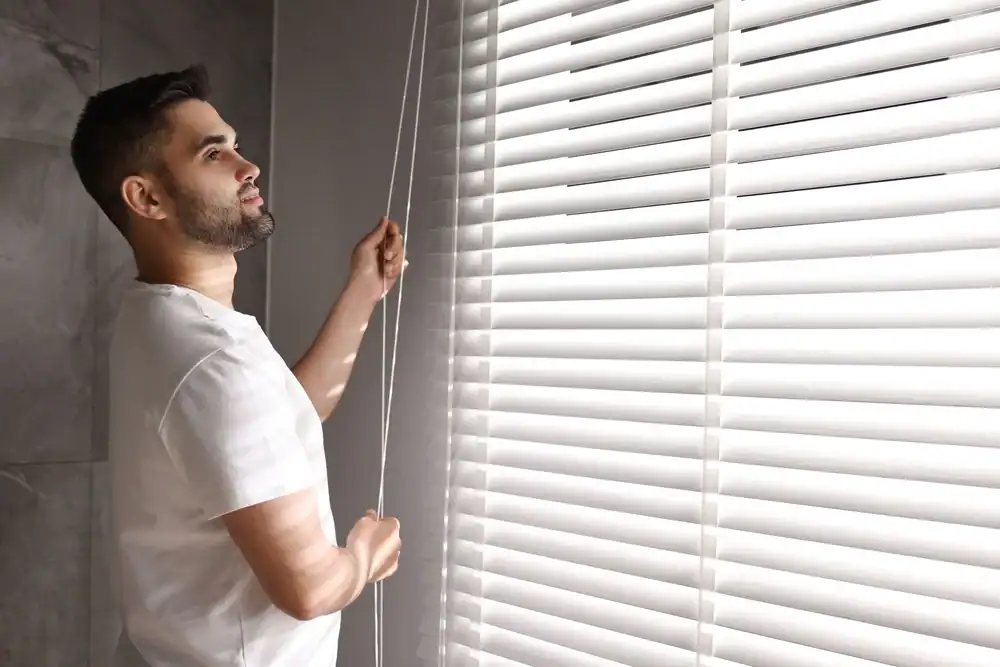
Here’s the honest reason most manual skylight blinds end up stuck in one position: adjusting them is inconvenient enough that people stop doing it. You need a ladder, or a three-foot extension pole, and even then getting the shade to sit exactly where you want it is a two-handed guessing game. After a few weeks, most homeowners just leave it closed and forget the skylight exists.
We solve this completely with motorized skylight shades. A remote, a wall switch, a smartphone app, or a voice command — and the shade moves to exactly where you want it without you leaving the couch. For an overhead window, this isn’t a luxury feature. It’s just the practical way to make the thing usable.
Our motorized skylight shades use a small motor built into the headrail that drives the shade up or down along the side tracks. The motor can be battery-powered, hardwired into your home’s electrical system, or — increasingly popular for skylights — solar-powered, where a small panel charges the motor from ambient light so you never deal with wiring or battery swaps.
Battery-powered motors are the most common choice for residential skylight installations because they don’t require any electrical work. They’re quiet, reliable, and the batteries typically last six months to a year depending on how often you use the shade. When it’s time to replace them, it’s a straightforward swap — similar to changing batteries in a smoke detector. If you’d rather not think about it at all, a solar-powered motor is worth the upgrade, particularly for south- or west-facing skylights in Tarrant County that get plenty of sun exposure year-round.
Control options have expanded significantly in recent years. Most of the motorized systems we install work with standard remotes, but they also integrate with Alexa, Google Home, and Apple HomeKit if you’re already running a smart home setup. You can set schedules so the shades close automatically during peak heat hours — say, noon to four in the afternoon during a Fort Worth summer — without having to think about it. That kind of automation is where the energy savings really add up. Studies have shown that motorized shades used strategically can reduce heat gain by up to 77% and cut overall cooling energy use by around 25%. For a home in Mansfield or Keller where summer electricity bills are already climbing, that’s a meaningful return on the investment.
One thing worth knowing upfront: motorized skylight shades do cost more than manual options. The installation is more involved, the hardware is more sophisticated, and the customization goes deeper. But when you weigh that against the cost of repeated DIY failures, the furniture and flooring that fades from unfiltered UV exposure, and the rooms you stop using because they’re too hot to sit in — the math usually works out clearly in favor of doing it right once.
Once homeowners in Tarrant County experience motorized operation on a skylight, the question that almost always follows is: can we do this on the rest of the windows too? The answer is yes — and it’s worth thinking about as a whole-home approach rather than a single fix.
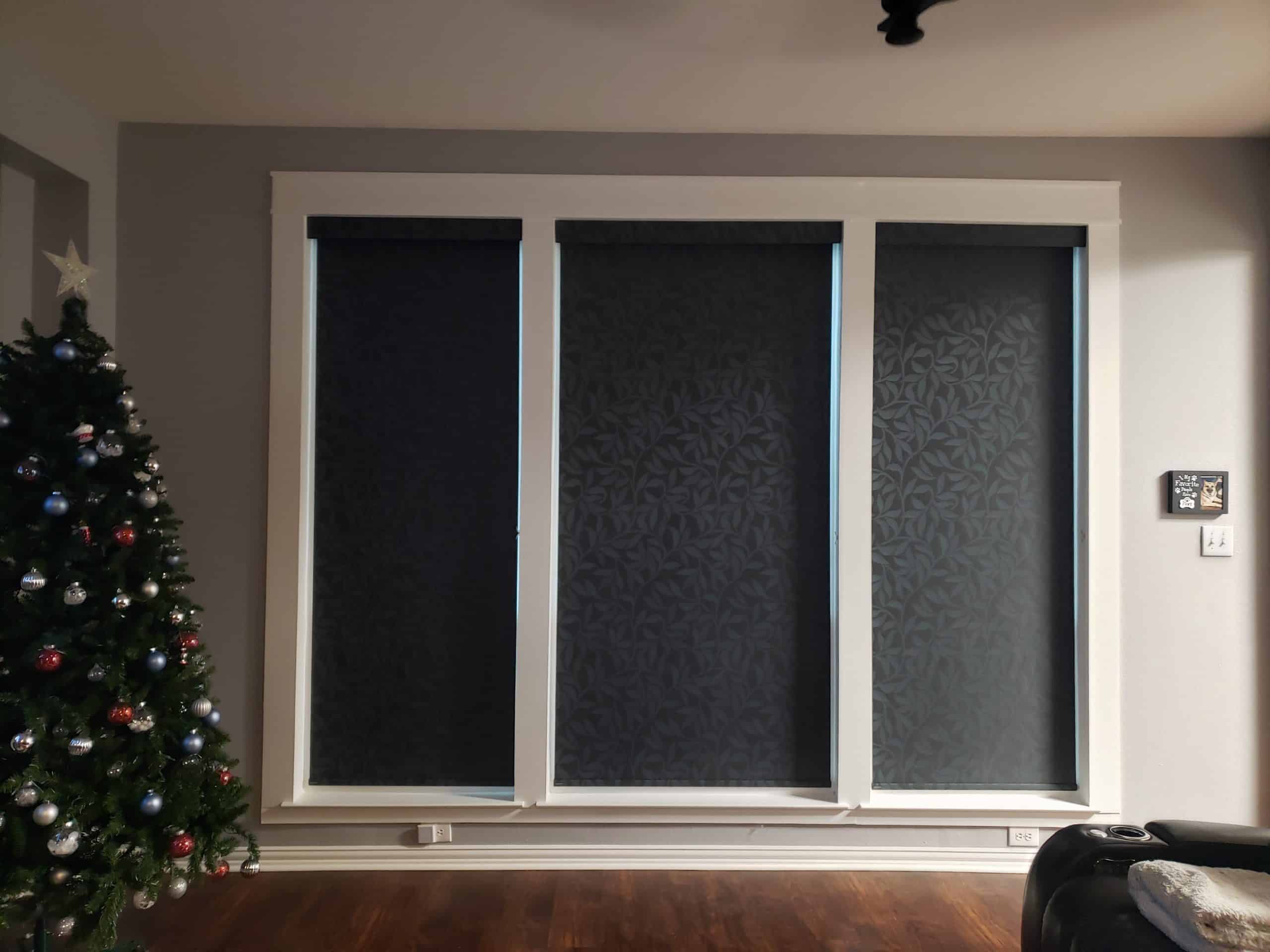
We install motorized roller shades that work well on large windows, picture windows, and any window where manual operation is inconvenient — which, in a Texas summer, is essentially every west-facing window in the house. The same smart home integration applies: Alexa, Google Home, app control, and scheduling all carry over from the skylight system to the rest of your motorized shades, so everything works together from a single interface.
For rooms where light control is the priority — a home office, a media room, a bedroom — motorized blackout roller shades give you precise, repeatable coverage without fumbling with cords or wand controls. For living spaces where you want flexibility, light-filtering fabrics let you dial in exactly how much sun you’re letting in at any point in the day.
We also install motorized exterior roller shades, which handle the heat before it even reaches the glass. For covered patios and outdoor living spaces — which are a big part of how people use their homes in Fort Worth and Arlington — exterior shades extend the usable hours of those spaces well into the summer months. The combination of exterior shades on a patio and motorized interior shades on the skylights and windows creates a layered approach to heat control that makes a noticeable difference in how comfortable your home stays from June through September.
The common thread across all of it is custom fit and professional installation. Motorized systems only work reliably when the hardware is mounted correctly, the tracks are aligned, and the motor is calibrated to the specific shade dimensions. That’s not something a big-box kit handles well — it’s what our proper installation delivers.
If your skylight is making rooms uncomfortable, fading your floors, or just sitting there covered by a blind you stopped adjusting months ago, the problem isn’t the skylight — it’s the treatment. The right shade, properly installed, turns an overhead window back into what it was supposed to be: a source of light you can actually control.
For most homes across Tarrant County, motorized cellular shades are the practical answer. They handle the heat, protect against UV damage, integrate with the smart home systems you already use, and — most importantly — get used every day because they’re easy to operate.
If you’re ready to stop tolerating the problem and want us to come measure your skylights and walk you through the options, reach out to A Plus Shutters & Shades. We serve Fort Worth, Arlington, Mansfield, Keller, Southlake, and the surrounding communities in Tarrant County, and we’ll give you a clear price before any work begins.
Article details:
Share:
Continue learning: