From roller shades to plantation shutters, this guide breaks down what custom window coverings actually are — and how to choose the right ones for your Tarrant County home.
Share:

Most people start their window covering search the same way: they grab something off the shelf, get home, and realize it’s a half-inch too narrow on each side. Light bleeds in from every edge. The look is off. And now they’re stuck with something that almost works.
That frustration is usually what sends homeowners across Tarrant County searching for something better. Custom window coverings exist to solve exactly that problem — but the term gets thrown around loosely enough that it’s worth slowing down and explaining what it actually means, what your options are, and how to make a decision that holds up through a Texas summer and beyond.
The words “blinds” and “shades” get used interchangeably, but they’re genuinely different products. Blinds have adjustable slats — horizontal ones like Venetian or wood blinds, or vertical ones for sliding doors — that tilt open or closed to control light. Shades are a single piece of fabric that raises and lowers as one unit.
They look different, they operate differently, and they perform differently when it comes to insulation and light control. That distinction matters because the right choice depends on what you’re actually trying to solve. A room where you need strong light control at certain hours calls for something different than a room where you just want softened natural light all day.
Knowing which category you’re working in is the first step toward making a decision you’ll actually be happy with.
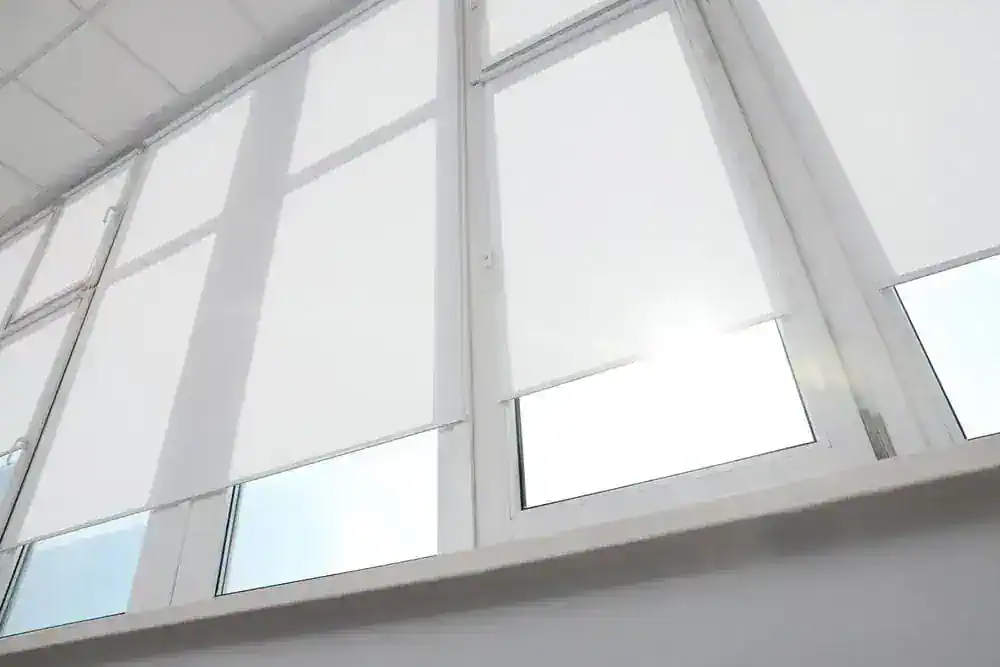
Roller shades are the most straightforward option — a single panel of fabric that rolls up or down from a tube at the top. They’re clean-looking, easy to operate, and available in a wide range of opacities, from sheer fabrics that soften light without blocking it to full blackout linings that eliminate it entirely.
Solar shades are a specific type of roller shade designed to reduce glare and block UV rays while still letting you see outside during the day. The openness factor — the percentage of the weave that’s open — determines how much light and visibility you get.
Roman shades fold into horizontal pleats as they raise, giving a softer, more tailored look than a standard roller shade. They work well in living rooms and dining areas where the aesthetic carries weight.
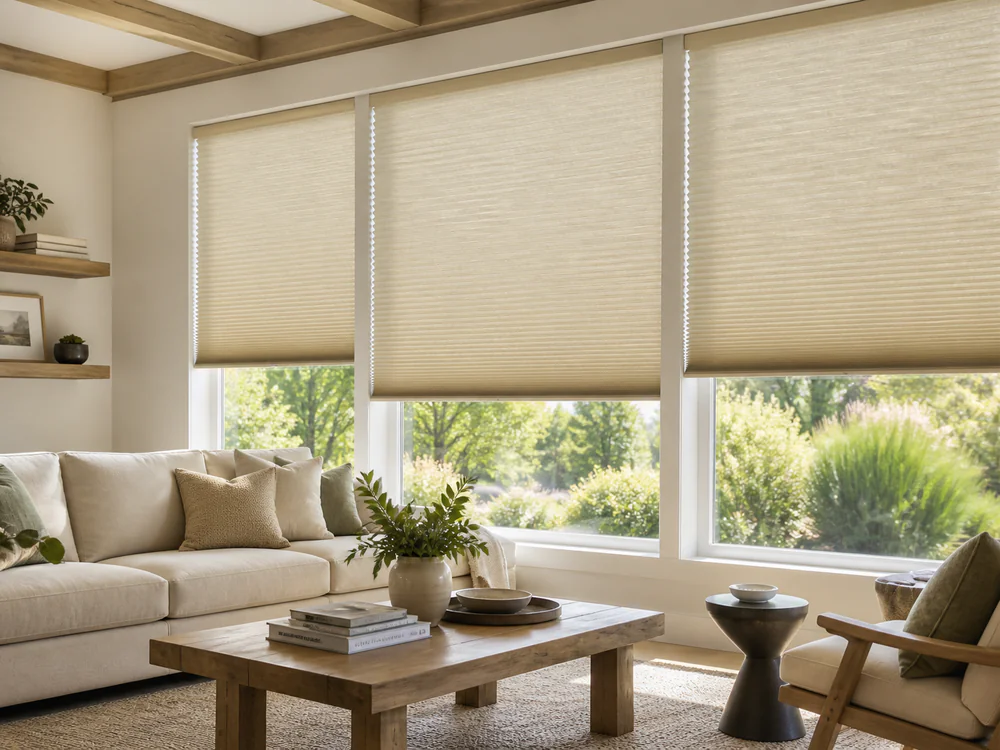
Cellular shades — sometimes called honeycomb shades — have a structured, accordion-like cell design that traps air between the fabric layers. That trapped air acts as insulation, which is why cellular shades consistently rank as the most energy-efficient window covering option available. The U.S. Department of Energy has found that the right window covering management can reduce heat gain by up to 77%, and cellular shades are at the top of that list.
Woven wood shades and sheer shades each bring their own look and functional tradeoffs. The point isn’t to memorize every category. It’s to understand that “shades” is a broad term, and within that category, your choices vary enormously based on what you need the product to do.
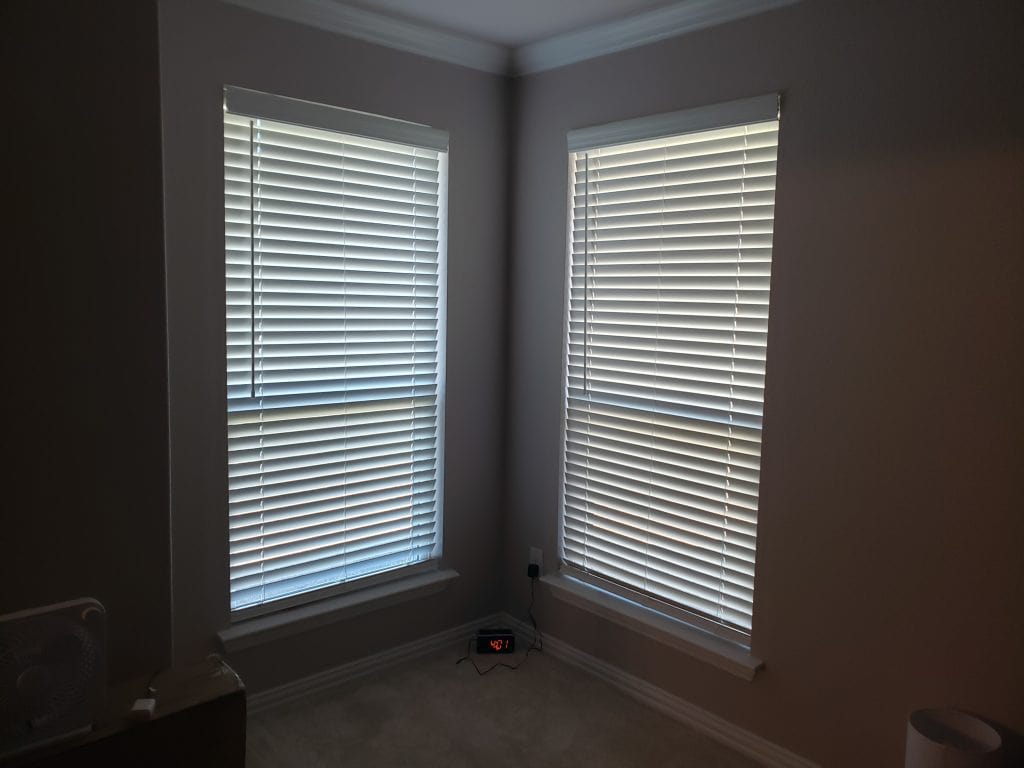
Blinds — wood, faux wood, metal, or vinyl — have adjustable slats that let you dial in exactly how much light enters and at what angle. Faux wood blinds hold up better in high-humidity rooms like kitchens and bathrooms, where real wood can warp over time.
Metal and vinyl blinds are the most common window covering in American homes, largely because they’re inexpensive and widely available — but they’re also the least energy-efficient option on the market. That matters in Tarrant County, where your windows are working against your air conditioner for five solid months every year.
Plantation shutters are a different animal. They’re a permanent architectural feature — solid panels with wide louvers that mount directly to the window frame. They don’t need to be replaced the way fabric shades eventually do. They’re easy to clean, they hold their shape, and in a Tarrant County home with strong afternoon sun, they give you precise control over light without sacrificing the look of the room.
For homes in Southlake, Colleyville, or the newer custom-build neighborhoods in North Fort Worth, shutters are often the finishing detail that makes a room feel intentional rather than assembled. The honest answer to “blinds or shutters?” depends on the room, the window, and what you’re prioritizing. A bedroom might call for shutters for their clean look and durability. A home office with a west-facing window might need an exterior roller shade to stop heat before it even hits the glass.
These aren’t one-size-fits-all decisions, which is exactly why getting a professional set of eyes on your windows before committing to anything is worth the time.
Here’s the thing about energy efficiency and window coverings: most of the generic advice out there was written for a climate that doesn’t look anything like North Texas. Cellular shades are great insulators — but the bigger problem in Tarrant County isn’t heat escaping in winter. It’s heat pouring in through west- and south-facing windows every afternoon from May through September.
That changes the conversation. The most effective window covering for a Tarrant County home isn’t just about insulation — it’s about stopping solar heat gain before it becomes your problem. And that’s where the distinction between interior and exterior shades becomes critical.

The bedroom question comes up more than any other room-specific topic, and for good reason. It’s the room where light control directly affects your sleep, which means getting it wrong has real consequences.
The core tension is this: you want darkness when you’re sleeping, but you don’t want to live in a cave the rest of the time. Blackout roller shades with a light-filtering layer are one of the most practical solutions for Tarrant County bedrooms — particularly in newer homes in Mansfield, Keller, or Arlington where the bedroom faces east and gets hit with direct morning sun.
A blackout shade blocks the light when you need it to. A sheer or light-filtering shade underneath lets you transition to a softened, livable level of light during the day without fully exposing the room to outside view. Plantation shutters are another strong option for bedrooms because the louvers give you granular control — you can angle them to let in morning light gradually without opening the room entirely.
Because shutters are a hard surface rather than fabric, they don’t collect dust the way shades do, which matters in a home where someone has allergies. The right answer depends on your window orientation, your morning routine, and how much privacy matters on that particular wall. These are the kinds of details that come out in an in-home consultation that you’d never think to consider when shopping online.
Interior shades help. But once sunlight passes through your glass, much of its heat is already inside your home. Your air conditioner is then working to remove heat that’s already entered the room — an uphill battle on a 103-degree afternoon in Fort Worth.
Exterior roller shades work differently. They stop solar heat gain before it reaches the glass. Research from the Department of Energy’s Building America program found that exterior shading cut the time indoor conditions reached dangerous heat levels by roughly 55% during extreme heat events — compared with 18 to 23% for interior shades. That’s not a marginal difference.
In a Tarrant County summer, that gap shows up directly on your electric bill. We offer both interior and exterior roller shades, which puts us in a different category from most local window covering providers who focus exclusively on interior products.
For homes with west-facing living rooms — an extremely common layout in suburban developments throughout Arlington, Mansfield, and North Richland Hills — exterior roller shades are often the most effective single upgrade a homeowner can make. They come in a range of fabrics and openness factors, so you’re not choosing between heat protection and the ability to see your backyard. You can have both.
Because they’re motorized, you can set them to drop automatically during peak heat hours and retract in the evening, without ever thinking about it. Our background in construction makes a real difference here. Exterior shade installation involves more than hanging a bracket — it requires understanding the mounting surface, the fascia, and how the product will perform through Texas weather cycles. That kind of installation knowledge comes from years of working on the structure of homes, not just dressing their windows.
Custom window coverings come down to one thing: fit. Not just physical fit — though that matters enormously when your windows aren’t standard dimensions — but fit for the room, the light, the climate, and how you actually live in your home.
A bedroom in Keller has different needs than a sunroom in Southlake. A home office with a west-facing window in Arlington needs a different solution than a kitchen that gets soft morning light. The good news is you don’t have to figure all of this out on your own before making a call.
The whole point of an in-home consultation is to work through these decisions with someone who’s seen thousands of windows across Tarrant County and knows what holds up — and what doesn’t — through a Texas summer. If you’re ready to stop guessing and start with a clear plan, A Plus Shutters & Shades offers free in-home consultations across the DFW area.
Reach out at 682-837-4233 and we’ll take it from there.
Article details:
Share:
Continue learning: