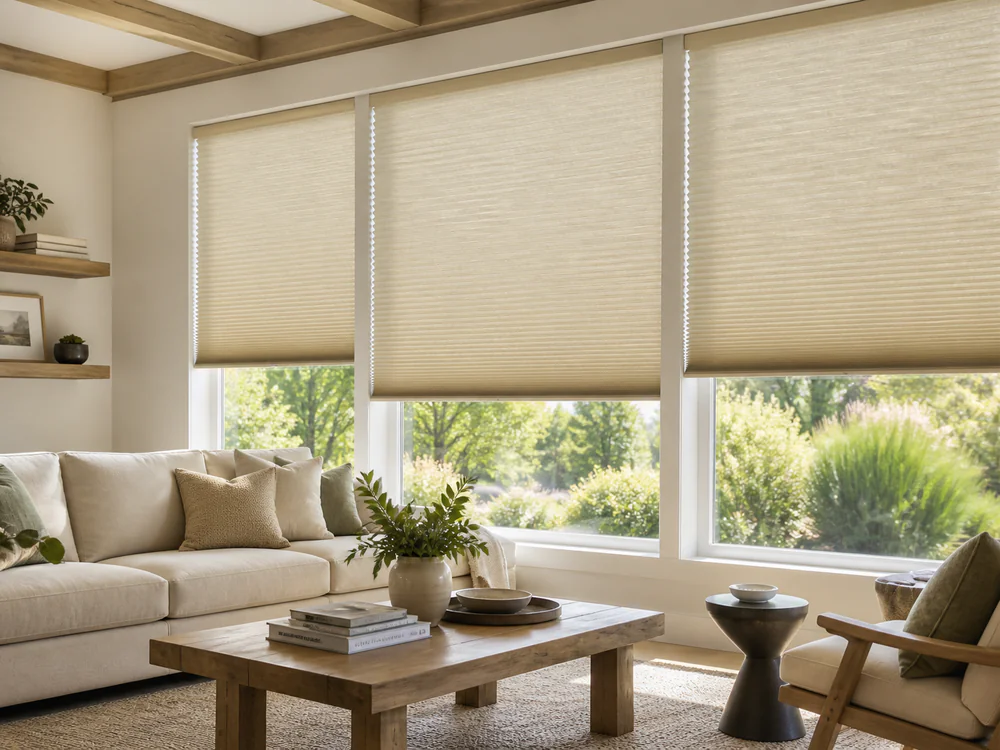
Not sure whether vertical or horizontal blinds are right for your windows? Here's a straightforward breakdown to help you decide before you buy.
Share:

Here’s a situation a lot of Tarrant County homeowners know well: you move into a new place, you’ve got a beautiful sliding glass door leading out to the patio, and you head to the store to grab some blinds. You come home, hang them up, and realize immediately that something is off. They’re awkward to raise, they block the whole door when you try to open it, and they just don’t look right. That’s not a taste problem — that’s a window type problem.
Vertical blinds and horizontal blinds are built for different jobs. Once you understand which does what, the decision gets a lot easier.
The core difference isn’t just the direction the slats run — it’s how each type operates and what kind of window or opening it’s designed to cover. Horizontal blinds, sometimes called Venetian blinds, stack upward when raised and tilt to control light when closed. Vertical blinds hang from a top rail and swing side to side, which makes them a completely different tool for a completely different situation.
For standard bedroom or kitchen windows, horizontal blinds are the workhorse. They give you precise control over light angle, they come in a wide range of materials, and they work well in rooms where you want to filter light without fully blocking it.
Vertical blinds, on the other hand, are purpose-built for wide, floor-to-ceiling openings — sliding glass doors, large picture windows, and oversized window spans where raising a horizontal blind all the way up just isn’t practical.

This is the mistake we see most often in Tarrant County homes, and it makes sense — horizontal blinds are everywhere, they’re familiar, and they’re easy to find. But putting them on a sliding glass door creates a daily frustration that adds up fast.
To use the door, you have to raise the blind completely. Every single time. That repeated lifting puts strain on the lift cords, wears out the mechanism faster than it should, and turns a simple thing — stepping outside to the patio — into a minor ordeal.
It’s also a proportion problem. Most sliding glass doors are wide and tall, and a horizontal blind that has to span that full width ends up looking heavy and awkward when fully raised, bunched up at the top of a door frame that wasn’t designed for it.
Tarrant County’s newer construction leans heavily into the indoor-outdoor lifestyle — open-plan living areas, large patios, outdoor kitchens, covered back porches. That means homes in Arlington, Mansfield, Keller, and Southlake have at least one large sliding glass door that needs a covering built for how it actually gets used.
Vertical blinds open sideways, in the same direction as the door itself. You push them to one side, the door opens freely, and nothing is fighting you. It’s a small thing until it isn’t — and once you’ve lived with the right setup, you notice the difference every day.
Because vertical vanes hang straight down, gravity works against dust settling on them. Horizontal blinds, with their flat horizontal slats, are natural dust collectors — every slat becomes a little shelf. If you have allergies, pets, or just don’t want to spend your weekends cleaning window treatments, that distinction matters more than most people realize before they buy.
None of this means horizontal blinds are the wrong choice — they’re just the wrong choice for the wrong window. For standard-sized windows in bedrooms, bathrooms, offices, and kitchens, horizontal blinds are genuinely excellent.
The smaller slat size — typically one to two inches — allows for fine, incremental tilting that gives you more precise light control than vertical blinds can offer. You can let in soft morning light while keeping direct sun off your face, or angle the slats to block street-level views while still pulling natural light from above. That kind of granular adjustment is something vertical blinds simply aren’t built to deliver.
Material variety is another real advantage. Horizontal blinds come in aluminum, real wood, faux wood, and fabric, each with different aesthetic results and different performance characteristics. Faux wood is particularly well-suited to Tarrant County’s climate — the intense summer heat and the humidity swings that come with Texas weather can cause real wood to warp or crack over time. Faux wood gives you the same warm, traditional look without the weather vulnerability, which is why it’s one of the more popular horizontal blind materials we work with.
For rooms where light control is the top priority — a home office where screen glare is a real problem, a bedroom where you need near-blackout coverage to sleep — horizontal blinds with fully closed slats can achieve up to 95% room darkening. That’s meaningful performance, not just a marketing claim.
The key is getting the fit right. Off-the-shelf blinds from a big-box store come in standard sizes, and even a slightly undersized blind creates light gaps at the edges that undercut the whole point. Custom-measured blinds eliminate that problem entirely, which is why the fit question matters as much as the style question.
If you’ve established that you need something for a sliding glass door or a large patio opening, vertical blinds are the starting point — but they’re not the only option worth knowing about.
Panel track blinds are a more contemporary alternative that operates on the same side-to-side principle. Instead of individual vanes, they use wider fabric panels that slide along a track, giving you a cleaner, more modern look that works well in open-plan spaces. Vertical cellular shades are another option that adds insulating value — useful in North Texas where the summer sun through a large west-facing glass door can meaningfully raise the temperature of a room.
The right choice depends on how the space is used, how much light you want to manage, and what the room looks like. That’s a conversation worth having before you order anything.

Motorized vertical blinds have moved well past the “luxury upgrade” category. About 44% of U.S. buyers now prioritize motorized or automated blinds when making a window covering purchase — and once you’ve used them on a large sliding glass door, it’s easy to understand why.
The daily interaction with a patio door covering is high-frequency. You’re adjusting it in the morning, opening it when the kids go outside, closing it against the afternoon sun, and adjusting it again in the evening. Doing that manually on a large vertical blind gets old.
Motorized vertical blinds operate via remote control, a smartphone app, or voice command through platforms like Amazon Alexa, Google Home, or Apple HomeKit. We offer PowerView motorization, which integrates cleanly with most major smart home systems and allows you to set schedules — so your blinds can close automatically during the hottest part of a Texas afternoon without you having to think about it. For west-facing living rooms in Southlake or Arlington, where the late afternoon sun is genuinely brutal from June through September, that kind of automation has real functional value.
There’s also a safety dimension that doesn’t get discussed enough. Traditional corded blinds carry risk in homes with young children, and the industry has been actively moving toward cordless and motorized alternatives as a result. Motorized blinds eliminate the cord problem entirely. For families with small kids, that’s a meaningful reason to choose motorized over manual regardless of the convenience factor.
If you’re outfitting a new home or renovating an existing one, motorized vertical blinds for the main living area’s sliding glass door is one of the upgrades that genuinely improves daily life rather than just looking good in a listing photo.
The vertical vs. horizontal decision looks different when you’re outfitting an office, a medical facility, a retail space, or a commercial property. Most comparison content online ignores this audience entirely, but Tarrant County’s commercial real estate market is growing fast — Fort Worth’s downtown corridors, the commercial development around Southlake Town Square, and the office parks throughout Arlington and North Richland Hills all represent real demand for commercial-grade window blinds that perform differently than residential options.
In a commercial setting, the priorities shift. Screen glare is a major issue in office environments, and horizontal aluminum blinds with precise tilt control are often the right answer — they can eliminate direct glare on monitors while maintaining enough ambient light to keep the space from feeling dim and closed off. Durability matters more in a commercial context, too, because the blinds are being adjusted by more people, more frequently, with less care than a homeowner would give their own window treatments.
Motorized commercial blinds are increasingly relevant for businesses that need to meet energy efficiency standards or simply want to reduce the manual burden on staff. Large conference rooms, client-facing reception areas, and open office floors with floor-to-ceiling glazing are all situations where automated blinds deliver both function and a cleaner, more professional aesthetic than manual systems.
We work with commercial clients across Tarrant County — property managers, business owners, and facilities teams — and the process is the same as residential: we come to you, measure accurately, and fabricate to the exact dimensions of your space. Off-the-shelf blinds in a commercial setting create the same light-gap and fit problems they create at home, just at a larger scale and with more people noticing. Getting it right the first time matters more, not less, in a professional environment.
The short version: if you have a sliding glass door, a large patio opening, or a wide floor-to-ceiling window, vertical blinds — or a panel track alternative — are almost certainly the right functional choice. If you have standard bedroom, bathroom, or office windows where light control and aesthetics are the main priorities, horizontal blinds in the right material will serve you better.
What matters most is getting the fit right and matching the blind type to how the window actually gets used — not just how it looks in a catalog. Tarrant County homes, especially the newer construction throughout Arlington, Mansfield, and Keller, tend to have a mix of both window types, which means most homeowners end up with both vertical and horizontal blinds across different rooms. That’s completely normal, and it’s a good reason to work with someone who can look at the whole house rather than just sell you one product.
If you’re ready to figure out exactly what your windows need, A Plus Shutters & Shades offers free in-home consultations across Tarrant County. We measure, we explain your options, and we fabricate to fit — no guesswork, no light gaps, no returns.
Article details:
Share:
Continue learning: