Not all hurricane window protection is created equal. Here's what Tarrant County homeowners should know before choosing a system that fits their home and budget.
Share:
Most homeowners don’t start thinking about window protection until a storm is already in the forecast. By then, you’re either scrambling to find someone who can help or hauling heavy panels out of a garage you barely have room to walk through. Neither is a great situation.
The good news is that there are more options now than ever — and some of them work harder than just storm prep. This guide walks through the main types of hurricane window protection, what each one actually involves, and how to think through the decision if you’re in Tarrant County or the surrounding DFW area. By the end, you’ll have a clear picture of what fits your home, your budget, and your life.
Hurricane window protection breaks down into a few broad categories: removable panels, permanent shutters, impact-resistant glass, and fabric or screen systems. Each one sits at a different point on the spectrum of cost, convenience, and protection level — and none of them is the right answer for every home.
Removable storm panels are the most affordable entry point, typically running $10 to $20 per square foot. They work, but they come with a real tradeoff: you have to install them before every storm, which means storing them somewhere the other 11 months of the year and being physically present when a storm is approaching. For some households, that’s manageable. For others — especially those with travel schedules or limited mobility — it’s a plan that falls apart exactly when you need it most.
Permanent solutions like accordion shutters, roll-down shutters, and impact glass sit at the other end of the spectrum. They cost more upfront, but they’re ready when you are. Accordion shutters can be closed in minutes. Motorized roll-down shutters close in seconds. Impact glass requires no action at all. The right choice depends on how much you want to spend now versus how much friction you’re willing to accept later.

Storm panels — sometimes called hurricane panels — are the most common entry-level solution. They’re typically made from aluminum, steel, or polycarbonate, and they mount onto hardware that’s installed permanently around your window frames. When a storm is coming, you pull the panels out of storage, carry them to each opening, and fasten them in place. When the storm passes, you take them down and store them again.
The appeal is straightforward: they’re affordable, they’re effective when installed correctly, and they meet building code requirements in most jurisdictions when paired with proper mounting hardware. For a homeowner in Mansfield or Keller who has the storage space and the physical ability to handle the installation, panels can be a reasonable choice.
The part that often catches people off guard is the labor involved. Installing panels for a full home typically takes a full day — and that’s if everything goes smoothly. You’re dealing with 15 to 30-pound pieces of aluminum, mounting them to hardware that may not have been touched since last season, and doing it while the weather is already deteriorating. It’s not a casual afternoon project.
Polycarbonate panels are lighter and allow some natural light through, which makes them easier to work with and less claustrophobic once installed. They cost more than aluminum but are a meaningful upgrade in usability. If you’re going the panel route, polycarbonate is worth the extra investment for most homeowners.
One more thing worth considering: panels only protect you if you’re home to install them. If a severe storm system moves through Tarrant County while you’re traveling — which happens — your windows are unprotected. That’s a real vulnerability, and it’s one reason many homeowners eventually move toward a permanent or semi-permanent system.
Sliding glass doors are one of the most overlooked vulnerabilities in a home’s storm protection plan. Most panel systems are designed around standard window dimensions — a sliding glass door that spans six to twelve feet wide is a fundamentally different structural challenge, and treating it the same way tends to produce gaps, flex points, and mounting failures that defeat the purpose of the protection.
The core issue is span. A standard window might be two or three feet wide. A patio door in a newer home in Southlake or Colleyville — where open-plan layouts with large rear glass openings are common — might be eight feet wide or more. At that span, a single panel isn’t sufficient. You need a multi-panel system with proper intermediate anchoring, or a purpose-built solution designed for large openings. The mounting hardware needs to be installed into structural framing, not just the window casing, to handle the wind load without flexing or pulling out.
This is where the installation expertise behind the product matters as much as the product itself. A panel system that’s correctly rated for hurricane conditions but improperly anchored to a door frame will fail under sustained wind pressure. The fastener spacing, the anchor depth, the frame reinforcement — these are construction-level decisions, not just window treatment decisions. Getting them right requires someone who understands how the wall assembly behind that opening is actually built.
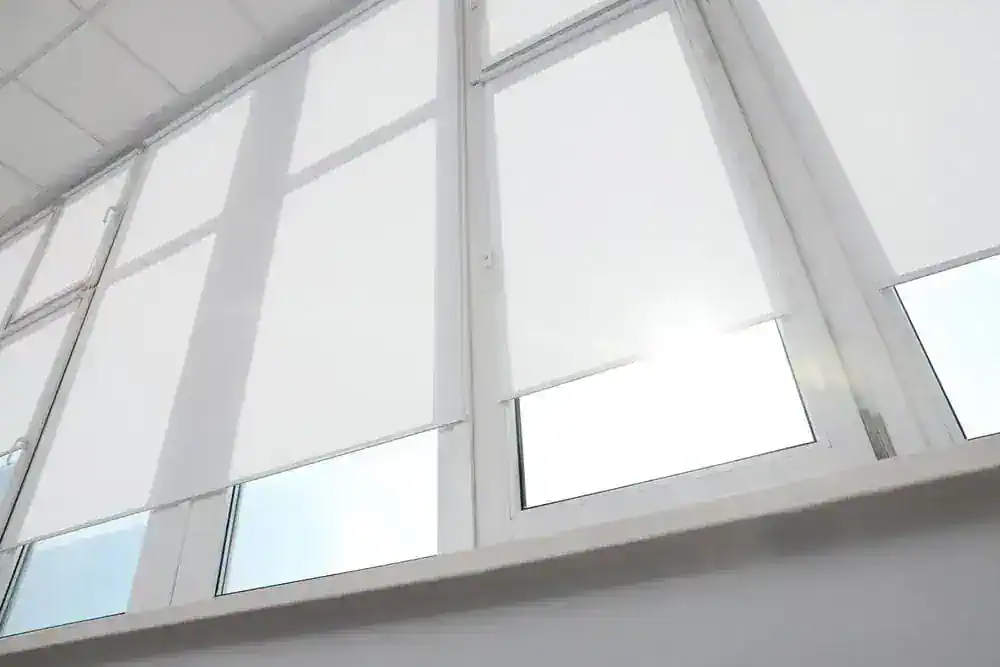
Exterior roller shades designed for large openings are an increasingly popular alternative for sliding glass doors, particularly in the DFW area. A high-quality exterior roller shade, built with weather-rated fabric and proper hardware, provides meaningful wind and debris protection while also doing something useful every single day — blocking the intense Texas afternoon sun that drives up cooling costs through the summer. It’s not a compromise. It’s a more practical solution for an opening you use constantly.
If your home has large patio doors and you’re evaluating storm protection options, don’t assume the same approach that works for your standard windows will translate. It won’t always, and the consequences of getting it wrong are significant.
Beyond removable panels, there are several permanent or semi-permanent options that offer better convenience and, in many cases, better daily value. The tradeoff is a higher upfront cost — but for homeowners who plan to stay in their home long-term, the math often works out in favor of a permanent solution.
Accordion shutters fold back against the wall when not in use and can be closed in under an hour. Roll-down shutters retract into a housing above the window and deploy in seconds, especially with a motorized system. Impact-resistant glass replaces your existing windows entirely and requires no action at all — it’s always on. Each of these options has a different cost profile, aesthetic footprint, and maintenance requirement, which is why the right answer varies from one home to the next.
The cost gap between shutters and impact glass is significant. Hurricane shutters — depending on type — typically run between $1,500 and $5,900 for a full home installation. Impact windows range from $4,250 to nearly $20,000. That’s a real difference, and for most homeowners it’s the first number they focus on.
What often gets overlooked is the long-term picture. Impact windows are Energy Star rated in many configurations, which means they reduce heat gain year-round — a meaningful benefit in a climate where Tarrant County summers regularly push past 100°F and air conditioning runs for months on end. Some configurations qualify for federal tax credits up to $1,500. Over time, the energy savings offset a portion of the upfront cost in a way that shutters don’t.
On the other hand, impact glass is a permanent alteration to your home. It requires a full window replacement project, not just an add-on installation. For homeowners in older Arlington or Fort Worth neighborhoods where window frames or rough openings aren’t perfectly standard, that project gets more complex quickly. A shutter or shade system installed by someone with real construction knowledge can adapt to those conditions in ways that a straightforward window replacement cannot.
The honest answer is that impact glass makes the most sense for new construction or major renovations where you’re already touching the windows. For existing homes, a well-installed shutter or exterior roller shade system often provides excellent protection at a fraction of the cost, with the added benefit of being able to address each opening individually rather than replacing everything at once.
There’s also the insurance angle. Texas homeowners have watched premiums rise sharply in recent years. Installing TDI-evaluated, code-compliant storm protection — whether shutters or impact glass — may qualify you for discounts of 15 to 20% on your windstorm premium. That requires products tested to ASTM standards and installed correctly. The installation quality is not a footnote; it’s what determines whether you qualify.
There’s a common assumption that hurricane window protection is a coastal concern — something for Galveston or Corpus Christi, not Fort Worth or Arlington. That assumption is worth examining closely, because the weather reality in Tarrant County tells a different story.
The DFW area sits squarely in one of the most hail-prone corridors in the United States. Large hail events — golf ball size and above — are a documented, recurring annual threat to windows, vehicles, and roofing across the county. Severe thunderstorm systems in North Texas regularly produce straight-line winds exceeding 70 to 80 mph. That’s equivalent to Category 1 hurricane conditions, without the storm ever being classified as a hurricane. No special warning, no days of advance notice — just a fast-moving storm system that arrives with little preparation time.
And then there are the inland tropical systems. When a Gulf hurricane pushes north — as Harvey did in 2017 and Beryl did in 2024 — it doesn’t stop at the coast. Tropical storm-force winds and heavy rain have reached the DFW area from storms that made landfall hundreds of miles away. The protection that makes sense on the coast makes sense here too, for exactly the same reasons.
The peak severe weather window for Tarrant County is March through June — not the traditional June through November hurricane season. That means if you’re planning to install storm protection, late winter is the right time to start the process. Lead times for custom-fabricated systems, combined with permit and installation scheduling, mean that waiting until April or May often pushes you past the point where you’re ready before the season peaks.
Exterior roller shades are particularly well-suited to the Tarrant County climate because they address two problems at once. During the summer, they block the intense afternoon sun that drives up cooling costs in homes across Mansfield, Keller, Hurst, and Bedford. When a storm system is approaching, that same shade — built with weather-rated fabric and proper hardware — is already in place and ready. You’re not scrambling to find panels or hoping you’re home in time. The protection is part of your daily routine, not a separate emergency task.
That dual-purpose value is what separates a good storm protection decision from a great one. The best system is the one that earns its place in your home year-round, not just twice a year when the weather turns.
The right type of hurricane window protection depends on your home’s layout, your budget, and how much you want to rely on last-minute preparation when a storm is coming. Removable panels are affordable but demand time and physical presence. Permanent shutters and motorized systems cost more upfront but are ready when you need them. Impact glass is the most convenient option but also the most significant investment. And exterior roller shades offer something most options don’t — real storm protection that also earns its place on a normal Tuesday in July.
What ties all of this together is installation quality. A well-rated product installed incorrectly is still a liability. Code compliance, proper anchoring, and the right approach for each opening — standard windows and large sliding glass doors included — determine whether your protection actually performs.
If you’re working through this decision for a home in Arlington, Fort Worth, Mansfield, Southlake, or anywhere else in Tarrant County, TX, we’re glad to walk through it with you. We offer free in-home consultations and bring a decade of construction expertise to every project — because getting this right matters.
Article details:
Share:
Continue learning: