Not all storm protection is built for North Texas. Here's what Tarrant County homeowners need to know before the next hail season hits.
Share:
Most people think of hurricane protection as a Florida problem. Then a June storm rolls through the Dallas-Fort Worth area and leaves billions of dollars in damage behind — and suddenly the question feels a lot more local.
If you live in Tarrant County, you already know what North Texas weather can do. The hail, the straight-line winds, the storms that build in under an hour and hit harder than anyone expected. What you might not know is what your actual options are for protecting your windows — and what it takes to get that protection in place before you actually need it. That’s what this page is for.
There’s no single answer to storm window protection — there are several, and each one makes sense in a different situation. The right choice depends on your budget, how much you want to think about it every storm season, and what kind of weather you’re actually preparing for.
In Tarrant County, the threat isn’t a Category 4 hurricane making landfall. It’s baseball-sized hail, 80-plus mph straight-line winds from severe thunderstorms, and the occasional tornado. That changes the math compared to what you’d read on a Florida-focused storm prep site — and it’s worth understanding before you spend a dollar on anything.

Accordion shutters are the ones you’ve probably seen on homes in coastal Texas. They’re permanently mounted on either side of the window and fold out to lock across the opening before a storm. They’re fast to deploy — typically under an hour for a full house — and they don’t require any storage because they live on the wall. The tradeoff is upfront cost and the fact that they change the look of your home year-round, even when they’re open.
Roll-down shutters work on a similar principle but retract into a housing above the window when not in use. Motorized versions can be closed with a switch, which is genuinely useful when a storm is building fast. They’re cleaner-looking than accordion shutters but typically cost more to install.
Storm panels are the most affordable permanent option. They’re aluminum or polycarbonate panels that you mount over windows when a storm is coming, then remove and store afterward. The protection is real — when installed correctly, they meet the same ASTM testing standards as other shutter types. The catch is the labor involved. Putting up storm panels for a full house takes a full day of work, which means you need to be home, you need time, and you need to start before the weather gets bad.
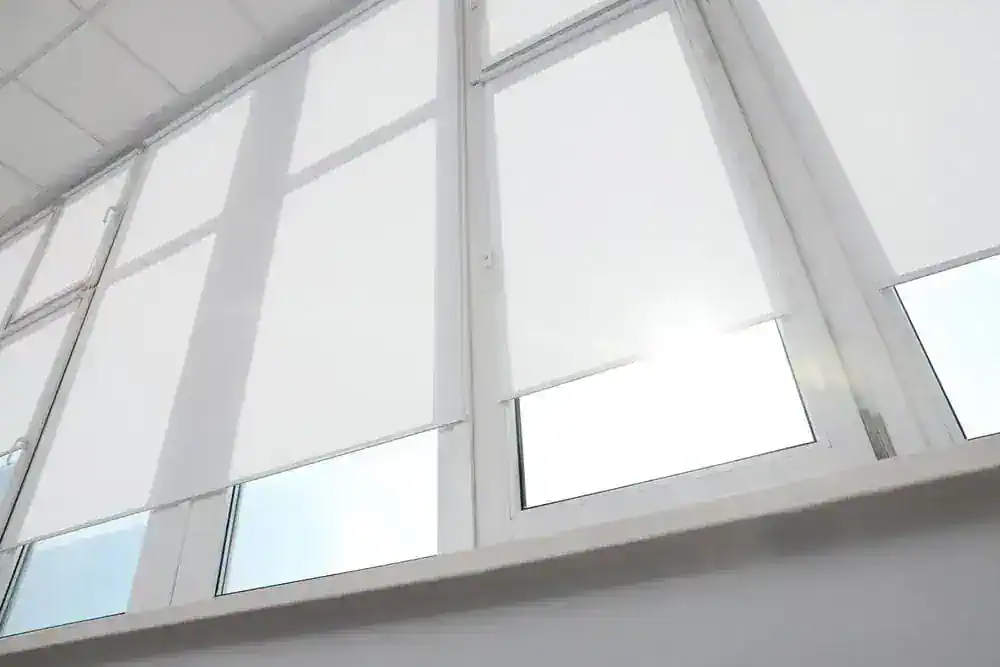
Exterior roller shades occupy a different category. They’re not purpose-built storm shutters in the traditional sense, but high-quality exterior shades with proper track systems can withstand significant wind loads and provide meaningful protection against the kind of weather Tarrant County actually sees — hail, wind-driven rain, flying debris from severe thunderstorms. They also do something the others don’t: they work every single day, blocking UV, reducing heat load through the glass, and cutting your cooling costs during a Texas summer. For many homeowners in Fort Worth, Arlington, and Mansfield, that year-round value is what tips the decision.
Impact windows are in a class of their own. They replace your existing windows entirely with laminated glass units that are tested to withstand hurricane-force winds and impact from flying debris. There’s nothing to deploy, nothing to store, and no decision to make when a storm is coming — the protection is always there. The cost is higher than any shutter option, typically $500 to $1,500 per window installed, but the ROI is real. Insurance companies offer premium discounts of 15 to 30 percent for qualifying installations, and the energy efficiency improvements can be significant. Over 10 to 15 years, the savings often offset a meaningful portion of the original investment.
The conversation usually comes down to this: do you want something cheaper that requires action before every storm, or something more expensive that you never have to think about again?
Storm panels are the most common entry point because the upfront cost is manageable — a few thousand dollars for a full home, depending on the number and size of openings. They’re tested, they work, and they meet Texas Department of Insurance standards when installed correctly. But they require you to be present, physically capable of mounting them, and paying attention to the forecast. If you’re traveling when a storm hits, or if the storm builds faster than expected, panels sitting in your garage don’t protect anything.
Permanent solutions — accordion shutters, roll-downs, impact windows — remove that variable. You’re paying for the peace of mind that comes with not having to do anything when the weather turns. For homeowners in Southlake or Keller with larger homes and more windows, that convenience factor is often worth the premium.
There’s also a middle path that doesn’t get discussed enough: exterior roller shades that are permanently mounted and motorized. They don’t require any pre-storm installation because they’re already there. A single switch or app command closes them across every window in the house. For the kind of weather that hits Tarrant County — fast-moving severe thunderstorms, hail events, high winds — that response time matters. Storms like that don’t give you a full day’s notice to install panels.
The honest answer is that the best storm protection is the one you’ll actually use. A system that requires significant effort to deploy before every storm is only as good as your ability to deploy it. If your schedule, your health, or your location makes that unreliable, a permanent option isn’t an upgrade — it’s a necessity.
Here’s something a lot of homeowners don’t find out until it’s too late: if you install storm protection without a permit and then file an insurance claim after storm damage, your insurer can deny the claim. Not because the product failed, but because the installation wasn’t documented and inspected the way the code requires.
In Tarrant County, any permanent or semi-permanent storm protection installation requires a building permit from your local city building department — whether that’s Fort Worth, Arlington, Mansfield, or any other municipality in the county. Projects valued at $2,500 or more also require a notarized Notice of Commencement filed with the county. Permit approval alone adds two to four weeks before installation can begin.

The permit process exists for a practical reason. Storm protection that’s anchored into structural members the right way holds. Storm protection that’s attached to drywall or siding with the wrong hardware fails — and when it fails in a high-wind event, it can create more damage than no protection at all. A building inspection confirms that what went up will actually do the job it’s supposed to do.
What the permit process involves: you’ll need to submit the shutter type, manufacturer specifications, and installation plans to your city’s building department. The permit is reviewed, approved, and then the installation can proceed. After installation, a building inspector reviews the work before the permit is closed. The whole process — from permit application through final inspection — typically adds three to six weeks to the total project timeline.
This is one of the reasons we always tell homeowners in Fort Worth and Arlington not to wait until a storm is named before they start thinking about this. By the time you’ve gone through the consultation, the product has been manufactured to your measurements, the permit has been approved, and the installation is scheduled, you’re looking at six to eight weeks minimum from first call to finished installation. That timeline doesn’t compress because the weather is getting bad.
There’s also an HOA layer for many Tarrant County homeowners, particularly in newer subdivisions in Mansfield, Southlake, and the growing communities along the western edge of the county. HOA rules about exterior modifications vary widely — some are straightforward, some require architectural review committee approval that takes weeks. We handle HOA coordination as part of our process, but it’s another reason why starting early matters.
The good news is that once you’re through the process, you’re through it. A properly permitted, inspected installation is documented, it qualifies for insurance discounts, and it’s not something you have to revisit. The 15 to 30 percent reduction in wind and hail premiums that most insurers offer for qualifying installations can add up to several hundred dollars per year — real savings that compound over time.
Sometimes you don’t have six weeks. A storm system is tracking toward North Texas, the forecast is getting worse by the hour, and you’re looking at windows with no protection in place. Here’s what’s realistic in that situation.
Plywood is the most common emergency measure, and it works — when it’s done correctly. That means exterior-grade plywood at least half an inch thick, cut to overlap the window frame by at least four inches on each side, and anchored into the structural framing, not just the siding. Done right, it provides basic protection against wind-driven debris. Done wrong — which is how it usually gets done in a hurry — it can be worse than nothing, because improperly attached plywood can become a projectile.
Temporary polycarbonate storm panels, if you can find them in stock, are a step up from plywood. They’re lighter, easier to handle, and provide better impact resistance. The challenge during an active storm season is availability — when a major storm is approaching the region, supply chains for storm protection products tighten fast, and what’s normally a two-day order can become a two-week wait.
Window security film is another emergency option worth knowing about. Applied directly to the glass, it won’t stop a window from breaking, but it holds the glass together when it does — reducing the risk of dangerous shards and slowing wind and water entry. It’s not a substitute for shutters or impact windows, but it’s something you can apply yourself in a few hours and it provides a real, if limited, layer of protection.
The honest message here is that emergency measures are exactly that — emergency measures. They’re better than nothing, but they’re not a plan. The homeowners in Tarrant County who come out of a bad storm season with intact windows and no insurance claims are almost always the ones who made a decision in March or April, not the ones who were on the phone with contractors the day before a storm watch was issued.
Tarrant County doesn’t need a hurricane to make landfall for storm damage to be serious. The weather that already moves through this part of Texas — the hail, the wind, the severe thunderstorms that build faster than the forecast suggests — is more than enough reason to think about your windows before something breaks.
The most important thing you can do right now is get ahead of the timeline. Understand your options, figure out what fits your home and your situation, and get the process started before storm season is already underway. Waiting until the weather turns means competing with every other homeowner in the county for contractor availability, product stock, and permit slots.
If you want a straightforward conversation about what makes sense for your home — no pressure, no upsell — reach out to A Plus Shutters & Shades. We’re based in Pantego, TX, we’ve been working in this area for over a decade, and we’ll give you a real answer, not a sales pitch.
Article details:
Share:
Continue learning: