
Not all blackout blinds are created equal — especially in Texas. Here's what Tarrant County homeowners need to know before buying.
Share:
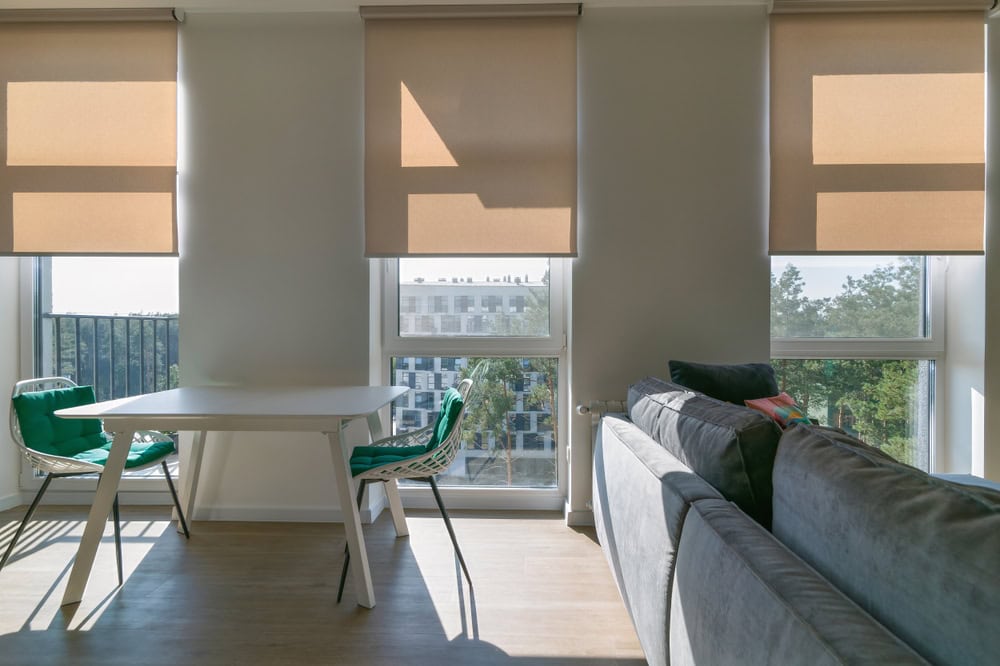
If you live in Tarrant County, you already know what the sun does to a room by mid-afternoon. West-facing windows. Five months of triple-digit heat. An AC that never quite catches up. And blinds that are supposed to block light but still let in enough glow to read by.
The problem isn’t always the product — it’s often the fit, the fabric, or both. We’ve helped hundreds of homeowners across Arlington, Fort Worth, Mansfield, and Keller solve this exact problem, and what we’ve learned is that a custom installation in a Tarrant County home performs very differently than something you pull off a shelf at a big-box store. This guide walks you through how blackout roller blinds actually work, what to look for when choosing them, and why proper fit matters so much in our climate.
The term “blackout” gets used loosely in the window treatment industry. A lot of products labeled blackout will reduce light by 85 to 95 percent — which sounds impressive until you’re lying in bed at 7 AM watching sunlight pour in around the edges of your blinds.
True blackout performance means blocking 99 percent or more of incoming light. The fabric matters, but so does the fit. Most standard-size roller blinds leave a gap of roughly half an inch to three-quarters of an inch on each side of the headrail — a mechanical necessity, not a defect — and that gap is where your darkness disappears. A properly measured, custom-fit shade eliminates that problem at the source.

One of the most common questions we hear from homeowners goes something like this: “I want blackout for sleeping, but I don’t want my living room to feel like a cave during the day.” That’s a completely reasonable thing to want, and it’s exactly what double roller blinds are designed to solve.
A double roller system fits two independent layers of fabric into a single headrail — typically one blackout layer and one light-filtering layer. You operate them separately depending on what you need at any given time. In the morning, you pull the sheer layer down and let in soft, diffused light without the glare. At night, or during a weekend nap, you drop the blackout layer and the room goes dark.
For homeowners in Arlington or Fort Worth with open-concept living spaces, this setup is particularly useful. You’re not choosing between privacy and natural light — you’re getting both, on your schedule. The hardware sits cleanly in one headrail, so it doesn’t look bulky or complicated on the window. It just looks like a shade.
We’ve installed double roller systems on some of the larger windows in newer Tarrant County subdivisions — places like Viridian in Arlington or newer developments in Mansfield and Keller where builders are putting in floor-to-ceiling glass to take advantage of the views. Those windows look stunning. They also let in an enormous amount of heat and light, which is where a well-configured double roller system earns its keep.
Day and night blinds work on a similar principle to double rollers but use alternating bands of opaque and sheer fabric woven into a single layer. As you adjust the shade, the bands shift — aligning the opaque sections for privacy and darkness, or opening the sheer sections to let filtered light through. It’s a more compact solution than a double roller system, and it gives you a surprising range of light control from a single shade.
They’re particularly popular in home offices and living rooms where the light conditions change throughout the day. In a Tarrant County home where the afternoon sun hits the south or west side of the house hard from May through September, having that kind of flexibility on a main living area window is genuinely useful — not just a nice-to-have.
One thing to understand is that day and night blinds, even in the fully closed position, don’t achieve the same depth of darkness as a dedicated blackout roller shade. They’re excellent for privacy and light management, but if your goal is a completely dark room for sleeping, a true blackout fabric in a properly fitted roller shade is still the better tool. The two options serve different needs, and part of what we do during a consultation is help you figure out which one actually fits the problem you’re trying to solve.
For rooms where you want both — say, a master bedroom that doubles as a sitting area — a double roller system combining blackout and day-and-night fabrics gives you the full range. It’s not a complicated setup, and once it’s installed, operating it becomes second nature within a day or two.
Standard-size blinds are built around common window dimensions. The problem is that a significant portion of Tarrant County homes — especially those built in the 1970s through the 1990s in Arlington and older Fort Worth neighborhoods — have windows that don’t match those standard dimensions. Even a quarter-inch gap between the blind and the frame is enough to let in light, heat, and a noticeable loss of privacy.
Custom roller blinds are measured on-site, fabricated to the exact dimensions of your window, and installed to fit precisely. That’s not a luxury upgrade — it’s the baseline for getting the performance you’re actually paying for. A blackout fabric that doesn’t cover the full opening isn’t blackout. It’s just a shade.

The U.S. Department of Energy estimates that heat gain through windows accounts for 25 to 30 percent of residential cooling costs. In Tarrant County, where the cooling season runs from roughly May through September and temperatures regularly exceed 100 degrees, that’s not an abstract statistic — it’s a line item on your electric bill every single month.
Blackout roller shades with the right solar heat gain coefficient can block up to 75 percent of radiant heat before it enters the room. Real-world data from similar Texas climates backs this up: homeowners have reported summer electric bill reductions of 12 to 15 percent after installing properly fitted roller blinds on their most sun-exposed windows. On a west-facing room that regularly hits 88 degrees by 5 PM in August, that kind of reduction is measurable and felt immediately.
Beyond cooling costs, there’s the UV damage angle. Texas sun fades hardwood floors, bleaches leather furniture, and degrades area rugs faster than most homeowners expect — often within two to three years of unprotected exposure. High-quality blackout and solar roller fabrics block up to 99 percent of UV rays, which means your floors and furniture hold their color and condition significantly longer. That’s a real financial benefit, not just a comfort one.
We source our roller shade fabrics from Texas-made manufacturers, including Mermet USA, whose materials are specifically tested for performance in high-heat climates. There’s a meaningful difference between fabric rated for the conditions it’ll actually face and a generic product that wasn’t designed with a Texas summer in mind.
Motorized roller shades have gotten considerably more reliable and more affordable over the past few years, and the question we hear most often is whether the added cost is actually worth it. The honest answer is: it depends on how you use your windows.
If you have high windows that are difficult to reach, shades you operate multiple times a day, or a home where you’ve already invested in smart home infrastructure — Alexa, Google Home, Apple HomeKit — then motorized electric blackout shades make a lot of practical sense. You set a schedule, the shades go up in the morning and down at night, and you don’t think about it again. For shift workers near NAS Fort Worth Joint Reserve Base, or parents managing a newborn’s sleep schedule, that kind of automation removes a daily friction point entirely.
What we do before any motorized installation is confirm compatibility with your existing smart home setup before we order anything. That step matters more than it sounds. A lot of homeowners have had the experience of buying smart devices that don’t actually talk to each other, and we don’t want to be the reason that happens with your window treatments.
The motorization adds roughly $150 to $250 per blind depending on the system, and the quiet motors we install are designed for daily use over many years. They’re not fragile, and they don’t require a technician every time something needs adjusting. For the right home and the right windows, electric blackout shades are one of those upgrades that people consistently say they wish they’d done sooner. For other situations, a well-fitted manual shade does everything you need at a lower cost. The consultation is where we figure out which one actually fits your life.
The short version: blackout performance comes down to fabric quality, fit, and installation. Get any one of those wrong and you’re back to lying awake watching light creep in around the edges of a shade that was supposed to solve the problem.
For Tarrant County homeowners dealing with intense afternoon sun, high cooling bills, or rooms that just won’t stay dark, the right custom roller blind — properly measured and professionally installed — makes a genuine, noticeable difference. Not a marginal one.
If you’re ready to figure out what that looks like for your specific windows, we offer free in-home consultations across Tarrant County. We bring samples, take precise measurements, and help you land on the right solution before anything gets ordered — no pressure, no guesswork.
Article details:
Share:
Continue learning:

