If your energy bills spike every summer and employees are complaining about the heat, the right commercial window treatments might be the most practical fix you haven't tried yet.
Share:

If your building runs hot from May through September, you already know the feeling — certain rooms are unbearable, your thermostat is working overtime, and your energy bill reflects it. Most business owners in Tarrant County assume that’s just the cost of operating in North Texas. It isn’t. A significant portion of that heat is coming straight through your windows, and the right commercial window treatments can change that equation in a meaningful way. This isn’t about aesthetics or upgrading the look of your space — it’s about understanding where your cooling dollars are actually going, and what you can do about it.
Not all window treatments perform equally when summer temperatures in Tarrant County regularly push past 100°F. The difference between a decorative blind and a purpose-built solar shade isn’t cosmetic — it’s measurable in BTUs and dollars. According to the U.S. Department of Energy, about 76% of the sunlight hitting a standard double-pane window enters the building as heat. Add the right window covering, and that number can drop to as low as 15%. That’s not a minor adjustment. That’s a fundamentally different thermal environment inside your building.
The three types of window coverings that consistently deliver real energy performance in hot climates are cellular shades, solar shades, and exterior roller shades. Each works differently, and the best choice depends on your building’s window orientation, how the space is used, and how aggressively you want to reduce heat gain.

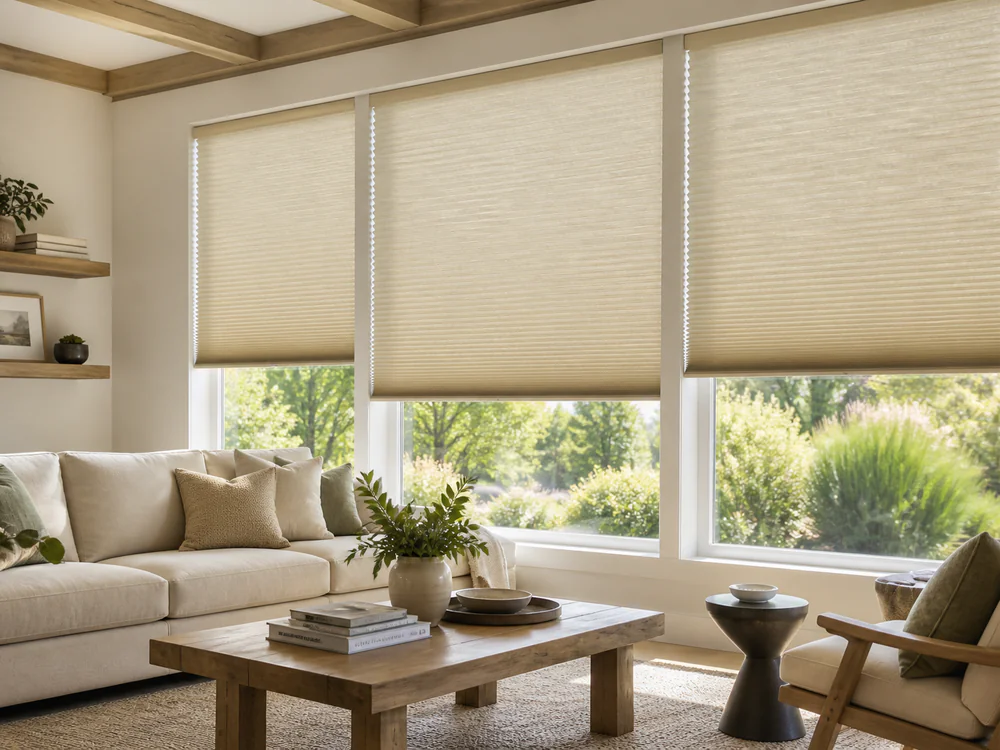
Cellular shades — sometimes called honeycomb shades — work by trapping air inside their pocket-shaped cells, creating a thermal buffer between the glass and the room. That trapped air slows heat transfer, which means your HVAC system isn’t fighting a radiating window all afternoon. They’re particularly effective in spaces where you want to block direct sun entirely while maintaining a consistent interior temperature, like medical waiting rooms, private offices, or conference rooms along a west-facing wall.
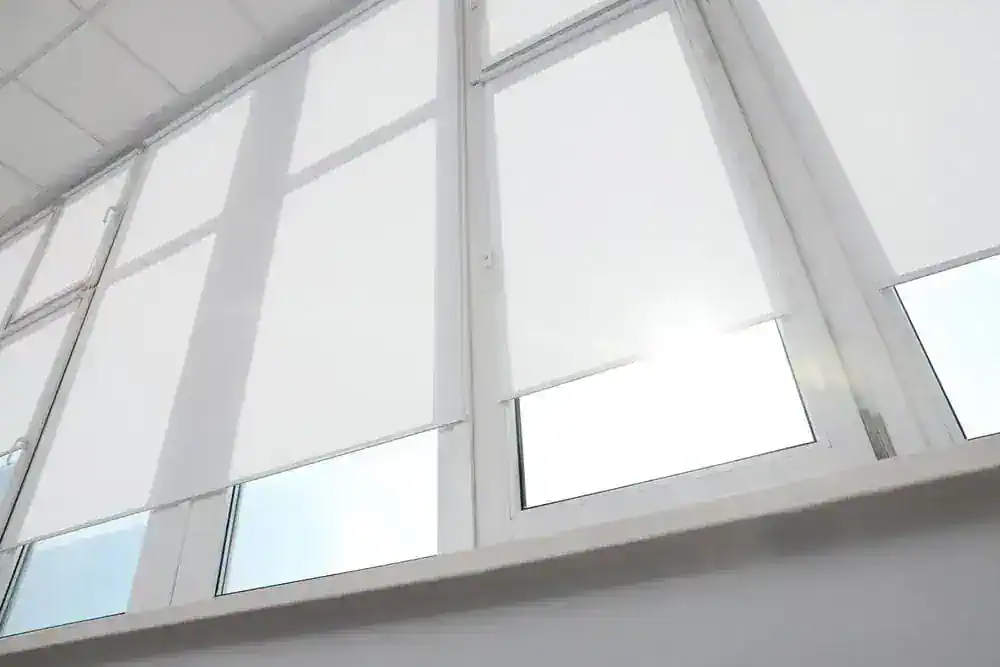
Solar shades take a different approach. Instead of blocking the view, they filter it. The fabric is woven tightly enough to reject a significant portion of solar heat and UV radiation while still allowing diffused natural light into the space. For commercial environments with heavy computer use — think open-plan offices, coworking spaces, or any workspace where screen glare is a daily complaint — solar shades are often the more practical choice. They reduce heat gain without making the room feel closed off or cave-like.
The honest answer to which performs better depends on your windows. A south-facing window in a Fort Worth office building along I-35W gets a different solar load than a north-facing window in a Southlake professional suite. Window orientation matters, and so does how the space is used throughout the day. That’s exactly why a professional site assessment is worth doing before you commit to a product — measuring the wrong thing for the wrong window is an expensive mistake.
One thing both cellular and solar shades share: they’re interior treatments. They intercept heat after it’s already reached the glass. That’s an important distinction when you start looking at exterior roller shades, which operate on a completely different principle.
Here’s the physics most people don’t know: once sunlight hits your window glass, some of that heat is already inside your building — even before it passes through an interior shade. Glass absorbs solar radiation and re-radiates it inward. An interior shade can reduce how much of that heat reaches the room, but it can’t undo what the glass has already absorbed.
Exterior roller shades work before the heat ever reaches the glass. They intercept solar radiation at the building envelope — outside the window entirely — which means the glass stays cooler, the interior temperature stays more stable, and your air conditioning system has significantly less work to do. In a climate like Tarrant County’s, where west- and south-facing commercial windows can receive four to six hours of direct afternoon sun on a flat, unshaded landscape, this distinction matters significantly.
For restaurant patios, retail storefronts, and office buildings along commercial corridors like I-20 in Arlington or I-30 through Fort Worth, exterior roller shades also serve a secondary function: they extend the usable square footage of outdoor areas by creating shade and reducing wind exposure. A covered patio that was previously unusable in July becomes a functional dining or seating space. That’s a revenue consideration, not just a comfort one.
We offer both interior and exterior roller shades — and our exterior options are built with UV-resistant, water-resistant fabrics designed specifically for the Texas climate, with motorized operation available for large or hard-to-reach installations. Most local window treatment companies don’t offer exterior shades at all. It’s one of the more practical gaps in the market, and it’s one we specifically built our commercial offering around.
For business owners who haven’t gone through a commercial window treatment installation before, the process can feel opaque. How long does it take? How disruptive is it? How do you know you’re getting the right product for your specific building? These are fair questions, and the answers depend heavily on who you’re working with and whether they actually know commercial installations — not just residential ones.
Commercial work has different requirements than residential. Fire and flame retardancy codes, egress clearances, ADA-compliant controls for motorized systems, and the sheer scale of multi-window installations all factor into the product selection and installation process. Getting this right requires professional measurement, commercial-grade materials, and an installer who understands the difference between what works in a home and what holds up in a high-traffic business environment.

If your commercial space has more than a dozen windows, manual operation becomes a real operational burden. Someone has to adjust each shade individually, multiple times a day, as the sun moves. In a busy office, a restaurant, or a medical facility, that’s not a realistic expectation for staff.
Motorized window treatments solve this by allowing an entire floor — or an entire building — to be adjusted simultaneously from a single control point. Systems like PowerView motorization can be programmed to respond to time of day, integrated with smart building controls, or operated remotely. For a business owner who wants west-facing shades to lower automatically at 2 p.m. when the afternoon sun hits hardest, that kind of automation isn’t a luxury — it’s a practical management tool.
The upfront cost of motorized systems is higher than manual installations, with motorized options generally running $20–$35 per square foot installed compared to $8–$18 per square foot for manual systems. But the operational savings — both in staff time and energy costs — tend to make that gap close faster than most business owners expect, especially in Tarrant County where the cooling season runs nearly seven months of the year. A window treatment investment that might take four years to pay back in a northern climate can pay back in closer to two years here, simply because the heat load is present for so much longer.
There’s also a compliance consideration worth noting: as of June 1, 2024, corded window coverings are no longer permitted for new commercial installations under WCMA safety standards. All new commercial installations must use cordless or motorized systems. If your building still has older corded blinds, a replacement project isn’t just about performance — it’s about bringing your space into compliance.
Cost is the question most business owners want answered before they’ll engage with anything else, and it’s a reasonable place to start. The honest answer is that commercial window treatment costs vary significantly based on product type, window count, motorization, and the size of your windows — which is why a flat price is difficult to quote without a site visit.
That said, here’s a realistic framework: manual commercial window treatment systems generally run $8–$18 per square foot installed. Motorized blinds and shades typically fall in the $20–$35 per square foot range. Premium automated systems with full building integration can reach $35–$45 per square foot. For individual windows, solar screens run $60–$380 per window depending on size, while motorized shades range from $350–$1,000 per window.
What most Tarrant County business owners don’t know is that commercial window treatments may qualify for federal tax incentives under Section 179D, which provides deductions of $0.60–$1.80 per square foot for window treatments that contribute to whole-building energy savings exceeding 25% compared to ASHRAE baseline performance. On a 5,000 square foot commercial space, that’s a potential federal deduction of $3,000–$9,000. That’s not a minor footnote — for a business evaluating a significant window treatment investment, it can meaningfully change the net cost calculation. We’d encourage you to bring this up with your accountant before assuming the sticker price is the final number.
Our products are manufactured locally in Denton, TX — not shipped from overseas. That means shorter lead times, custom fabrication to your exact window measurements, and no waiting on a container that’s three months out. For business owners in Tarrant County working against a renovation timeline or trying to get a new space ready before peak season, that matters.
The bottom line is straightforward: if your building runs hot from May through October, your windows are a large part of why — and the right window treatments are one of the most cost-effective ways to do something about it. Whether that means solar shades for a glare-heavy office in Mansfield, exterior roller shades for a restaurant patio in Fort Worth’s Near Southside, or a motorized system for a multi-window medical office in Arlington, the solution depends on your specific building, not a generic recommendation.
What we’ve found working with commercial clients across Tarrant County is that most business owners are surprised by how quickly the right window treatments pay for themselves — especially once energy savings, reduced HVAC wear, and available tax incentives are factored in together.
If you’re ready to understand what your specific building actually needs, A Plus Shutters & Shades offers a free consultation with professional measurement — no obligation, no pressure, just a clear picture of your options and what they’ll actually do for your space.
Article details:
Share:
Continue learning: