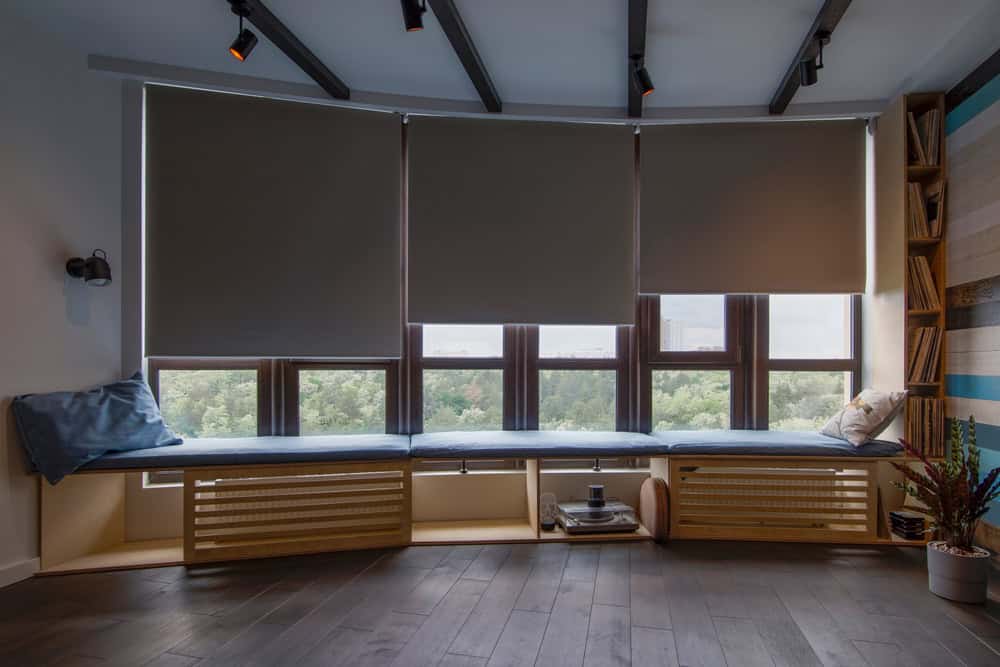
Not all wood blinds survive a Texas summer. Here's how to choose the right material for every room in your Tarrant County home.
Share:

If you’ve been shopping for wood blinds for windows and ended up more confused than when you started, you’re not alone. The options are everywhere, the advice is contradictory, and most of the comparison guides online were written for a generic American home — not one that bakes under a Tarrant County July.
The real question isn’t which material is universally better. It’s which material is right for each room in your specific home, given what Texas heat, sun, and humidity actually do to window treatments over time. That’s what we’re going to walk through here.
Real wood blinds are exactly what they sound like — horizontal slats milled from actual wood, most commonly basswood or alder. Basswood is the more popular choice because it’s lightweight and strong, which matters more than you’d think when you’re operating a wide set of blinds every day. Real wood takes stain beautifully, offers a warmth and grain variation that no manufactured product has fully replicated, and tends to feel noticeably more substantial when you handle it.
Faux wood blinds are made from PVC or a composite blend designed to mimic the look of wood while resisting moisture. They’re heavier than real wood slats, hold paint well, and are genuinely impervious to water — which is why they’re the default recommendation for bathrooms and kitchens. The quality range, however, is enormous. Builder-grade faux wood and custom-grade faux wood are not the same product, and in Tarrant County, that difference shows up fast.
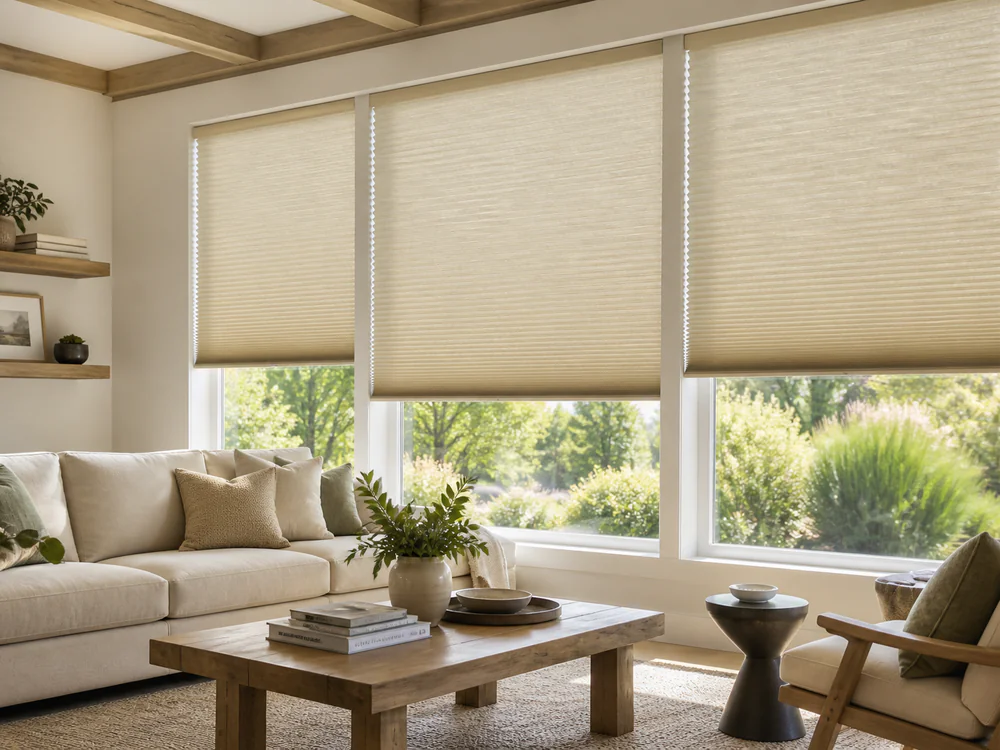
The common assumption is that real wood and Texas don’t mix. That’s an overcorrection. Real wood blinds fail in specific conditions — direct moisture exposure, south- or west-facing windows with hours of unfiltered afternoon sun, rooms where humidity spikes regularly. In those situations, yes, real wood is the wrong call. But that’s not every room in your house.
A master bedroom on the north or east side of your home, a formal living room with consistent HVAC control, a home office that doesn’t get direct sun — these are exactly the environments where real wood performs well and looks better than any faux alternative. The natural grain variation in basswood or alder reads differently than even the best-printed faux wood texture. At close range, in a room where you spend real time, that difference is visible.
There’s also a practical weight argument. Faux wood slats are heavier than real wood, and on a large window — say, a wide set of windows in an open-plan living area — that weight adds up. Real wood operates more smoothly, puts less stress on the headrail mechanism over time, and is generally the better choice for any window wider than about 48 inches, assuming the room’s humidity is stable.
In Tarrant County’s newer builds — places like Walsh Ranch in Fort Worth or the developments spreading through Mansfield — large windows are standard. Builders love the open, light-filled aesthetic. But those wide spans in climate-controlled rooms are where real wood actually earns its premium. The caveat is always the same: stable humidity, no direct moisture, and not a south- or west-facing window that gets hammered all afternoon.
If your home is in one of the older neighborhoods in Arlington or the historic districts in Fort Worth — Fairmount, Ryan Place — you may also be dealing with windows that aren’t perfectly square. Custom fitting matters more than material in those cases, but real wood can absolutely be part of that equation when the room conditions are right.
For most rooms in most Tarrant County homes, faux wood is the practical default — and for good reason. Bathrooms, kitchens, laundry rooms, and any space with regular humidity spikes are simply not appropriate for real wood. The moisture doesn’t have to be dramatic. Steam from a shower, condensation near a kitchen window, or even the humidity swings that come with a Texas spring — dry winter air at 20 to 30 percent relative humidity swinging up to 60 or 90 percent in summer — are enough to cause real wood to expand, contract, and eventually crack or warp.
Faux wood handles all of that without complaint. It doesn’t absorb moisture, it doesn’t expand and contract with humidity changes, and it can be wiped clean rather than carefully dusted. For families with kids and pets, that wipe-clean quality is genuinely useful, not just a marketing line.
But here’s what most comparison guides won’t tell you: not all faux wood survives Texas heat either. Low-quality PVC slats can permanently warp in south-facing windows where the temperature between the glass and the blind exceeds 115°F — which happens in Tarrant County homes more often than people expect, even in air-conditioned rooms. The slats develop a permanent downward curve, a failure mode sometimes called “smiling,” and once it sets, it doesn’t reverse. This is why builder-grade faux wood blinds — the kind that come standard in new construction or cost $30 at a big box store — often fail within three to five years in Texas.
Custom-grade faux wood uses thicker slats and stronger hardware specifically rated for this kind of heat cycling. The difference isn’t visible when you hold a slat in your hand in a showroom. It shows up in year four when one set is still flat and the other looks like a row of sad smiles. If you’ve replaced faux wood blinds already and wondered why they warped when they were supposed to be heat-resistant, this is almost certainly what happened.
West-facing rooms are the highest-risk situation in Tarrant County. The afternoon sun in DFW hits west-facing windows directly from roughly 1 to 7 PM in summer. That sustained exposure is where the temperature between glass and blind climbs highest, and where the difference between builder-grade and custom-grade faux wood becomes impossible to ignore.
Heat management is one of the most common reasons Tarrant County homeowners start shopping for new window treatments. Summer electric bills that push past $300 or $400 a month have a way of making the question feel urgent. And the honest answer is that not all blinds are equally effective at reducing heat gain — the material matters, but so does the type of product.
Wood blinds, whether real or faux, are primarily light-control and privacy products. They reduce solar heat gain by blocking direct sunlight when the slats are closed, but they don’t insulate the window opening the way a different product type does. If heat reduction is your primary goal, it’s worth understanding how wood blinds compare to the alternatives.
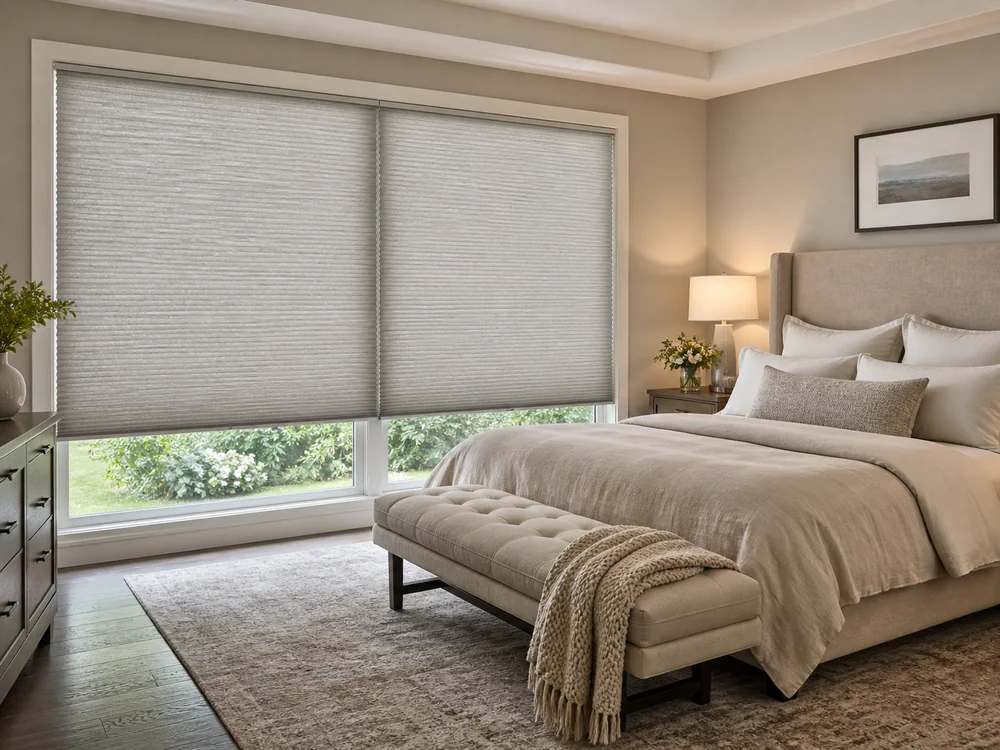
Cellular blinds — also called honeycomb shades — work on a fundamentally different principle than faux wood blinds. Instead of blocking light with solid slats, they trap air inside fabric cells, creating a layer of insulation between the window glass and the room. That trapped air is what reduces heat transfer, both in summer when you’re trying to keep heat out and in winter when you’re trying to keep warmth in.
For pure thermal performance, cellular blinds outperform faux wood. If your goal is to reduce how much heat enters a room and lower the load on your HVAC system, a quality cellular shade will do more of that work than a faux wood blind at the same window. The tradeoff is that cellular shades don’t offer the same aesthetic — they have a softer, more fabric-forward look that doesn’t suit every room or design preference. They also don’t have the same moisture resistance as faux wood, so they’re not ideal for bathrooms or kitchens.
Faux wood blinds, on the other hand, do reduce heat gain when the slats are closed — they just do it through blockage rather than insulation. For rooms where you want both light control and a wood-look aesthetic, faux wood is the more versatile choice. For rooms where heat reduction is the primary driver and aesthetics are secondary, cellular shades are worth serious consideration.
In practice, many Tarrant County homeowners end up using both — cellular or solar shades on the windows that face south and west, where heat gain is most aggressive, and faux wood or real wood blinds in rooms where the look matters more than the thermal performance. That’s matching the product to the problem, which is what good window treatment selection actually looks like.
We serve both residential and commercial clients across Tarrant County, and this combination approach comes up constantly in consultations — especially in the newer open-plan homes where a west-facing great room and a north-facing bedroom are very different problems that need different solutions.
Most comparison guides frame this as a binary choice: faux wood or real wood. But there’s a third category that fits a specific type of buyer really well — custom bamboo blinds and woven wood shades.
Bamboo and woven wood shades are made from natural materials — bamboo, reeds, grasses, and similar plant fibers woven into panels. They have a textural, organic quality that neither real wood nor faux wood can replicate. If you’ve seen them in a space, you know the look: warm, handcrafted, with a natural variation that makes each shade slightly unique. They work particularly well in living rooms, dining rooms, and bedrooms where a relaxed, natural aesthetic fits the design direction.
The practical profile is different from both wood blind types. Bamboo and woven wood shades filter light rather than blocking it completely — they’re not a blackout solution, and they’re not designed for rooms that need full privacy. They’re also not moisture-resistant, so bathrooms and kitchens are out. But in the right room, they offer something neither faux wood nor real wood does: a genuinely natural material with a handwoven texture that reads as intentional design rather than a practical default.
From a heat management standpoint, woven wood shades provide light filtering that reduces glare and some solar heat gain, but they’re not in the same category as cellular shades for thermal performance. Think of them as an aesthetic-first choice that also happens to filter light reasonably well — not as a heat-management solution for a west-facing window.
In Tarrant County homes, we see bamboo and woven wood shades work best in rooms that face north or east, where the light is softer and the heat load is lower. They’re also popular in the Southlake and Colleyville market, where design-forward buyers want window treatments that feel custom and considered rather than practical and generic. If you’re renovating or building and you want something that photographs well and feels genuinely different, custom bamboo blinds are worth a conversation.
The short version: faux wood is the right call for moisture-exposed rooms and any window that takes sustained direct sun — but only if it’s custom-grade, not builder-grade. Real wood is a legitimate choice for climate-controlled rooms where aesthetics matter and humidity is stable. Cellular shades outperform both on pure heat reduction. And bamboo or woven wood shades offer a natural aesthetic that neither wood type can match, in the right room.
What makes this decision harder than it looks is that the right answer is almost always room-specific. A Tarrant County home with west-facing living areas, a south-facing kitchen, and a north-facing master bedroom may need three different solutions. That’s not a problem — it’s just the reality of designing window treatments around how your home actually sits on its lot and how Texas light moves through it.
If you’re working through this decision and want a straight answer rather than another comparison chart, that’s exactly what we do. A Plus Shutters & Shades offers free in-home consultations — we bring samples, take measurements, and give you a real recommendation based on your specific rooms and conditions, not a one-size-fits-all answer.
Article details:
Share:
Continue learning: