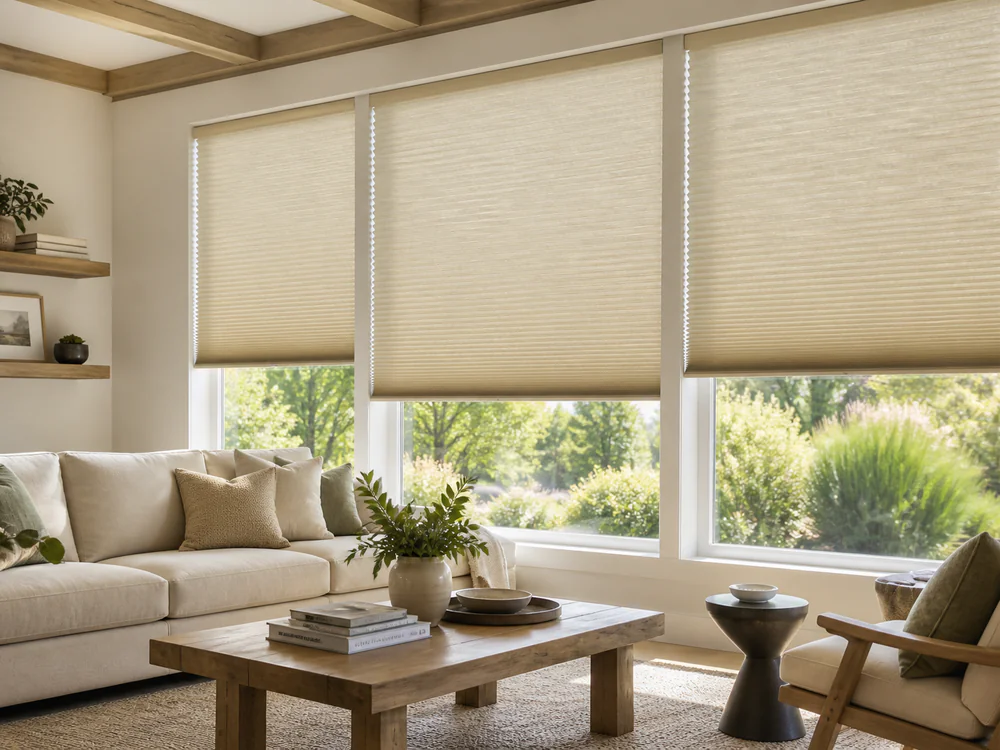
Not all plantation blinds are built for Texas. Here's what to know before you buy — materials, fit, cost, and what holds up in Tarrant County heat.
Share:
If you’ve been staring at faded, flimsy window coverings while your air conditioner fights a losing battle against the afternoon sun, you’re not alone. A lot of Tarrant County homeowners reach the same breaking point — usually sometime in July, when the west-facing windows turn the living room into a greenhouse. Plantation blinds come up fast in that search. But there’s a wide gap between what you find online and what actually performs in a Texas home. This guide cuts through the noise. By the end, you’ll know exactly what to look for, what questions to ask, and what separates a solid investment from a regret.
The term “plantation blinds” gets used loosely, and that creates confusion. Technically, plantation shutters are solid panel window coverings mounted directly to your window frame — they’re a permanent fixture, not something you hang and take down. Plantation-style blinds, on the other hand, are horizontal slat blinds with wider-than-average louvers that mimic the look but are built very differently. One is a long-term home improvement. The other is a window accessory.
The distinction matters because the price, durability, and performance are not in the same category. True interior shutters create an insulating layer between your glass and your living space, which is why they hold up in Tarrant County heat in a way that fabric shades and standard blinds simply don’t. When someone in Keller or Colleyville asks about plantation blinds, they usually mean shutters — and that’s where the real conversation starts.
Here’s something most people don’t realize until it’s too late: the quality of a plantation shutter has less to do with the material and more to do with the fit. A shutter that isn’t built to your exact window dimensions will gap at the edges, bind when you open it, and let light bleed through in ways that defeat the whole purpose. That’s not a minor cosmetic issue — it’s the difference between a shutter that works and one that frustrates you every time you walk past it.
Windows in Tarrant County homes are rarely perfectly square. Older neighborhoods in Fort Worth and Arlington have settled over decades, and even newer builds in Mansfield or Burleson can have subtle variations in the window casing that throw off a pre-sized shutter. The only real solution is a shutter built to the actual dimensions of your specific window — measured in person, to the sixteenth of an inch, before anything gets manufactured.
This is where the process matters as much as the product. A proper in-home measurement isn’t just about getting the numbers right. It’s about understanding the window casing depth, the trim profile, the mounting surface, and how the shutter panel will operate once it’s installed. Get that wrong and no amount of quality material will save the finished result. Get it right and the shutter looks like it was designed into the home from day one.
That’s exactly the standard we hold ourselves to on every job — whether it’s a single window in a Pantego bungalow or a whole-house installation in a custom-built home in Southlake. The measurement process is where the outcome is determined, and it’s not something we rush.
Material selection is where a lot of buyers get overwhelmed, and it’s where a lot of salespeople oversimplify. The honest answer is that there’s no single best material — there’s the right material for your specific room, your climate exposure, and your budget.
Solid wood shutters are the premium option. Basswood and alder are the most common species, and they offer the warmth and richness that painted or stained alternatives can’t quite replicate. They’re the right call for living rooms, bedrooms, and formal spaces where aesthetics carry weight. The trade-off is that real wood is sensitive to moisture. In a bathroom or a kitchen near the sink, wood can warp over time — and in Tarrant County, where humidity swings between dry winter air and muggy summer storms, that’s a real consideration.
Vinyl and composite shutters — sometimes called polywood or faux wood — solve the moisture problem. They’re built to handle humidity without warping or cracking, which makes them the smart choice for bathrooms, laundry rooms, and any window near a water source. They also tend to hold their finish better under intense UV exposure, which matters when your south-facing windows are taking direct Texas sun for six or seven hours a day. The visual difference between a quality composite shutter and a painted wood shutter is minimal from a normal viewing distance — most guests won’t know the difference.
Where you want to be cautious is with the budget end of the vinyl market. Thin, hollow vinyl shutters feel flimsy, flex when you tilt the louvers, and don’t insulate the way a properly constructed shutter should. The material category isn’t the issue — the manufacturing quality is. That’s why we manufacture our shutters locally in Texas rather than importing them from overseas factories. The materials are selected for this climate, the construction is built to last, and the finished product reflects that. Quality wooden plantation shutters can last 30 years or more. Even a well-made composite shutter will outlast cheap vinyl blinds by a decade.
“Custom” is one of the most overused words in the window treatment industry. Every franchise and big-box retailer uses it. But there’s a real difference between a shutter that’s been selected from a range of pre-sized options and one that’s been built from scratch to fit your exact window.
Made-to-measure window shutters start with a precise in-home measurement — not a self-measurement kit mailed to your door, not an estimate based on standard window sizes. Someone comes to your home, measures each window individually, accounts for any irregularities in the casing, and then that data drives the manufacturing. The result is a shutter that closes flush, operates smoothly, and looks intentional.

One of the most common frustrations we hear from homeowners across Tarrant County is that they have a window nobody seems to know how to handle. An arched window above the front door. A half-moon transom in the master bedroom. An oversized sliding glass door that standard shutters won’t span. These aren’t rare — they show up constantly in the custom builds around Southlake and Colleyville, and in the older, character-rich neighborhoods of Fort Worth’s historic districts.
The reason most companies struggle with specialty shapes isn’t a product problem — it’s a measurement and fabrication problem. An arch window shutter requires a panel that follows the curve of the frame precisely. A half-moon window shutter needs to be shaped to match the radius of the glass. Half-round window shutters demand the same level of custom fabrication. When the shutter is built from a standard template and forced to fit a non-standard opening, the result looks wrong and often doesn’t function properly.
Our background in construction is what makes the difference here. We’re not just window treatment installers — we came out of A Plus Home Remodel, a construction company with over a decade of work in the DFW market. That means when we look at an arched window or a specialty transom, we’re reading the structural context, not just the surface dimensions. We understand how the frame was built, what the mounting surface can support, and how to fabricate a shutter that integrates with the architecture rather than fighting it.
If you’ve been told your windows “can’t be shuttered,” it’s worth getting a second opinion. The answer is almost always that the right fabrication process just wasn’t applied.
Motorized and automated plantation shutters have moved from a luxury niche to a genuinely practical upgrade — especially in Tarrant County, where managing solar gain throughout the day is less about aesthetics and more about keeping your cooling costs under control.
The basic concept is straightforward: instead of manually adjusting louvers on every window in your home, motorized shutters allow you to control tilt and position remotely — through a wall switch, a remote, or a smart home app. For west-facing windows in Arlington or Grand Prairie that take the full force of the afternoon sun, being able to close the louvers at 2 p.m. without walking room to room is a real quality-of-life improvement. For homeowners who travel frequently or manage vacation properties, automated shutters offer a level of control that manual options simply can’t match.
The integration side has gotten more sophisticated too. Most motorized shutter systems now work with major smart home platforms, which means you can tie shutter position to a schedule, to a thermostat trigger, or to a broader home automation routine. The motorized shutters segment is growing at a meaningful pace, and the technology has become reliable enough that it’s no longer a “bleeding edge” conversation — it’s a standard upgrade option.
From a practical standpoint, motorized shutters are still custom-built and custom-fitted the same way manual shutters are. The motor is integrated into the panel system during fabrication, not added on after the fact. That means the fit, finish, and operation quality depend entirely on the manufacturing and installation process — which is why working with a plantation shutters company that builds and installs its own product matters more, not less, when you’re adding motorization to the equation.
The upfront cost of plantation shutters is higher than blinds — that’s just true. But the comparison most people make stops too early. Cheap vinyl blinds last three to five years before they’re yellowing, warping, or snapping. Quality plantation shutters last 30 years or more. Run that math over the life of your home and shutters aren’t the expensive option — they’re the one you stop paying for.
There’s also the energy side of the equation. Properly fitted shutters reduce heat transfer through your windows by a meaningful margin, which translates directly to lower cooling costs during a Texas summer. For a home in Mansfield or North Richland Hills running the AC hard from May through September, that’s real money over time. And unlike blinds or curtains, shutters are considered a home fixture — they transfer with the property when you sell, and buyers in the DFW market notice them.
If you’re ready to stop guessing and start with a real conversation about what works for your home, reach out to us at A Plus Shutters & Shades. We serve homeowners across Tarrant County — from Arlington and Fort Worth to Keller, Southlake, and everywhere in between — and we’ll come to you, measure every window, and give you a straight answer on what makes sense for your space and your budget. No pressure, no runaround.
Article details:
Share:
Continue learning: