Not all window coverings cut your cooling bill. Here's which ones actually do — and why Tarrant County homes need a different answer than the rest of the country.
Share:
If your living room turns into an oven every afternoon from April through October, you already know your windows are part of the problem. What you might not know is that not all window coverings actually fix it. Some barely make a dent. Others — the right ones, installed the right way — can cut your cooling costs by 30 to 40 percent.
In Tarrant County, where summer doesn’t let up until late fall, that’s a real number worth paying attention to. This page cuts through the noise and tells you exactly which products move the needle, what they cost, and how to figure out what your home actually needs.
The honest answer is that it’s a short list. Cellular shades, solar shades, and exterior roller shades are the three product types that consistently deliver real, measurable thermal performance. Everything else — standard horizontal blinds, thin curtains, basic roller shades — offers light control and maybe some privacy, but not meaningful insulation.
The reason comes down to how heat actually moves through a window. Solar radiation passes through the glass and heats the room from the inside out. Air also transfers through gaps around the frame. The products that address both of those problems are the ones worth your money in a North Texas climate.
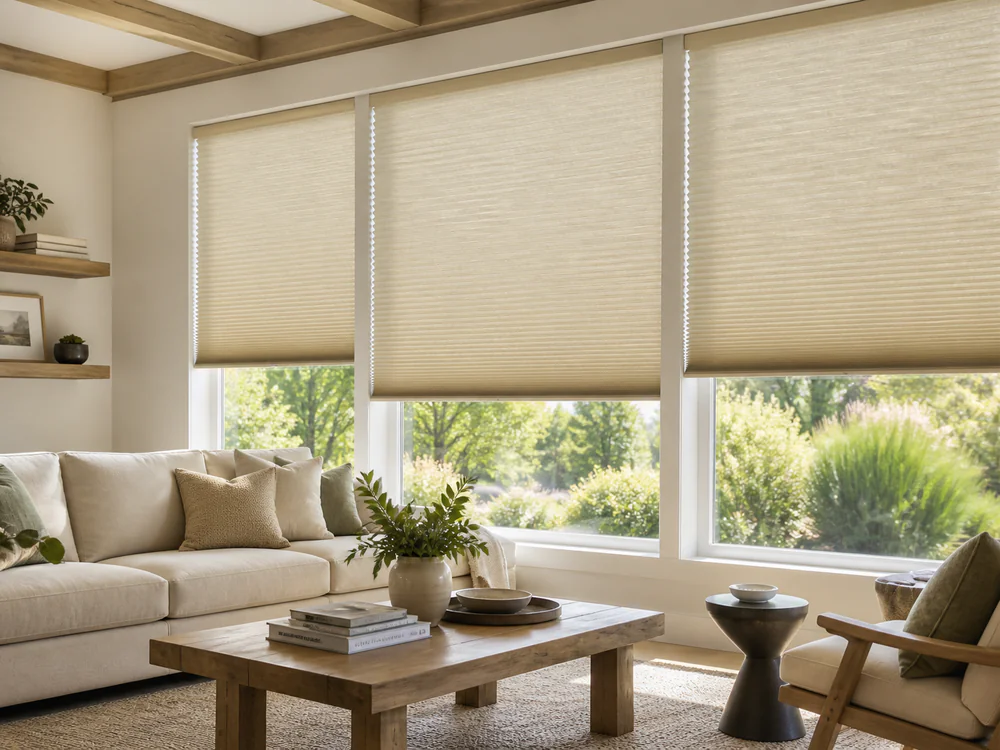
Cellular shades — sometimes called honeycomb shades — work by trapping air inside small pockets built into the fabric. That trapped air acts as insulation, slowing the transfer of heat between the window and the room. It’s the same principle as insulation in your walls, just applied to glass.
The performance difference between single-cell, double-cell, and triple-cell construction is significant. Double-cell shades reach R-values of 3.0 to 3.5. Triple-cell shades push up to 4.0 — the highest R-value available in any window covering on the market.
For context, a standard single-pane window has an R-value of about 1. Even a good double-pane window sits around 2 to 3. Adding triple-cell shades on top of that makes a measurable difference in how hard your AC has to work.
The Department of Energy identifies insulated cellular shades as the top-performing window covering for energy efficiency. In Tarrant County, where you’re running the AC from April through October — sometimes longer — cellular shades can reduce cooling costs by up to 40 percent. That’s not a marketing number. That’s what the data shows when the shades are properly fitted with minimal gaps at the edges.
One thing worth knowing: the R-value rating on a cellular shade assumes a proper fit. If there are gaps along the sides or top, warm air bypasses the shade entirely and the thermal barrier breaks down. This is why professional measurement and installation matters more than most people realize. A shade that fits perfectly performs like it’s rated. One that doesn’t can underperform significantly.
Here’s something most window covering guides won’t tell you: interior shades, no matter how good they are, are fighting the heat after it’s already entered your home. The solar energy passes through the glass, heats the air inside the shade pocket, and some of that heat still radiates into the room. You’re managing the problem, not stopping it at the source.
Exterior roller shades stop the heat before it hits the glass. That’s a fundamentally different approach, and the performance difference is real. By blocking solar radiation on the outside of the window, exterior shades reduce the heat load entering your home by a significantly higher margin than any interior solution can match.
In Tarrant County, this matters most for west- and southwest-facing windows — which is exactly the configuration you’ll find in a large number of newer subdivisions in Mansfield, Burleson, Crowley, and the Alliance corridor. Those homes were designed with generous windows and sliding glass doors to bring in natural light. From April through October, those same windows become heat sources that your AC can’t fully compensate for.
Exterior roller shades also solve a problem that doesn’t get talked about enough: the covered patio that becomes unusable by noon. If you’ve got an outdoor living space — a covered patio, a pergola, a back porch — and you can’t use it during the hottest part of the day, exterior shades extend those hours without sacrificing your ability to open everything up on a cool evening. That’s a quality-of-life improvement that goes well beyond the energy savings.
We offer both interior and exterior roller shades for residential and commercial clients throughout Tarrant County — which means you can address every window in your home, including the ones that face the afternoon sun, with a single provider.
Cost is one of the first questions people ask, and it’s a fair one. The range is wide because the options are wide — from basic blinds to motorized cellular shades to custom exterior roller systems. What’s worth understanding upfront is that in a market like Tarrant County, with a cooling season that runs nearly six months, the energy savings from a higher-performing product often close the gap faster than you’d expect.
The average cost of window treatments runs from $30 to $600 per window depending on the product type and whether installation is included. For a full home project, most homeowners land somewhere between $167 and $1,874, with an average around $1,020. Those are wide ranges, but they give you a realistic starting point before you start getting quotes.
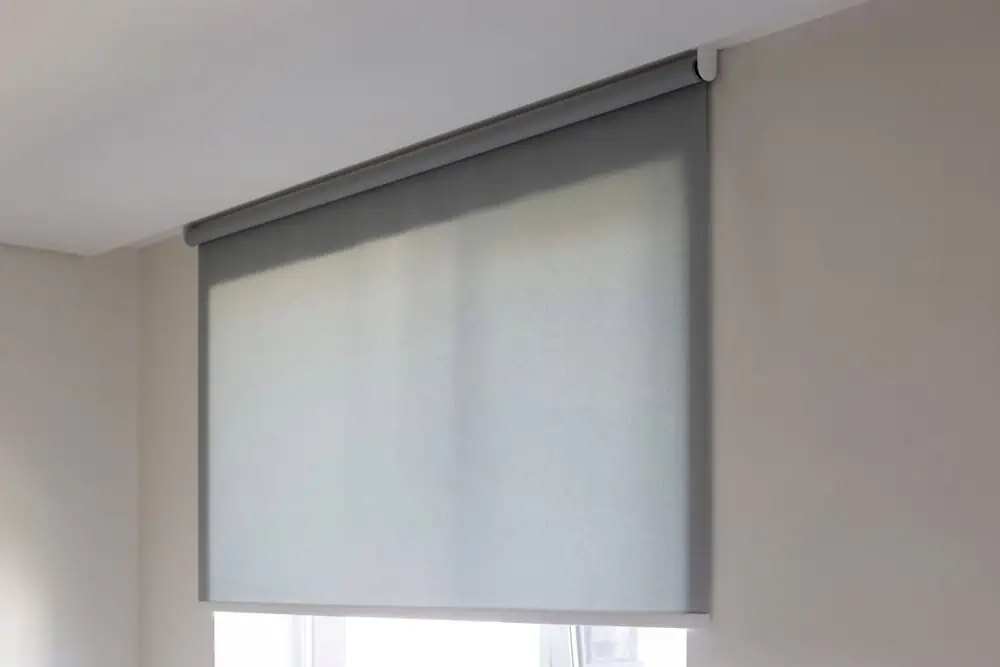
Blinds and shades are not the same thing, and the distinction matters more than most buyers realize — especially when energy efficiency is the goal. Blinds are made with slats that tilt open or closed. Shades are made from a single piece of material that raises or lowers. That structural difference is exactly why shades outperform blinds for thermal insulation.
Standard horizontal blinds, even when fully closed, leave gaps between the slats where air and radiant heat move freely. There’s no air pocket, no sealed barrier, no meaningful R-value. They’re useful for light control. They’re not useful for keeping your room cool.
Shades — particularly cellular construction — create a continuous barrier across the window surface. When fitted properly, they significantly reduce both radiant heat gain and convective heat transfer. The performance gap between a quality cellular shade and a set of standard blinds is not subtle.
On the cost side: blind installation typically runs $30 to $50 per blind, with a full installation project ranging from $180 to $300. Standard window shades run $60 to $600 per window. Motorized shades — which allow you to schedule your shades to close automatically during peak heat hours — run $350 to $1,000 per window. For a west-facing living room that bakes every afternoon, the motorized option pays for itself in comfort alone, independent of the energy savings.
Plantation shutters sit in their own category. They run $150 to $800 per window installed, depending on material — vinyl, faux wood, or premium wood. They’re the only window covering that actively works for both cooling and heating efficiency, with adjustable louvers that let you control light and airflow year-round. Wood shutters carry R-values of 2.0 to 2.5 and are built to last 15 to 20 years, which changes the math on what “expensive” actually means over time.
Solar shades are one of the most misunderstood products in the window covering category. People assume they’re just a tinted version of a regular roller shade. They’re not. Solar shades are engineered specifically to block solar heat gain while preserving your view — which is a different design goal than blocking light or creating privacy.
The key spec is the openness percentage. A 1% openness fabric blocks the most heat and UV radiation but gives you a more filtered view. A 3% openness fabric still provides excellent heat protection while allowing more visibility through the shade. For a living room or dining room where you want to keep the light without the heat, a 3% solar shade is often the right balance. For a west-facing window that gets direct afternoon sun, 1% gives you maximum protection.
In hot climates like Tarrant County, quality solar shades can reduce cooling costs by 15 to 25 percent. They also block UV radiation, which is what fades hardwood floors, area rugs, and leather furniture over time. That’s a secondary benefit, but for homeowners who’ve watched a wood floor fade unevenly across a sunlit room, it’s not a small one.
Solar shades work particularly well on windows where you don’t want to lose the view — a backyard, a street-facing window, a room that gets great natural light in the morning. They let the light in without the heat load that comes with it. For windows that need both privacy and insulation, cellular shades are still the stronger performer. But for view-preservation with meaningful heat reduction, solar shades are genuinely effective and often more affordable than buyers expect.
One thing to keep in mind: solar shades are an interior product. They manage heat after it enters the glass. For maximum performance on your worst-offending windows, exterior roller shades are still the higher-performing option. Many homeowners in Fort Worth, Arlington, and Southlake end up using a combination — solar shades on the windows where view matters, exterior rollers on the windows where heat is the primary problem.
The short version: cellular shades for maximum insulation, solar shades where you want to keep the view, and exterior roller shades for the windows that take the worst of the afternoon sun — or for a patio you actually want to use in July.
None of these decisions have to be complicated, but they do depend on your specific windows, your home’s orientation, and what you’re trying to solve. A west-facing wall of glass in Mansfield has different needs than a north-facing bedroom in Grapevine. Getting that match right is what separates a window covering that performs from one that just looks good.
If you’re ready to stop guessing and start with a clear recommendation for your home, A Plus Shutters & Shades offers free in-home consultations throughout Tarrant County. Reach out and we’ll come to you, measure what needs measuring, and tell you exactly what will work — and why.
Article details:
Share:
Continue learning: