Soft fabric, smart control, and no dangling cords — here's what motorized roman shades actually do for your home, room by room.
Share:
There’s a moment most Tarrant County homeowners know well — it’s early afternoon, the sun is hammering your west-facing windows, and you either forgot to close the shades or couldn’t be bothered to wrestle with the cord again. By 3 PM, your AC is working overtime and your living room is uninhabitable.
Motorized roman shades solve that problem without asking you to think about it. They close on a schedule, respond to your voice or your phone, and look genuinely good doing it. This guide covers how they work, which rooms benefit most, and what you should know before you invest.
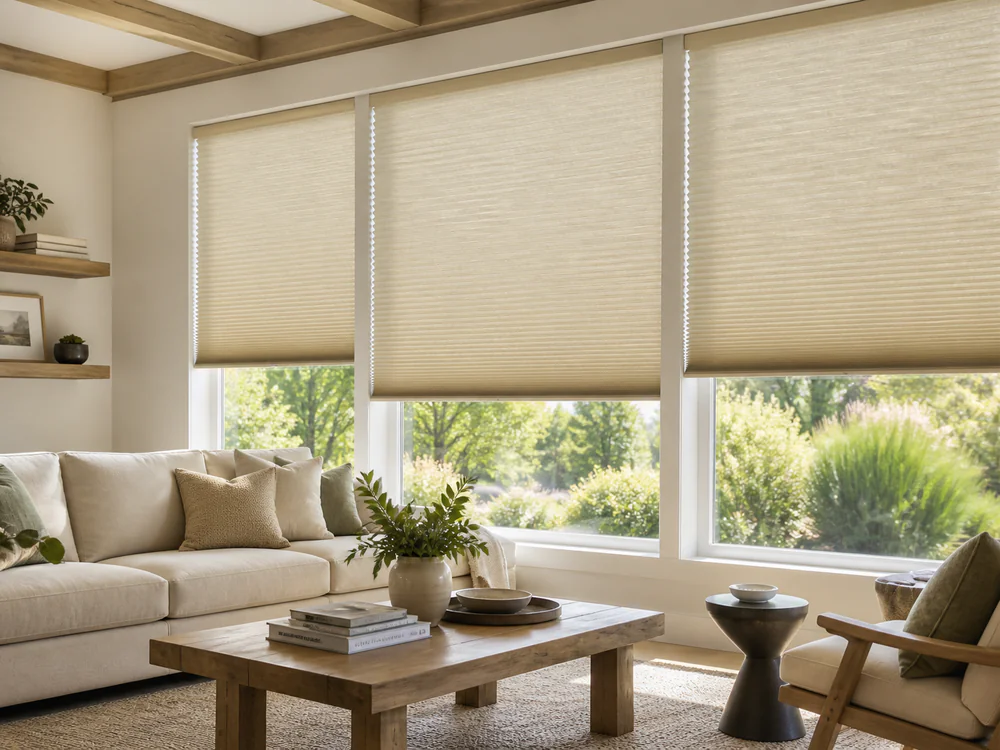
Roman shades are fabric window coverings that stack evenly as they raise, creating clean horizontal folds rather than the slat-and-cord look of traditional blinds. They’ve always been a popular choice for homeowners who want something softer and more refined than standard horizontal blinds without going full drapery.
Motorization changes the equation because it removes the one thing that makes any window treatment annoying to live with — the manual part. Instead of pulling a cord or lifting a shade by hand every time the light shifts, you set a schedule, tap your phone, or say a word to your smart speaker. The shade does the rest.
For custom roman shades specifically, motorization also opens up options that aren’t practical otherwise — hard-to-reach windows, grouped shades that move together, and automation tied to the time of day or your daily routine.

The motor sits inside the headrail at the top of the shade — you don’t see it, and it doesn’t change how the shade looks from the front. When you trigger it, the motor winds or unwinds the lift system, raising or lowering the fabric in smooth, even increments.
Most motorized roman shades run on one of three power setups. Rechargeable battery motors are the most common for retrofit installs — no wiring required, and a charge typically lasts several months depending on how often you operate the shade. Plug-in motors work well when there’s an outlet nearby and you don’t mind a low-profile cord running to the wall. Hardwired motors are the cleanest option aesthetically, but they require electrical rough-in work, which makes them best suited for new construction or a remodel — something that’s increasingly relevant in Tarrant County’s active new-build market.
Control options vary, but the most useful setups for most homeowners are app control from a smartphone, a handheld remote, voice commands through Alexa, Google Home, Apple HomeKit, or SmartThings, and scheduled automation. That last one is where things get genuinely practical for this part of Texas. You can program your shades to close at 1:45 PM before the afternoon heat peaks, then reopen in the early evening when the sun drops below your roofline. You don’t have to be home for it to work. You don’t have to remember. The shade just closes.
One thing worth understanding: a motorized roman shade is only as good as its installation. The motor needs to be properly commissioned, the smart home pairing needs to be set up correctly, and the mounting has to be precise enough that the fabric folds evenly every single time. That’s not a job that goes well when you’re following a YouTube tutorial on a Saturday afternoon — it’s the kind of thing that benefits from someone who’s done it hundreds of times.
This is the question most people are quietly thinking but don’t always ask out loud. The concern makes sense — you’re adding a motor to something that used to be purely mechanical, and motors can fail.
The honest answer is that quality motorized shade motors are built for exactly this application. They’re tested through thousands of operating cycles before they’re released, and a well-specified motor from a reputable manufacturer is designed to last five to ten years or longer under normal residential use. That’s not a marketing claim — it’s the engineering standard the industry has settled on after years of refinement.
The failure point, when it does happen, is almost never the motor itself. It’s usually a commissioning issue — the motor wasn’t set up correctly, the travel limits weren’t calibrated, or the smart home pairing was done sloppily. That’s why installation matters as much as the hardware. A shade that’s been properly installed and programmed will run reliably for years. One that was rushed through setup will give you problems within months.
There’s also a safety angle here that’s worth naming directly. Traditional roman shades with lift cords carry a documented hazard for young children and pets — dangling cords are the specific concern, and the window covering industry has been moving away from them for years. Motorized roman shades eliminate that problem entirely. There’s no cord to grab, no loop to get caught in. For households with kids or animals, that’s a meaningful reason to choose motorized over manual.
Kitchens are one of the most common rooms where homeowners want roman shades and one of the most common rooms where the wrong choice creates problems. The kitchen environment is different — there’s humidity from cooking, grease in the air, and windows that often sit directly above a sink or countertop where you can’t easily reach a manual shade.
Motorization solves the reach problem immediately. When your hands are wet or you’re mid-recipe, you’re not stopping to pull a cord. A voice command or a scheduled close handles it. The fabric choice matters just as much, though — kitchen roman shades need to be moisture-resistant and easy to wipe down, which means the delicate linen that looks beautiful in a living room is probably the wrong call here.

In Tarrant County’s climate, fabric durability is a real consideration in every room, but the kitchen amplifies it. You’re dealing with heat from cooking, steam, and the kind of casual daily contact that shows wear on anything that isn’t built for it.
Polyester and polyester-linen blends tend to hold up best in kitchen environments. They resist moisture, they don’t absorb odors the way natural fibers can, and they’re significantly easier to spot-clean. Pure linen is beautiful but it can warp in high-humidity conditions and it shows stains more readily. Woven wood shades are popular for their look, but they’re not ideal for kitchens for the same reason — natural materials and consistent moisture exposure are a bad combination over time.
For opacity, most kitchen roman shades work best in a light-filtering fabric rather than blackout. You want to diffuse the direct sun without losing the natural light that makes a kitchen feel open and workable. If your kitchen faces west — which is common in Tarrant County neighborhoods where homes are oriented toward the street — a light-filtering fabric that blocks UV while still letting ambient light through is usually the right balance.
The motorization layer matters here specifically because kitchens are high-traffic, high-distraction spaces. Having the shades on a schedule means you’re not adding “close the kitchen shades” to the mental checklist you’re already running while cooking, helping kids with homework, or managing the end-of-day chaos that most households know well. It just happens.
The bedroom use case for motorized roman shades is different from every other room in the house. Here, the priorities are darkness, quiet, and the ability to automate around your sleep schedule rather than the sun’s schedule.
Blackout roman shades for bedrooms are exactly what they sound like — fabric with a blackout liner that blocks light almost completely when the shade is down. In Tarrant County, where summer mornings get bright early and the sun doesn’t care about your weekend sleep schedule, this matters. A blackout roman shade in a bedroom gives you genuine darkness at 6 AM in July, which is something a light-filtering shade simply can’t do.
The motorization angle in a bedroom is particularly useful for two reasons. First, you can set a morning schedule — shades open gradually at whatever time you want, which is a gentler way to wake up than an alarm alone. Second, if you share a bedroom with someone on a different schedule, one person can operate the shades from their phone without getting up, without making noise, and without disturbing the other person. Modern motors are quiet — not silent, but quiet enough that operating a shade in a bedroom at night isn’t going to wake anyone.
For bedrooms with multiple windows, the grouping function is worth understanding. You can set all the bedroom shades to move together as a single group, so one tap closes everything at once. For master bedrooms in larger Tarrant County homes — the kind with bay windows, multiple exposures, or a sitting area with its own windows — this is genuinely useful rather than just a novelty.
The one thing to verify before committing to blackout roman shades in a bedroom is the mount type. Inside-mount shades sit inside the window frame and look clean, but they require at least three-quarters of an inch of frame depth to mount properly. If your windows are shallow — which is common in certain home styles throughout the Fort Worth and Arlington area — an outside mount may be the better fit, positioned above the frame to cover the full window opening without light gaps at the edges. Getting this right during the measurement phase is the difference between a shade that performs as expected and one that lets in light strips along both sides every morning.
Motorized roman shades aren’t a complicated upgrade — they’re a practical one. For Tarrant County homeowners dealing with intense afternoon sun, hard-to-reach windows, young kids, or just the daily friction of managing window treatments by hand, the case for automation is straightforward. You get better light control, real energy management, no cord hazards, and a window treatment that actually looks the way it should.
The room-by-room details matter, though. Kitchen fabrics are different from bedroom fabrics. Blackout liners work in bedrooms and not in kitchens. Inside mounts require frame depth that not every window has. Getting those details right from the start is what separates a window treatment you love from one you tolerate.
If you’re in Tarrant County and you’re ready to figure out what the right setup looks like for your specific home, A Plus Shutters & Shades offers free consultations — no pressure, just a real conversation about what will actually work in your space.
Article details:
Share:
Continue learning: