Arched windows, half-rounds, bay windows — standard treatments don't cut it. Here's what actually works, and how to get it done right in Tarrant County.
Share:
If you’ve ever tried to cover an arched window with a standard blind or shade, you already know the problem. The treatment either squares off the opening and hides the arch entirely, or it leaves gaps that defeat the purpose of having a window covering at all. Neither option is great when you spent good money on a home with architectural character worth keeping.
The good news is that custom shutter blinds are built specifically for this situation. And if you’re in Tarrant County, TX — where arched transoms, half-round windows, and oversized specialty shapes are common in everything from Southlake custom builds to older Arlington homes — there are real solutions available locally. Here’s what you need to know.
“Shutter blinds” is a term people use to describe interior plantation-style shutters — the kind with adjustable louvers set inside a solid frame. Unlike fabric shades or horizontal blinds, they’re built as a structural panel that mounts directly to your window frame. That distinction matters more than most people realize.
Standard blinds and shades are manufactured in set sizes and rely on tracks, rollers, or tension systems that only work in rectangular openings. Custom shutter blinds, by contrast, are fabricated from scratch to match the exact dimensions and shape of your specific window — curve, angle, and all. That’s not a marketing phrase. It’s a fundamentally different manufacturing process.
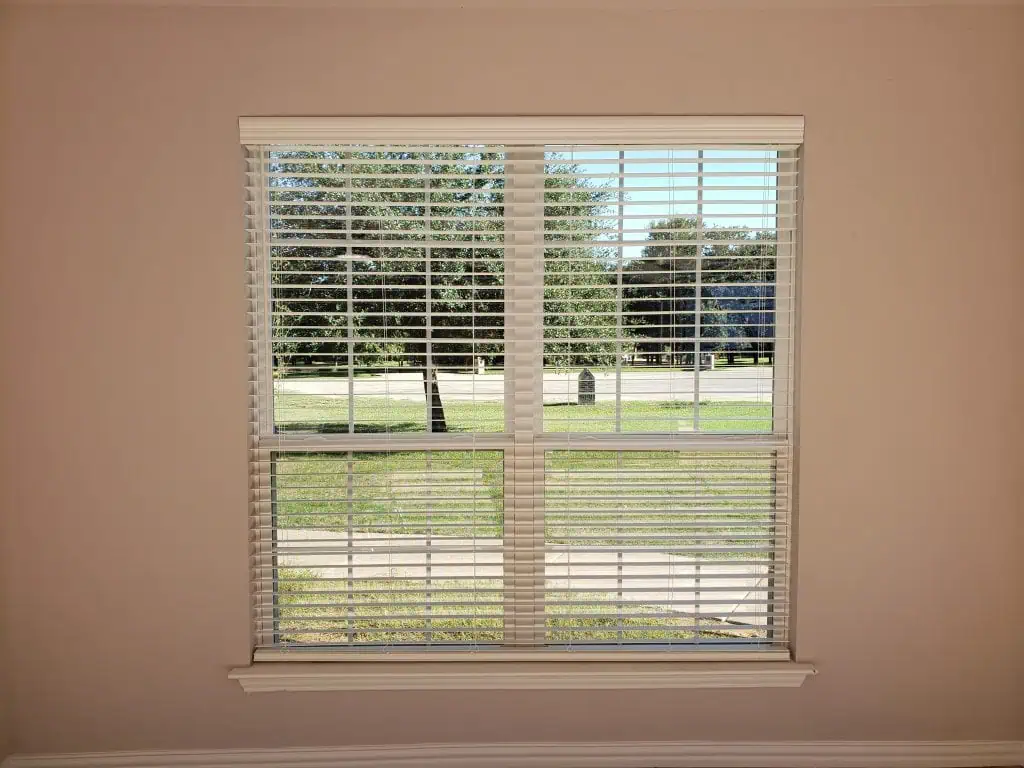
Here’s the honest version of what happens when you try to force a standard window treatment onto an arched window. A roller shade pulled down to the sill covers the arch, but the curved portion above the shade is now either bare glass or awkwardly draped fabric. A standard blind hangs inside the rectangular portion of the opening and leaves the arch exposed, which solves nothing if your goal is privacy or light control. Curtains and drapes can be hung wide enough to cover the whole wall, but then you’ve effectively eliminated the window as a design feature.
Custom shutters for arched windows take a completely different approach. The shutter panel is fabricated to mirror the shape of the arch itself — the frame follows the curve, the louvers fill the opening, and the result looks like the shutters were always meant to be there. Because they were built to be.
There are two main design approaches depending on your window. The first is to “isolate the arch” — rectangular operable shutters cover the lower portion of the window, and a fixed decorative panel fills the arch above. This is the more common and cost-effective approach, and it works beautifully in most homes. The second is a fully framed arch shutter, where the entire opening — curve included — is enclosed within a single custom frame with operable louvers throughout. This is the premium option and requires more precise fabrication, but it gives you full light control over the entire window.
The right choice depends on the size of the arch, how much light control you need in the curved portion, and your budget. In practice, most homeowners with standard half-round transoms above a rectangular window are well-served by the isolated approach. Larger, more prominent arches — the kind you’d find in a Southlake entryway or a high-ceiling great room in a newer Fort Worth build — often benefit from the fully framed option.
What matters most is that whoever fabricates your shutters actually measures the arch accurately. A curve that’s off by even a small margin creates a visible gap at the top of the frame. That’s not a minor cosmetic issue — it lets in light, reduces insulation value, and looks wrong every time you walk past it.
Half-round windows — the semicircular windows you often see above a front door or at the top of a tall window — are one of the most common specialty shapes in Tarrant County homes. They’re especially popular in the Mediterranean-influenced and transitional-style homes that have gone up across Mansfield, Colleyville, and the southern Fort Worth corridor over the past two decades. They look great from the street. They’re a headache when you want privacy or need to block afternoon sun.
The standard solution for a half-round window is a sunburst or fan-style fixed panel — a custom-fabricated shutter piece where the louvers radiate outward from a central point, following the curve of the arch. These panels are typically fixed (non-operable), which is fine for most half-round applications because the window itself is usually fixed glass. The visual effect is clean, architectural, and consistent with the rest of the home if you’re also putting shutters on the rectangular windows below.
The key word in all of this is “fixed.” Because half-round panels don’t have movable louvers, they control light passively — they filter and diffuse rather than block completely. If your half-round window faces west in Arlington or Fort Worth, you already know what that afternoon sun feels like coming through unfiltered glass. A properly fitted sunburst panel won’t eliminate all light, but it cuts the glare significantly and adds a layer of insulation that bare glass simply doesn’t provide.
Where things get complicated is when homeowners try to handle this themselves or hire someone who doesn’t regularly work with specialty shapes. Half-round windows look simple, but the geometry of fabricating a panel that actually fills the opening — without gaps at the edges or a frame that doesn’t quite follow the curve — requires precise measurement and experience with non-rectangular fabrication. We’ve seen plenty of half-round installations done by less experienced installers where the panel sits slightly off-center or the frame doesn’t fully contact the window casing. It’s noticeable, and it’s not something you want after spending several hundred dollars per window.
Choosing the right material for your shutters matters as much as getting the shape right — maybe more so in North Texas. Tarrant County summers are not gentle. Temperatures push past 100°F from June through August, UV intensity is extreme, and the humidity swings between dry winters and wet spring seasons create real expansion and contraction cycles in wood-based products.
Standard wood blinds and lower-grade vinyl treatments often warp, fade, or crack within a few years in this environment. That’s not hypothetical — it’s a pattern we see regularly when homeowners come to us after replacing cheap treatments two or three times. The right material choice upfront saves money over time and looks better doing it.
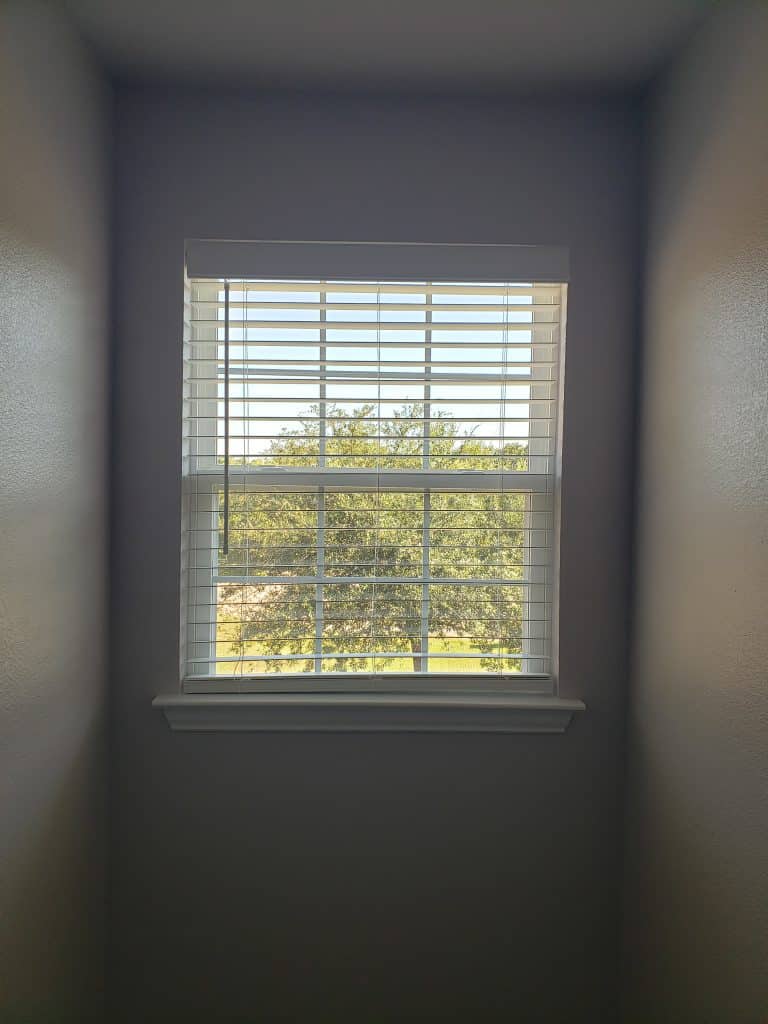
Solid wood shutters — typically basswood — are the premium aesthetic choice. They have warmth and grain character that composite materials don’t fully replicate, and they’re the right call in the right environment. In a climate-controlled room with consistent humidity, a quality wood shutter can last decades without issue.
In a Texas home, though, the calculus changes. Rooms with large west-facing windows, sunrooms, kitchens, and bathrooms all experience more dramatic temperature and humidity swings than the rest of the house. In those spaces, solid wood is a risk. Even well-finished wood shutters can develop gaps between louvers, warping in the frame, or sticking panels when the wood expands and contracts repeatedly over years of Texas summers.
Polywood and composite shutters are the industry-recommended alternative for high-stress environments, and they’re what we recommend for most Tarrant County homes. The material is engineered to resist moisture, UV exposure, and temperature extremes without the structural vulnerabilities of natural wood. It doesn’t warp. It doesn’t crack. It holds paint finishes exceptionally well, which matters when you’re investing in a custom color match for your interior. And it carries the same clean, architectural look that makes plantation shutters worth having in the first place.
For arched and specialty-shaped windows specifically, composite is often the better choice regardless of room placement. Custom-fabricated curved frames put more stress on the material than standard rectangular panels, and a composite frame holds its shape more reliably over time. That’s not a knock on wood — it’s just the practical reality of what these shapes demand.
Properly fitted window coverings can reduce solar heat gain by up to 77% in summer. In Tarrant County, where air conditioning is running hard for five or six months a year, that’s not a small number. A shutter that fits precisely — no gaps at the arch, no light leaking around the frame — performs significantly better than one that’s close but not quite right.
There’s a version of this where someone orders custom shutters online, measures their own arched window, and everything works out fine. It happens. But for specialty shapes — arches, half-rounds, bay windows, sliding glass doors — the margin for error is much smaller than it is for a standard rectangular window, and the consequences of getting it wrong are more expensive to fix.
Measuring an arched window accurately requires understanding the geometry of the curve, not just the width and height of the opening. The rise of the arch, the exact radius, and the depth of the window casing all affect how the frame is fabricated and how the panel will sit once installed. An off measurement on a standard window might mean a slightly loose fit. An off measurement on an arch means a panel that doesn’t close properly, a visible gap along the curve, or a frame that can’t be mounted flush to the casing.
Installation of heavy custom shutters — particularly fully framed arch panels — also requires knowledge of what’s behind your wall. Improper anchoring into drywall alone, without hitting the frame or casing correctly, is a real risk. We come from a construction background — A Plus Shutters & Shades is part of A Plus Home Remodel, with over a decade of construction work across Arlington, Fort Worth, Mansfield, and the surrounding Tarrant County area — and that matters in ways that are easy to overlook until something goes wrong.
Beyond fit and mounting, professional installation protects your investment in a practical sense. Many shutter manufacturers require professional installation to honor their warranty. A DIY installation or a subcontracted crew that wasn’t part of the original measurement and fabrication process can void that coverage. We measure, build, and install — the same team throughout — so there’s no gap in accountability between what was specified and what gets mounted.
For homeowners in newer construction areas like Mansfield or the western Fort Worth corridor, where custom home builders commonly spec arched transoms and specialty windows as standard features, getting the window treatments right from the start is worth doing once and doing well. For those in established Arlington or Grand Prairie neighborhoods upgrading older homes, the same applies — a properly installed custom shutter is a 50-year investment. It’s worth the extra step to have someone who knows what they’re doing handle it.
If your home has arched windows, half-round transoms, bay windows, or any opening that doesn’t fit a standard rectangle, the most important thing you can do before buying anything is talk to someone who actually specializes in these shapes — not someone who handles them occasionally as an afterthought.
The right installer will measure precisely, recommend the right material for your specific rooms and climate exposure, and walk you through the design options without pushing you toward the most expensive choice. That conversation should feel straightforward, not like a sales pitch.
We work with homeowners across Tarrant County — from Southlake and Colleyville to Arlington, Mansfield, and Fort Worth — specifically on the kinds of custom window treatment challenges that other companies often turn away. If you’re ready to stop settling for window treatments that almost fit, reach out and schedule a free in-home consultation. No pressure, no middleman — just a direct conversation about what your windows actually need.
Article details:
Share:
Continue learning: