Sliding glass doors need more than a standard blind. Here's what actually works — and why motorized roller shades are the go-to for Tarrant County homeowners.
Share:

If you’ve got a sliding glass door, you already know the problem. The vertical blinds that came with the house are either broken, tangled, or just embarrassing at this point. You can’t reach the cord without moving the couch. And every afternoon from about 1 PM onward, the sun turns your living room into something you want to leave rather than relax in.
Motorized blinds for sliding glass doors solve all of that — but not all systems are built the same, and sliding glass doors have specific demands that most off-the-shelf products weren’t designed to handle. Here’s what you actually need to know before making a decision.
A sliding glass door isn’t just a big window. It’s the most-used opening in most homes — operated multiple times a day, every day, by everyone in the household. That daily friction is exactly why the treatment you put on it matters more than anywhere else.
Standard blinds are engineered for fixed windows at moderate widths. Sliding glass doors typically run 60 to 96 inches wide, sometimes wider, and they need to stack completely clear of the opening when the door is in use. A treatment that looks fine closed but blocks the door track when open isn’t a solution — it’s a new problem. That’s the first thing to get right before anything else.

Vertical blinds became the default for sliding glass doors decades ago, and they’ve been frustrating homeowners ever since. The vanes snap off, the wand gets lost behind furniture, and even when everything is working, the look is dated and the light control is inconsistent. Most people replacing their sliding door treatment are replacing vertical blinds — and they’re not going back.
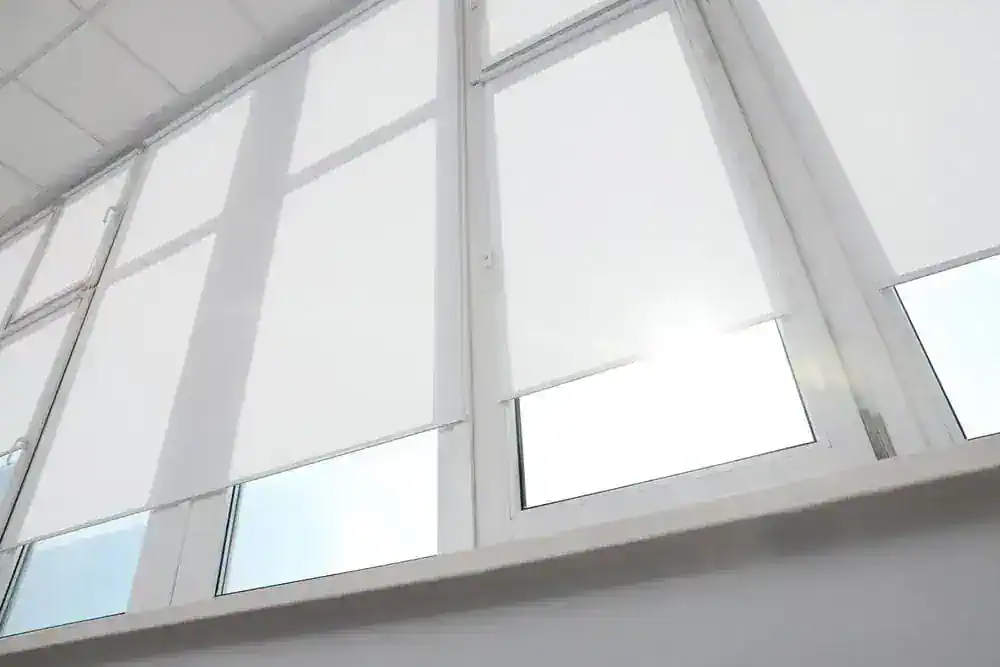
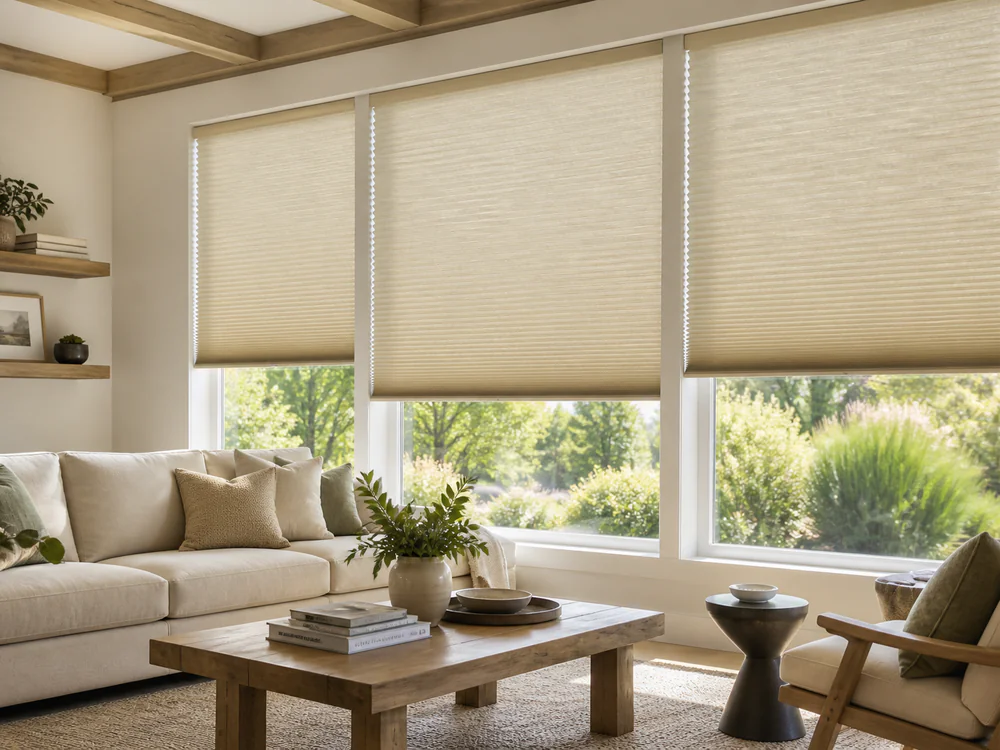
Motorized roller shades have become the leading choice for good reason. They operate as a single, continuous panel that rolls up cleanly above the door when you want the opening clear. There are no individual slats to break, no cords to tangle, and no wand to reach for. You control them with a remote, a wall switch, or your phone — or you set a schedule and stop thinking about it entirely.
Panel track systems are another option worth knowing about, particularly for very wide openings or when you want a more architectural look. They work similarly to sliding glass doors themselves — panels that glide along a track — and they can be motorized as well. The right choice depends on your door configuration, how the room is used, and what you want the treatment to look like when it’s fully open.
What matters most for any sliding glass door treatment is that it’s measured panel by panel, not as one continuous span. Sliding glass door panels can vary slightly in size, and a treatment that’s measured correctly for each section fits and operates the way it should. This is one of the details that separates a professional installation from a DIY order that arrives and doesn’t quite work.
For Tarrant County homes — especially the newer construction in Mansfield, Keller, and the Alliance corridor — sliding glass doors to covered patios are essentially a standard feature. They’re wide, they’re used constantly, and they’re usually the last thing homeowners get around to covering properly after move-in. A motorized roller shade, custom-fabricated to the exact dimensions of your door, is the most practical long-term answer for that opening.
Here’s the scenario that comes up constantly with homeowners across Tarrant County: the living room faces west, the sliding glass door gets full afternoon sun from around 1 PM to sunset, and by 3 PM the room is uncomfortable enough that nobody wants to be in it. The fix seems obvious — close the blinds. But if you’re not home, you can’t. And if you are home, you forget, or the furniture makes it awkward to reach.
Motorized shades with smart home scheduling solve this without requiring any daily action. You set the shade to close at 1 PM and open again at 6 PM. The room manages itself. During a North Texas summer — which runs from May through September and regularly hits 100°F — that kind of automated solar management isn’t a luxury feature. It’s a practical response to conditions that genuinely affect how comfortable your home is and what your electricity bill looks like.
The scheduling works through whatever smart home platform you already use. Most motorized systems are compatible with Amazon Alexa, Google Home, and Apple HomeKit, so if you’ve already built out a smart home setup, motorized shades slot into it without requiring a separate hub or a new app to manage. You can also control them with a dedicated remote or a wall switch if you prefer to keep it simple — the smart home integration is there when you want it, not mandatory.
One thing worth knowing: battery-powered motorized systems are fully functional and don’t require any electrical work. If your sliding glass door doesn’t have an outlet nearby — which is common in older Tarrant County homes — that’s not a barrier. Battery-powered motors are rechargeable and can go months between charges under normal use. Hardwired systems are also available for new construction or when you’re doing a larger renovation and want a permanent solution.
When we install a motorized system with smart home integration, we program and test everything before we leave. You’re not handed a manual and a “good luck.” The shade connects, the schedule runs, and the voice commands work — or we stay until they do.
Most content about motorized blinds for sliding glass doors stops at the door itself. But in Tarrant County, the sliding glass door is rarely just a window — it’s the entry point to a covered patio, pergola, or outdoor kitchen that homeowners have invested real money in. Treating the door without addressing the patio leaves the job half done.
We’re one of the few local providers in Tarrant County who handle both sides of that transition: motorized roller shades for the interior sliding glass door and motorized exterior shades for the patio or covered outdoor area. One consultation, one installation, one system that manages light and heat from the inside out.
Exterior motorized shades work differently from interior ones — they’re built to handle direct sun, wind, and weather, and they block solar heat before it ever reaches the glass. For a covered patio that gets afternoon sun in Fort Worth, Arlington, or anywhere across Tarrant County, a motorized exterior shade can make the difference between a space you actually use and one that sits empty from June through August.
The fabric choices for outdoor motorized shades are built around solar performance. Openness factor — how tightly the fabric is woven — determines how much light and heat gets through. A more open weave lets in more light and preserves your view while still cutting UV exposure and reducing heat. A tighter weave blocks more aggressively and gives you more privacy. The right choice depends on which direction your patio faces and how much direct sun it gets at peak hours.
For west-facing patios in communities like Grand Prairie, Mansfield, or North Richland Hills, afternoon sun exposure is intense and sustained. A motorized exterior shade that closes automatically at 1 PM and opens in the evening lets you use the patio on your schedule rather than the sun’s. And because it’s motorized, it takes no more effort than tapping your phone or asking your smart speaker.
Exterior motorized shades also serve a practical function for homeowners in HOA communities — which cover a significant portion of Tarrant County, particularly in Southlake, Keller, and Colleyville. HOAs in these areas frequently regulate exterior-facing window treatment colors and materials. Working with us, a local provider who understands those requirements, means you get a shade that looks right from the street and meets your HOA’s standards, not one you have to replace after the next community inspection.
Off-the-shelf outdoor shades exist, and they’re fine for a standard-size opening where precision doesn’t matter much. A covered patio in a Tarrant County home is rarely that simple. You might have a 14-foot wide opening, a pergola with irregular posts, or a covered area that wraps around a corner. Standard retail shades leave light gaps, fit poorly, and tend to fail faster because they’re not built for the specific conditions of your space.
Custom outdoor roller shades are fabricated to the exact dimensions of your opening — width, height, and mounting configuration. The motor is sized for the shade, not selected from a one-size-fits-most catalog. The fabric is chosen based on your actual exposure, not a generic recommendation. That specificity is what makes a custom shade last and perform the way it’s supposed to.
We source Texas-made products and fabricate every shade to the measurements we take on-site. That means we’re not guessing at your dimensions or hoping a standard size is close enough. We measure, we order, and we install — and the result fits your specific opening the way a custom product should.
The other thing that matters with outdoor motorized shades is the motor’s weather resistance. Exterior motors are built to handle the temperature swings and humidity that come with a Texas climate. A motor spec’d for an interior shade isn’t built for the same conditions. This is the kind of detail that’s easy to overlook when ordering online and easy to get right when you’re working with someone who installs both types regularly.
For homeowners who are investing in an outdoor living space — a covered patio, an outdoor kitchen, a pergola — motorized exterior shades are the finishing element that makes the space usable year-round. They manage the sun, extend the hours you can be outside, and integrate with the same smart home system controlling your interior shades. It’s a complete solution for the whole transition zone, not just the door.
The right motorized blind for a sliding glass door comes down to three things: a precise fit for your specific door, a motor system that integrates with how you actually live, and fabric that performs in your home’s real sun exposure — not a generic recommendation.
For most Tarrant County homeowners, that means a custom-fabricated motorized roller shade, battery-powered or hardwired depending on your setup, connected to whatever smart home platform you’re already using, and scheduled to manage your west- or south-facing exposure automatically. For homes with covered patios, it means extending that same thinking to the outdoor space beyond the door.
If you’re ready to stop wrestling with vertical blinds or just want to understand what your options actually look like in your specific space, A Plus Shutters & Shades offers free in-home consultations throughout Tarrant County. We bring samples, take measurements, and make sure you know exactly what you’re getting before anything is ordered.
Article details:
Share:
Continue learning: