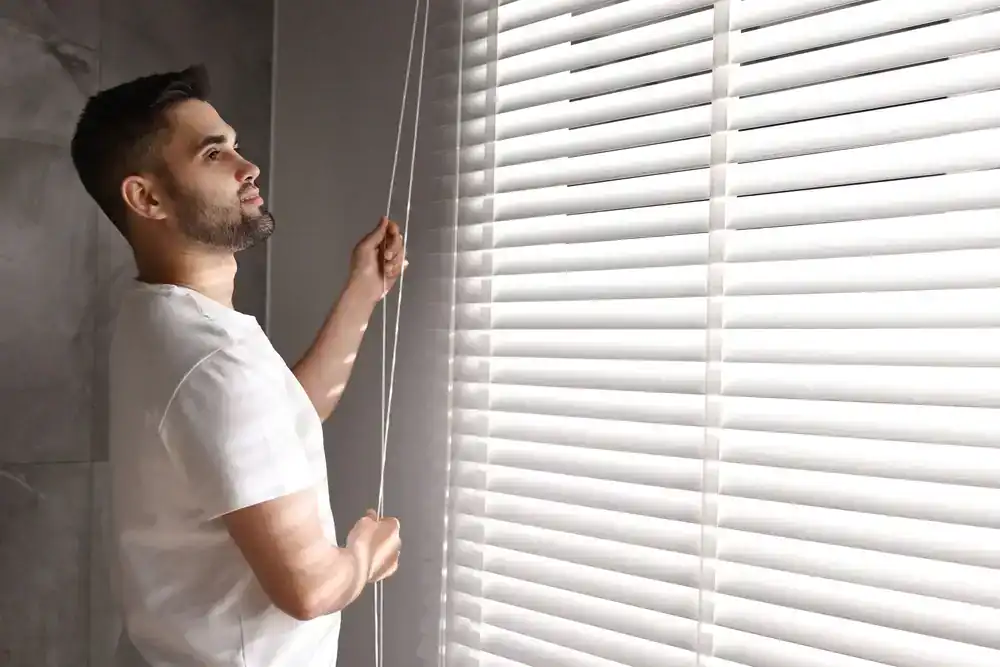
Interior designers in DFW don't choose window treatments by accident. Here's the logic behind their decisions — and how you can use it.
Share:

Most homeowners pick window treatments by walking into a store and guessing. Designers don’t. They think about light direction, room function, fabric opacity, and how a treatment will hold up in a west-facing room in July. The result is almost always better — and it doesn’t require hiring a designer to get there. Understanding how DFW design professionals think about custom blinds and shades gives you a real advantage, whether you’re furnishing a new home in Mansfield, upgrading an older house in the Mid-Cities, or trying to make a sun-drenched living room in Arlington actually usable again.
The first thing a designer does when specifying window treatments isn’t open a catalog. It’s look at the windows themselves — which direction they face, how much natural light they get, and what the room needs to do.
A bedroom in Southlake that gets morning sun needs a different solution than a living room in Fort Worth’s Cultural District that bakes in afternoon heat. Function comes before aesthetics, even for the most design-forward professionals.
From there, the conversation moves to light control and privacy. How much does the homeowner want filtered versus blocked? Do they want to see out during the day without being seen from the street? Those answers narrow the field quickly — from roller shades to plantation shutters to layered treatments — before color or style even enters the picture.
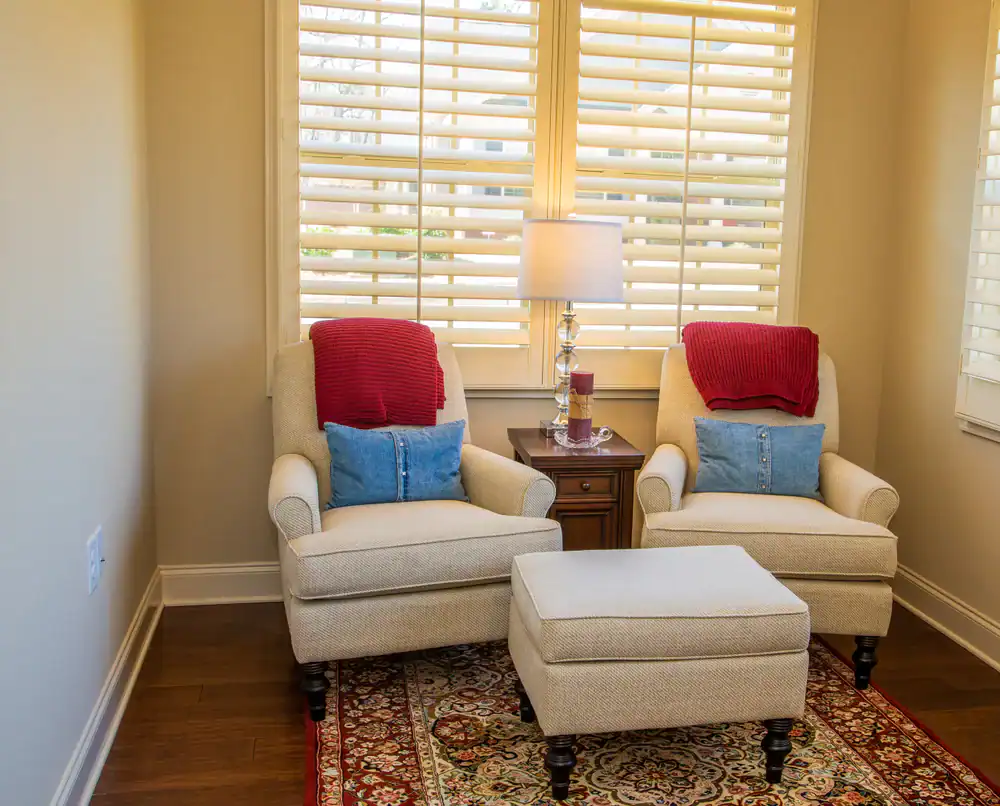
It’s not snobbery. It’s math. Off-the-shelf blinds are sized to fit the most common window dimensions, which means they almost never fit correctly in homes with non-standard windows — and Tarrant County has plenty of those.
Older homes in the HEB corridor (Hurst, Euless, Bedford) often have windows that are slightly out of square. Newer builds in Mansfield or Keller frequently include specialty shapes: arched tops, oversized picture windows, angled frames in vaulted ceilings. A stock blind from a big-box retailer doesn’t account for any of that.
Beyond fit, there’s the durability question. Designers who have watched a client’s home evolve over five or ten years know that cheap treatments fade, warp, and fail faster than their price tag suggests. The cord mechanisms strip. The slats crack. In a Texas climate that swings from 100°F summers to freezing winter nights, materials that weren’t built for that range show it quickly. Custom window treatments are made to the exact dimensions of each window, from materials selected for the specific demands of the space — which is why they tend to outlast their off-the-shelf counterparts by years.
There’s also the UV factor, which is hard to overstate in North Texas. With more than 230 sunny days per year and afternoon sun hitting west-facing rooms with full, unobstructed intensity, window treatments aren’t just a design choice — they’re a protective layer. Designers working on Tarrant County homes regularly specify solar shades and UV-blocking treatments not because they look good (though they do), but because hardwood floors, upholstered furniture, and artwork start fading noticeably within a few years without adequate protection.
When a designer recommends a local custom installer over a retail chain, they’re not adding complexity to the process. They’re removing the risk of a costly mistake — wrong size, wrong material, wrong fit — that the homeowner would eventually have to fix anyway.
It depends heavily on the home’s architecture and the room’s function, but a few treatments come up consistently in Tarrant County design projects.
Plantation shutters are a perennial recommendation for living rooms and bedrooms in traditional and transitional-style homes — they offer precise light control, hold up well over time, and photograph beautifully, which matters for clients who plan to sell eventually. Fort Worth’s blend of traditional ranch homes, craftsman bungalows, and newer suburban builds makes shutters a versatile fit across a wide range of aesthetics.
Roller shades — particularly solar shades — are increasingly the go-to for modern and contemporary interiors, and for any room with significant sun exposure. They’re clean, minimal, and highly functional. A well-specified solar shade can reduce heat gain substantially while still preserving an outdoor view, which is a meaningful quality-of-life improvement in a room that gets afternoon sun. Designers working on homes near the Stockyards or in older Fort Worth neighborhoods often layer roller shades behind drapery panels to get both light control and a softer, more layered look.
For bedrooms, blackout options — whether roller shades or cellular shades — are almost always in the conversation. Cellular (honeycomb) shades also offer meaningful insulation value, which is relevant in a market where summer cooling costs are a real concern. Motorized treatments are becoming a more common recommendation as well, particularly in higher-end projects in Southlake and Keller. The ability to program shades to close automatically during peak afternoon heat hours — reducing heat gain by a significant margin — is no longer a novelty. It’s a practical energy management tool that we’re increasingly comfortable specifying.
What’s less common in designer recommendations: faux wood blinds for primary living spaces (they’re practical, but limited aesthetically), and anything that requires the homeowner to measure and install themselves. Precision matters too much.
One of the most common points of confusion for homeowners working on a larger design project is understanding who does what. If you’re working with an interior designer, do they handle the window treatments? Do you find your own installer? Who measures, who orders, who installs, and who warranties the product if something goes wrong?
The honest answer is that it varies — but the most functional arrangement is one where the designer specifies and the installer executes. A good local installer becomes an extension of the designer’s vision, not a separate contractor the homeowner has to manage independently.
The coordination process is simpler than most homeowners expect, once you understand the roles. A designer typically handles the creative specification: what style of treatment, what material, what opacity level, what finish or color. They’re making decisions based on the room’s overall design direction, the client’s lifestyle, and their knowledge of what performs well in a given space.
What they’re not always set up to do is take precise field measurements, manage fabrication timelines, and handle the physical installation. That’s where a local specialist comes in.
A quality custom installer measures every window on-site — not relying on the homeowner’s dimensions or the designer’s estimates — because even a quarter-inch error can mean a treatment that doesn’t seat correctly in the frame. They manage the order, handle the fabrication timeline, and do the installation themselves. If something isn’t right, they’re accountable for fixing it.
The best outcomes happen when the designer and installer have an established working relationship. The designer knows the installer’s capabilities — including whether they can handle arched windows, exterior applications, or motorized systems — and the installer understands the designer’s standards. For homeowners in Tarrant County who are mid-project and trying to figure out how to bridge that gap, the practical advice is simple: ask your designer if they have a preferred local installer, and if they don’t, find an installer who has experience working alongside designers and can speak the same language.
What makes that relationship work on the installer side is construction-level expertise. A team that has spent years working on residential and commercial projects understands structural nuances — how to work in older homes with irregular window frames, how to handle the bay windows common in newer Southlake builds, how to install exterior roller shades on a covered patio without compromising the structure. That’s a different skill set than hanging a stock blind from a bracket.
**How much do custom blinds and shades cost in Tarrant County?** Custom roller shades in Tarrant County typically range from $150 to $500 per window, depending on the material and complexity. Motorized systems, specialty shapes, and exterior-grade treatments will be toward the higher end of that range. Plantation shutters and cellular shades cost more upfront but last significantly longer than big-box alternatives. The better question is how that compares to replacing cheap treatments every few years — which most homeowners who’ve gone the big-box route have already done at least once.
**What are the best window treatments for west-facing rooms in North Texas?** This is one of the most common questions we hear from Tarrant County homeowners, and for good reason. West-facing rooms in this part of Texas get unobstructed afternoon sun for hours during the summer — there’s no natural terrain to soften it. Solar shades are the most practical solution for rooms where you want to keep the view but cut the heat and glare. For rooms where you need full light control (a home office, a media room), a layered approach — solar shade plus a blackout option — gives you flexibility. Motorized shades that are programmed to close during peak afternoon hours can reduce heat gain significantly, which shows up directly in your cooling costs.
**Do I need an interior designer to get custom window treatments?** No. We can walk you through the options, bring samples to your home so you can see them in your actual space and lighting, take precise measurements, and guide you toward treatments that make sense for each room. The in-home consultation process is specifically designed to replace the guesswork that leads to buyer’s remorse. If you are working with a designer, a local custom installer is almost always the better execution partner than ordering through a national chain — the precision, the accountability, and the ability to handle anything unusual about your windows are all meaningfully better.
**How long does custom blind and shade installation take?** For most residential projects in Tarrant County, installation completes in a single day. The timeline from consultation to installation depends on fabrication — custom treatments are made to order, not pulled from a shelf — but the installation itself is typically a one-day process. That’s worth knowing if you’ve been putting off the project because you’re picturing a week of disruption.
**Can I get exterior roller shades for my patio or outdoor living space?** Yes, and in North Texas, it’s one of the most practical investments you can make in an outdoor space. Exterior roller shades block direct sun and radiant heat before it enters the structure, which makes covered patios and pergolas usable for a much larger portion of the year. We offer both interior and exterior roller shades — something not every local provider carries — and the installation process accounts for the structural requirements of an exterior application.
The way designers choose window treatments isn’t a secret formula. It’s a disciplined process: understand the room, understand the light, choose a product that solves the actual problem, and work with an installer who can execute it precisely. That process is available to any homeowner who wants to approach the decision the same way.
What makes the difference in Tarrant County specifically is finding a local installer who understands the climate, knows how to handle the full range of window configurations you’ll find across this market — from the older homes in the Mid-Cities to the newer builds in Mansfield and Burleson — and can be personally accountable for the outcome.
If you’re ready to stop guessing and start with a real conversation about what your home actually needs, A Plus Shutters & Shades is a good place to start. We bring samples to you, measure everything ourselves, and don’t finish anything until you’ve approved it.
Article details:
Share:
Continue learning: