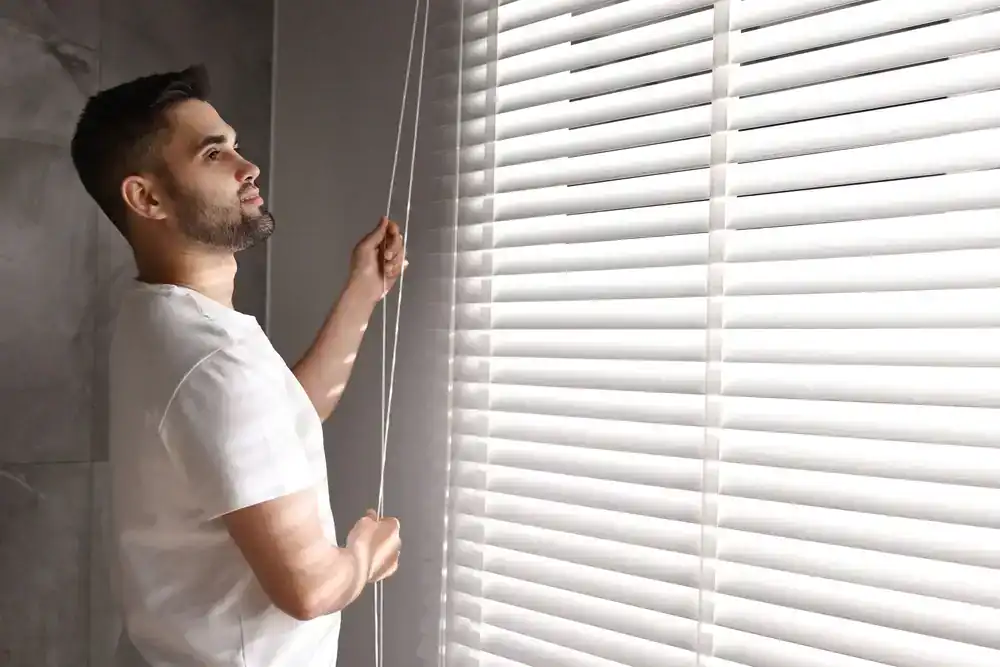
Just moved into a Tarrant County home and staring down 15 windows worth of decisions? Here's how to tackle them room by room.
Share:

You closed on your new Tarrant County home, got the keys, started unpacking — and then you noticed the blinds. Thin white slats that rattle when the AC kicks on, let in light from every angle, and somehow make a brand-new house feel unfinished. You’re not imagining it. Builder-grade blinds are a near-universal disappointment for new homeowners across Arlington, Fort Worth, Mansfield, and the rest of the Tarrant County area. The good news is you don’t have to figure out the solution all at once. Start room by room, with a clear sense of what each space actually needs, and the whole thing gets a lot more manageable.
Builder blinds aren’t designed to last. They’re designed to meet a minimum standard at the lowest possible cost so the builder can hand over a house that technically has window coverings. Most are made from lightweight vinyl, sized to approximate fit rather than exact fit, and installed with the kind of speed that prioritizes volume over quality. In a market like Tarrant County — where new construction has been booming for years — this is the starting point for a lot of new homeowners.
The problem isn’t just cosmetic. North Texas gets around 229 sunny days a year, and the summer sun here is relentless. A west-facing living room window with a cheap vinyl blind isn’t blocking much of anything. You’re still getting the glare, the heat, and the UV exposure that fades furniture and flooring over time. What you need in a Tarrant County home is coverage that actually matches the climate — not something that came bundled with the house because it had to.

The word “custom” gets used loosely in this industry, so it’s worth being specific about what it means in practice. Custom window treatment installation starts with professional measurement — and that single step eliminates the most common and most frustrating mistake people run into when they try to handle this themselves.
Here’s what most homeowners don’t realize: windows in newer homes, especially homes built on North Texas clay soil, are rarely perfectly square. The expansive clay that runs through much of Tarrant County swells when it rains and contracts in dry heat. Over time, that movement shifts foundations and frames — sometimes subtly, sometimes not so subtly. A window that looks perfectly rectangular to the eye might be off by a meaningful fraction of an inch. If you order a treatment based on a quick tape measure reading without accounting for that, you end up with something that doesn’t sit flush, doesn’t close cleanly, or leaves light gaps along the edges.
Professional measurement also accounts for mounting depth, clearance around window handles and cranks, and the specific tolerances required for each type of product. A plantation shutter and a roller shade don’t install the same way, and neither does an inside mount versus an outside mount. These details matter, and getting them right at the measurement stage is what separates a finished result that looks intentional from one that looks like an afterthought.
Beyond measurement, professional installation means the hardware goes in level, the fabric hangs without bunching, and the mechanism operates smoothly from day one. It’s the difference between something that functions well for years and something you’re adjusting every morning and replacing within two.
Not every room has the same priorities, and treating them all the same is the most visible mistake we see in newly furnished homes. Here’s a practical way to think through each space.
The primary bedroom is almost always the first priority. Privacy and light control are the two things that actually affect how you feel in that room every day. For most Tarrant County bedrooms, that means something with genuine blackout capability — not just “room darkening,” which is a softer standard. Plantation shutters with a split-tilt feature are a strong choice here because they let you close the lower panels for privacy while keeping the upper panels open for airflow and ambient light. Blackout roller shades are another solid option, especially for rooms where you want a cleaner, more minimal look.
The living room in a Tarrant County home is where the Texas sun problem becomes most obvious. West-facing living rooms take the full force of afternoon heat, and the right treatment here isn’t just about style — it’s about managing solar heat gain before it drives up your cooling costs. Solar shades are built specifically for this: they reduce glare and UV exposure while keeping your view intact. For rooms that get extreme afternoon sun, exterior roller shades go even further by blocking heat before it ever reaches the glass.
Kitchens need something moisture-tolerant and easy to clean. Real wood blinds can warp in a humid Tarrant County kitchen, especially near a sink or dishwasher. Faux wood or vinyl is a better fit — it handles the humidity swings between a hot Texas summer and a dry winter without buckling or discoloring.
Bathrooms are about privacy first. Frosted or sheer options that allow light while blocking sightlines are the standard choice, but the material matters just as much as the style. Anything that can’t handle steam and moisture will show its age quickly.
If you have a nursery or a young child’s room, cordless treatments aren’t optional — they’re the right call. Dangling cords are a documented safety hazard, and the WCMA standards governing window coverings in the U.S. exist for a reason. Motorized shades eliminate the cord issue entirely and give you the added convenience of adjusting the room without waking a sleeping baby.
One of the most practical questions new homeowners ask — and one almost nobody answers directly — is how far in advance to start the process. Custom window treatments aren’t off-the-shelf. They’re manufactured to your exact measurements, which means there’s a lead time between when you order and when installation happens. Depending on the product, that window is typically somewhere between two and six weeks.
If you’re moving into a new construction home in a Tarrant County community like Mansfield, Keller, or north Fort Worth, the smart move is to start the consultation process before you close if possible — or in the first week or two after you get the keys. That way, your installation is scheduled and ready to go before the boxes are fully unpacked.
The consultation model we use at A Plus Shutters & Shades is built around one simple idea: you shouldn’t have to guess how something will look in your home based on a showroom sample under fluorescent lighting. We bring the samples to you.
During an in-home consultation, we walk through your space room by room, look at the actual light conditions, take professional measurements, and talk through what each room actually needs — not just what looks good in a catalog. You get to see how fabrics and finishes look against your walls, your floors, and in your natural light before you commit to anything.
This matters more than most people expect. A fabric that looks warm and neutral in a showroom can read completely differently in a room with north-facing windows versus one that gets direct afternoon sun. Color, opacity, and texture all shift depending on the light source, and the only way to know for certain is to see it in the space. That’s why the in-home consultation step isn’t a sales formality — it’s the part of the process that actually prevents the outcome most people are trying to avoid: ordering something, having it installed, and then wishing you’d gone a different direction.
From there, we handle the ordering and scheduling, and we give you a clear timeline so you know exactly when to expect installation. For new homeowners juggling a move, contractor visits, and a hundred other priorities, having a straightforward timeline from someone you can actually reach — not a national call center — makes a real difference.
We work across Arlington, Fort Worth, Southlake, Mansfield, Grand Prairie, Pantego, Cedar Hill, and the surrounding Tarrant County area. If you’re in the middle of a move or just starting to think about your windows, the earlier you get in touch, the more flexibility you’ll have on timing.
**How long does window treatment installation take once I’ve ordered?** Lead times vary by product, but most custom window treatments run two to six weeks from order to installation. Our plantation shutters — manufactured at a facility in Denton, TX — can often move faster than products shipped from overseas. The installation itself, once your treatments arrive, typically takes a few hours depending on the number of windows and the complexity of the product.
**Do I really need professional measurement, or can I do it myself?** You can measure yourself, but it’s worth understanding what you might miss. In Tarrant County specifically, homes built on North Texas clay soil are prone to subtle foundation movement that can affect whether a window frame is truly square. A measurement that looks correct on paper can result in a treatment that doesn’t fit cleanly once it’s installed. Professional measurement accounts for this — along with mounting depth, hardware clearance, and product-specific tolerances — and it’s included in the consultation process, not a separate fee.
**What’s the difference between solar shades and blackout shades?** Solar shades reduce glare and UV exposure while keeping your view visible — they’re designed for rooms where you want light management without losing the window entirely. Blackout shades block virtually all light and are built for spaces where darkness matters, like bedrooms or media rooms. In a Tarrant County home with intense afternoon sun, you might use solar shades in the living room and blackout shades in the bedroom — they serve different purposes.
**Are motorized window treatments practical for a new home, or are they a luxury add-on?** Motorized treatments have moved firmly into the mainstream, especially for new construction homes that are already set up for smart home systems. PowerView motorization integrates with Alexa and Google Home, eliminates cord hazards for families with kids, and is built to handle Tarrant County conditions — including the heat, humidity swings, and foundation movement that can stress cheaper systems over time. Whether it makes sense for your home depends on the room and how you use it, which is exactly the kind of thing we work through during a consultation.
**I have a lot of windows. Do I need to do them all at once?** No. Most homeowners prioritize the rooms they use most — the primary bedroom and main living areas first — and work through the rest over time. We can help you think through a logical sequence based on your budget, your timeline, and which rooms are creating the most immediate problems.
The builder blinds in your new Tarrant County home were never meant to be permanent. They were meant to get you to closing. What comes next is the part that actually makes your house feel finished — and it doesn’t have to be complicated if you approach it room by room with a clear sense of what each space needs.
Start with the rooms that are creating the most friction right now. Get a professional measurement done before you order anything. And give yourself enough lead time to have everything installed before your next big deadline, whether that’s guests visiting, a new baby arriving, or just the point where you’re done looking at those rattling vinyl slats every morning.
When you’re ready to take the next step, A Plus Shutters & Shades is here to walk through it with you — in your home, on your timeline, with someone who actually picks up the phone.
Article details:
Share:
Continue learning: