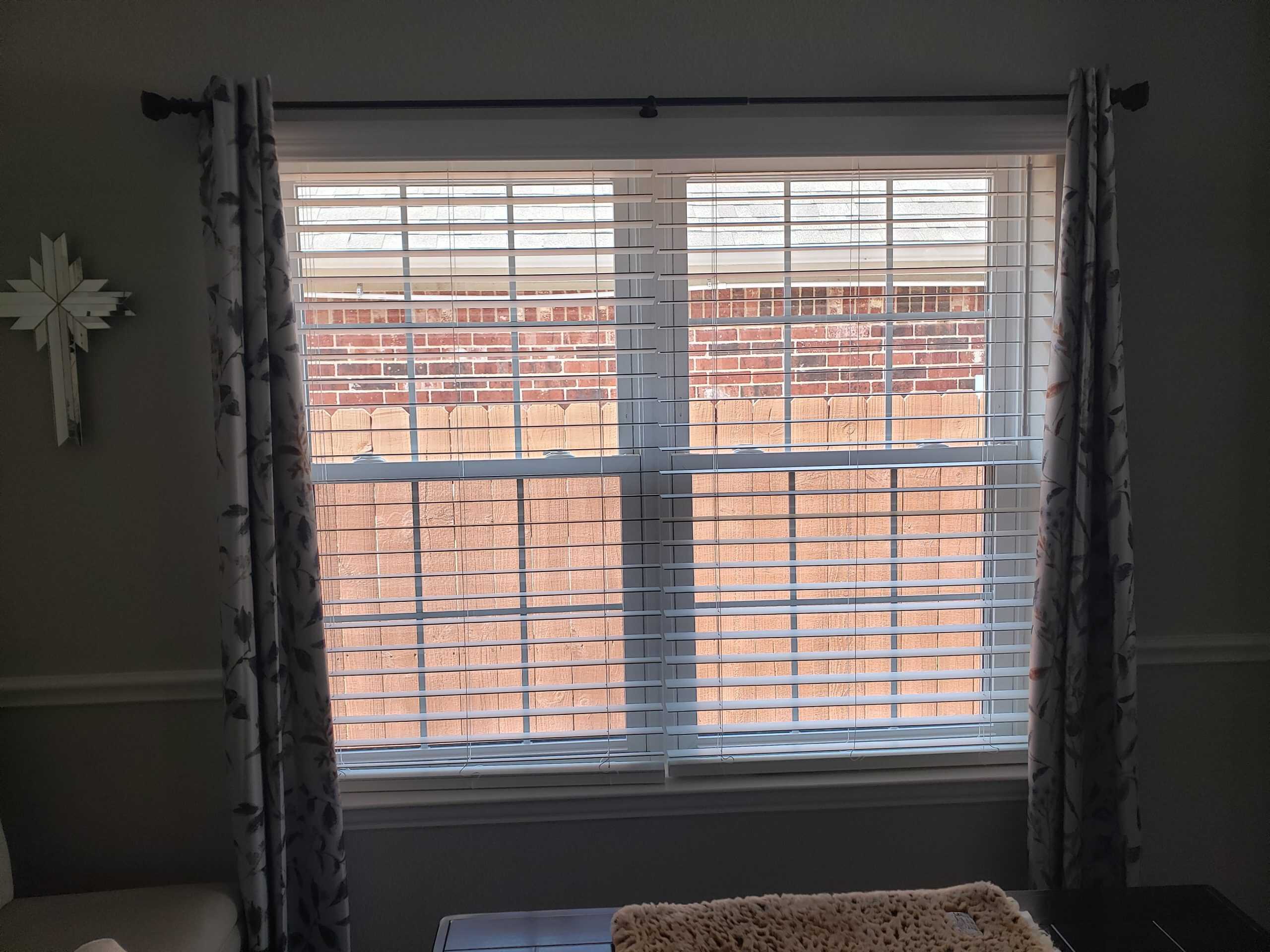
Not sure whether cellular shades or roller shades are right for your home? Here's what actually matters — especially if you're dealing with a Tarrant County summer.
Share:

If you’ve spent any time researching window shades, you’ve probably noticed the terminology gets messy fast. Cellular shades. Honeycomb shades. Roller shades. Pleated shades. It’s easy to feel like you need a glossary just to get started. And once you do start comparing products, most guides are written for a generic homeowner somewhere with mild weather and no particular urgency — not for someone in Tarrant County, TX whose west-facing living room turns into a sauna every afternoon from May through October. This guide is for you. We’ll clear up the terminology confusion first, then give you a straight comparison so you can make a decision that actually makes sense for your home.
Here’s the short answer: no. Honeycomb shades and cellular shades are the same product. “Honeycomb” describes what the cells look like when you look at the shade from the side — a series of hexagonal air pockets stacked together. “Cellular” describes how the shade is constructed — multiple layers of fabric bonded together to form those pockets. Different name, same shade.
This matters because a lot of people waste time comparing the two, thinking they’re evaluating different options. You’re not. Once you see “honeycomb shades” and “cellular shades” used interchangeably, you can stop second-guessing and focus on what actually separates cellular shades from other products — like roller shades and pleated shades — which are genuinely different in how they’re built and what they do.

The reason cellular shades have earned their reputation for energy efficiency comes down to those air pockets. When a cellular shade is properly fitted to a window, the trapped air inside each cell acts as insulation — slowing heat transfer in both directions. In summer, that means less heat pushing through the glass into your room. In winter, it means less warmth escaping through the window.
The U.S. Department of Energy has found that tightly installed cellular shades can reduce solar heat gain through windows by up to 80% in the cooling season, and reduce heat loss by 40% or more in winter. For a Tarrant County home running the AC from April through October, those aren’t abstract percentages — they show up on your electricity bill.
Cellular shades are rated by R-value, which measures thermal resistance. A single-cell shade typically reaches around R-2.0. Double-cell shades — which have two layers of air pockets instead of one — can reach R-2.5 to R-3.5. Triple-cell shades push that to R-5.0 or higher. For comparison, a standard roller shade sits somewhere between R-1.3 and R-1.8. That gap is significant if your priority is keeping heat out.
The catch — and this is important — is that those R-values only hold up when the shade fits the window correctly. Gaps around the edges defeat the thermal barrier entirely. A cellular shade that’s a half-inch too narrow on each side is just a decorative piece of fabric. This is one of the main reasons professional installation matters more for cellular shades than for almost any other window treatment. When we measure and install cellular shades, we’re not just hanging hardware — we’re making sure the insulation actually works.
For Tarrant County homes specifically, the most effective configuration tends to be double-cell shades on west- and south-facing windows, where afternoon sun hits hardest. If you have a room that’s genuinely uncomfortable by 3 PM in July, that’s usually a west-facing window problem — and a properly fitted double-cell shade is one of the most direct ways to address it.
This is where we’ll be straight with you: roller shades win on style. They come in a wider range of fabrics, colors, patterns, and textures than cellular shades — from sheer solar fabrics to full blackout, woven natural fibers to sleek modern weaves. If you’re furnishing a living room where the look matters as much as the function, roller shades give you more to work with.
Roller shades also do a real job on UV protection and glare reduction. Solar roller shades, in particular, are engineered to cut glare while still letting in diffused natural light — which makes them a popular choice for home offices, kitchens, and spaces where you want to see outside without squinting. They’re not as thermally efficient as cellular shades, but they’re not doing nothing either. A quality solar roller shade still reduces heat gain meaningfully, just not to the same degree.
Where cellular shades pull ahead is thermal performance — and in Tarrant County, that’s a real consideration for a lot of rooms. If you’re dealing with a bedroom that won’t cool down at night, a home office that’s too bright and too hot by midday, or a nursery where you need genuine blackout combined with temperature stability, cellular shades are the more functional choice. The air-pocket construction does something a flat sheet of fabric simply can’t.
We offer both interior and exterior roller shades, which is worth mentioning here because most local providers don’t. Exterior roller shades — the kind mounted outside the window frame or on a patio — stop solar heat before it ever enters the structure. For covered patios, pergolas, or outdoor living spaces throughout Tarrant County, they extend the usable season by weeks. If you have an outdoor area that becomes unusable by noon in summer, exterior shades are worth a conversation.
The honest framework for choosing between the two: if the room is primarily a comfort and efficiency problem, lean toward cellular. If it’s primarily a style and light-control decision, roller shades give you more options. And in a house with multiple exposures and multiple room types, the answer is often both — different products for different rooms based on what each room actually needs.
Pleated shades and cellular shades look similar at first glance — both have that folded, accordion-style fabric when raised. But the construction is fundamentally different, and that difference determines what each one actually does for your home.
A pleated shade uses a single layer of fabric folded into crisp pleats. It’s a clean, classic look, and it tends to be more affordable than cellular shades. A cellular shade uses multiple bonded layers of fabric that form those enclosed air pockets — the honeycomb structure that gives it its insulating properties. Visually similar. Functionally different.
Pleated shades make sense when aesthetics and budget are the primary drivers and insulation isn’t a top priority for that particular window. They’re available in a large range of fabrics and can look quite elegant — particularly in formal spaces like dining rooms where the shade is rarely fully deployed and the visual impression matters more than thermal performance.
If you have a north-facing window in a room that doesn’t get direct sun and doesn’t experience significant temperature swings, the insulation advantage of a cellular shade may not justify the price difference. In that case, a pleated shade in a fabric you love might be the better call.
That said, the moment energy efficiency becomes part of the conversation — which in Tarrant County it almost always does by the time someone is actually shopping for window treatments — cellular shades are the stronger choice. The air pockets aren’t decorative. They do real work, and the difference between a pleated shade and a cellular shade on a south-facing window in August is something you’ll feel in the room and eventually see on your bill.
Cellular shades also outperform pleated shades on sound absorption. The same air-pocket construction that traps heat also dampens noise — which matters in Tarrant County neighborhoods where homes sit close together, or in rooms that face a busy street. It’s not a dramatic effect, but it’s a genuine one, and it’s something pleated shades don’t offer.
If you’re comparing the two and cost is the deciding factor, it’s worth framing it this way: pleated shades cost less upfront. Cellular shades cost more upfront but tend to pay back some of that difference through reduced cooling and heating costs over time. For a window that gets direct sun six months of the year, the math usually favors cellular. For a low-exposure window in a less-used room, pleated shades are a reasonable, honest choice.
We touched on this earlier, but it’s worth saying plainly: the performance of a cellular shade depends almost entirely on how well it fits. The R-value numbers — R-2.5, R-3.5, R-5.0 — assume the shade is sealing the window opening properly. If there are gaps at the sides, the top, or the bottom, warm air moves right around the shade and the insulation benefit drops sharply. A cellular shade with poor fit is an expensive piece of fabric.
This is where the construction background we bring to every installation actually matters. We’ve spent years working with how homes are built — wall depths, window framing, trim profiles, the difference between an inside mount that fits cleanly and one that’s fighting the frame. Tarrant County’s housing stock covers a wide range: older craftsman bungalows in Fort Worth neighborhoods like Arlington Heights and Fairmount with non-standard window dimensions, newer construction in Southlake and Mansfield with large modern windows and significant glazing area, mid-century ranch homes throughout Arlington where window openings weren’t built to any standard you’d find in a catalog. Each of those situations requires a different approach to measurement and mounting.
Off-the-shelf cellular shades from a big-box store come in standard sizes that may or may not fit your actual window. When they don’t fit precisely — and they often don’t — you end up with the gaps we just described. Custom-manufactured cellular shades, measured and installed by us, are built to your exact window dimensions. That’s not an upsell. It’s the reason the product performs the way it’s supposed to.
There’s also the durability question. A lot of people have encountered cheap cellular shades that feel flimsy or paper-thin, and that experience sticks with them. Professional-grade cellular shades are made from durable polyester fabrics engineered to resist UV degradation and daily use. They’re not the same product you’d find in a discount bin, and they don’t behave like it either. When we install cellular shades, we test every mechanism before we leave — cords, cordless lifts, motorized systems — because a shade that doesn’t operate smoothly is a shade that gets left in one position and stops doing its job.
Speaking of motorization: if you’re already thinking about cellular shades for energy efficiency, pairing them with PowerView motorization is worth considering. Scheduling your shades to close automatically before afternoon heat hits your west-facing windows means the thermal barrier is always in place — even when you’re at work, even when you forget. It’s not just a convenience feature. It’s the difference between passive insulation and active energy management.
The decision doesn’t have to be all-or-nothing. Most homes in Tarrant County benefit from a mix — cellular shades where thermal performance is the priority, roller shades where style versatility and light control take the lead. The key is matching the product to the room and the window, not picking one type for the whole house because it was easier to decide.
If your west-facing rooms are uncomfortable by afternoon, cellular shades with a proper fit will do more for that problem than any other window treatment option. If you have a living room where the look matters as much as the function, roller shades give you more to work with on the design side. And if you’ve been comparing pleated shades and cellular shades without being sure why they look so similar but cost so differently — now you know.
When you’re ready to figure out what actually makes sense for your windows, the team at A Plus Shutters & Shades is happy to walk through it with you. We measure, we bring samples, and we give you a straight recommendation based on your rooms — not a sales pitch based on margin.
Article details:
Share:
Continue learning: