Trying to choose between blackout curtains and shades for your bedroom? Here's what actually matters — and why the answer might surprise you.
Share:
You bought blackout curtains. You hung them up. And somehow, your bedroom is still not dark. Light leaks in at the sides, glows along the top, and by 6:30 in the morning, you’re wide awake whether you wanted to be or not. Sound familiar?
This is one of the most common frustrations we hear from Tarrant County homeowners — and it’s almost never the curtain’s fault. It’s the fit. Standard-size blackout curtains are built around common window dimensions that rarely match real homes. The fabric might be doing its job perfectly, but if there’s a gap between the curtain and the wall, that gap is where your sleep goes.
Here’s what actually works, why it works, and how to get it right the first time.
Every room in your home has different window treatment priorities. The living room is about style and managing glare. The kitchen is about light and privacy. But the bedroom has to do something harder — it has to block out the world on demand, regardless of what time it is outside.
That means the functional bar is higher. A treatment that works fine in a dining room can completely fail in a bedroom. In Tarrant County, where summer sunrise hits before 6:30 AM and the sun doesn’t set until after 8:30 PM, “close enough” darkness isn’t close enough at all. You’re dealing with 14-plus hours of daylight at peak summer, and a west- or south-facing bedroom gets the worst of it.

The window treatment industry has a labeling problem, and it costs homeowners money and sleep. “Blackout” and “room darkening” are used almost interchangeably on product tags, but they describe meaningfully different levels of performance.
Room-darkening curtains block roughly 85 to 95 percent of incoming light. That sounds like a lot — and in a north-facing bedroom on a cloudy day, it might be enough. But in a sun-facing bedroom in Arlington, Mansfield, or anywhere across Tarrant County during a Texas summer, that remaining 5 to 15 percent of light is still enough to wake you up, disrupt a nap, or keep a toddler from settling down. True blackout fabric — the foam-backed or triple-weave construction — blocks 95 to 100 percent. The difference between those two categories is the difference between a room that’s dim and a room that’s actually dark.
Here’s the part that most product descriptions skip: even if you buy a genuinely blackout-rated curtain, you can still end up with a bright bedroom. The fabric itself isn’t the weak point. The gaps are. Light travels around curtains, not just through them. A curtain rod mounted too close to the window frame, panels that don’t extend far enough past the glass, or a gap at the top between the rod and the wall — any of these will let in enough light to suppress melatonin and disrupt sleep, even if the curtain in the center of the window is doing exactly what it’s supposed to do.
This is why custom measurement and professional installation matter for blackout performance in a way they don’t for purely decorative treatments. When we measure a window for a blackout installation, we’re accounting for the full coverage area — not just the glass, but the frame, the wall space on either side, and the mounting height. Getting that right is what separates a treatment that performs from one that just looks like it should.
One of the most common pushbacks we hear is some version of “I don’t want my bedroom to look like a cave.” It’s a fair concern. The word “blackout” conjures something utilitarian — heavy, dark, institutional. But modern blackout fabric technology has come a long way, and the options available today look nothing like the heavy drapes people picture.
Linen-look blackout fabrics, velvet blackout panels, patterned blackout weaves — these are all real products that can be made to custom dimensions and hung as full drapery panels. From across the room, they’re indistinguishable from purely decorative curtains. The blackout performance is built into the fabric construction or added through a blackout lining, not achieved by making the curtain look heavy or dark.
For Tarrant County homeowners who want their bedroom to feel designed — not just functional — we typically recommend a layered approach. A blackout roller shade handles the light control work. It sits close to the window, covers the full frame, and eliminates the gap problem entirely. Custom drapery panels hang on either side, adding warmth, texture, and the visual softness that makes a bedroom feel finished. When the shade is raised, the panels frame the window beautifully. When the shade is down, the room is genuinely dark.
This isn’t a compromise between form and function. It’s how you get both. The shade does the technical work; the drapes do the aesthetic work. Because we design and install both layers as a coordinated system — measuring everything together, selecting hardware that works at the right height and extension — the result looks intentional rather than assembled from separate purchases. For new construction homes in Keller, Southlake, or anywhere in Tarrant County with oversized windows and non-standard dimensions, this kind of coordinated approach is often the only way to get a result that actually fits.
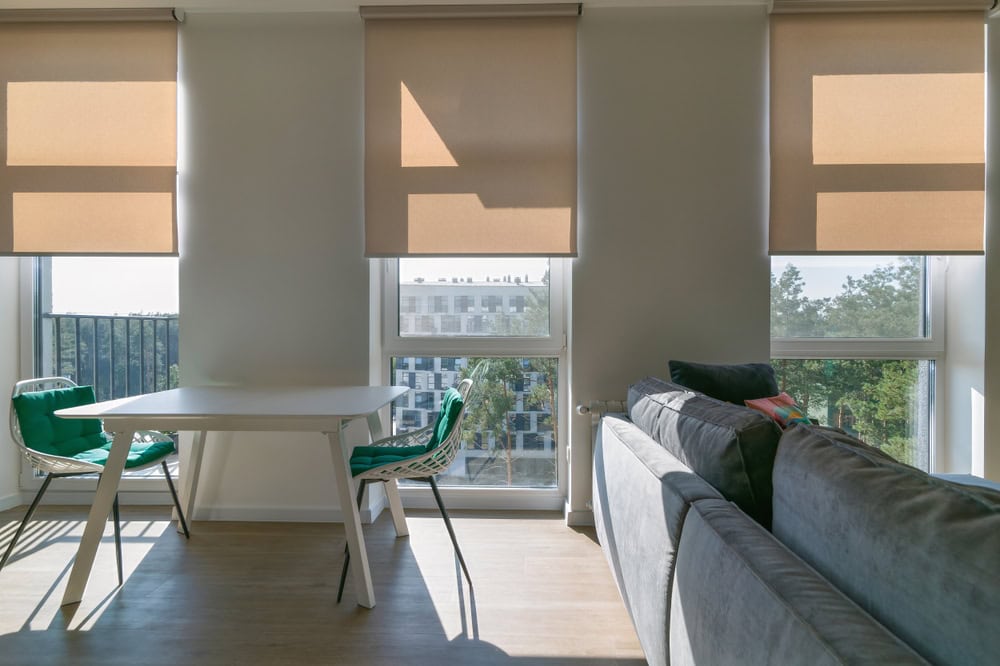
Blackout roller shades and cellular shades solve the gap problem structurally. Because they mount directly to the window frame — or just outside it — and roll or fold down to cover the full glass area, there’s no fabric edge floating in open air. The coverage is complete in a way that hanging curtains, even well-installed ones, can’t fully replicate.
For bedrooms where total darkness is non-negotiable — a nursery, a master bedroom on the west side of the house, or a room used by someone working a night shift — a properly installed blackout shade is the most reliable starting point. Curtains can supplement it beautifully, but the shade is doing the foundational work.

This is where the conversation shifts from sleep to energy costs — and in Tarrant County, it’s a conversation worth having. Texas AC season runs from roughly May through September. During those months, a west-facing bedroom window isn’t just a light problem; it’s a heat problem. The afternoon sun hits those windows directly, solar heat radiates through the glass, and the room temperature climbs even with the AC running.
Blackout cellular shades address this through their honeycomb construction. The air pockets trapped inside the cells create a thermal barrier between the glass and the room, reducing how much heat transfers inward during summer and how much warmth escapes outward in winter. It’s not a dramatic effect on any single day, but over a five-month cooling season, properly fitted cellular shades on bedroom windows do reduce the load on your AC — and that shows up in your electric bill.
For the most aggressive heat management, we also offer exterior roller shades. These intercept solar radiation at the window’s outer surface, before it ever has a chance to enter the room. An interior shade or curtain absorbs heat that has already passed through the glass; an exterior shade stops it before that happens. For west-facing bedrooms in Mansfield, North Richland Hills, or anywhere across Tarrant County where afternoon sun is a persistent problem, exterior shades are worth considering as part of the system.
If your bedroom faces west and you’re running the AC hard from June through August, the window treatment conversation isn’t just about sleep quality. It’s about managing your home’s thermal performance — and the right treatment choice makes a real difference on both fronts.
The short answer is yes — especially for the situations where blackout performance matters most.
Think about who actually needs true bedroom darkness in Tarrant County. Healthcare workers at JPS Health Network or Texas Health Resources coming off a night shift and trying to sleep at 8 AM. Flight crew based out of Fort Worth dealing with rotating schedules and time zone changes. New parents trying to get a baby down for a nap at 2 PM when the sun is fully up. In all of these cases, the window treatment has to work every single time, without friction, without fumbling with cords or wands when you’re exhausted.
Motorized blackout shades — we install PowerView motorization with smart home integration — solve that friction completely. You can set a schedule so the shades lower automatically at bedtime and raise at a time you choose in the morning. You can control them from your phone without getting out of bed. You can connect them to a smart home system so they respond to routines you’ve already built. For a shift worker who gets home at 7 AM and needs the bedroom dark by 7:05, that automation isn’t a luxury — it’s the whole point.
There’s also a practical benefit for nurseries specifically. One-handed operation matters when you’re holding a sleeping baby and trying not to wake them by wrestling with a curtain rod. A motorized shade that lowers quietly with a tap on your phone is a genuinely useful thing in that context, not a gadget.
Beyond the convenience, motorization also means the shade is positioned correctly every time. Manual shades get left partially open, adjusted unevenly, or skipped entirely because it’s easier. A motorized shade that runs on a schedule is always doing its job — which means the blackout performance you paid for is actually being used.
The curtains-versus-shades question doesn’t have a single right answer — it has a right answer for your specific bedroom, your window orientation, your schedule, and what you’re trying to solve. For most Tarrant County homeowners, the best outcome involves both: a blackout shade for structural light control and custom drapery panels for the look and feel the room deserves.
What makes the difference between a treatment that works and one that doesn’t isn’t usually the product itself. It’s the fit, the mounting, and the installation precision. That’s where our decade of construction experience actually matters — because hanging a blackout treatment correctly is a different skill set than simply selling one.
If you’re ready to stop guessing and get a bedroom that’s genuinely dark when you need it to be, reach out to A Plus Shutters & Shades for a free consultation. We’ll measure your windows, talk through your options, and put together something that actually performs.
Article details:
Share:
Continue learning: