Not every room needs automation equally. Here's how to figure out where power shades will actually make a difference in your Tarrant County home.
Share:
There’s a particular kind of frustration that comes with a living room you can’t use between 2 and 6 PM in July. Or a bedroom where the morning sun wakes you up an hour before your alarm. Or a window above the staircase that you’ve never once touched since you moved in because there’s no safe way to reach it. These aren’t minor inconveniences — in Tarrant County, where Fort Worth logs around 229 sunny days a year and summer temperatures push well past 100°F, they’re real comfort and cost problems. Power shades for windows can solve all of them. The smarter question is where to start.
Motorized or “power” shades are window coverings with a built-in motor that opens and closes them — via remote, wall switch, smartphone app, or a scheduled automation. That last part is what separates them from a standard remote-controlled blind. A scheduled power shade doesn’t wait for you to remember. It closes your west-facing living room shades at 12:55 PM every day, whether you’re home, at work, or out of town.
What they don’t do is solve every window situation equally. A power shade on a north-facing bathroom window you never think about delivers almost no meaningful benefit. The same shade on a south-facing bedroom or a two-story window wall? Completely different story. That’s why the room-by-room question matters more than people realize when they’re first exploring this category.

If there’s one room where power shades consistently make a noticeable daily difference, it’s the bedroom. The reason is simple: your sleep schedule and the sun’s schedule don’t always agree. East-facing bedrooms in Tarrant County get hit with direct morning light early — and if you’re relying on manual blinds, you’re either waking up to close them or sleeping through an alarm because you forgot to close them the night before. A scheduled shade eliminates both problems.
The blackout angle matters here too. A properly fitted motorized blackout shade seals the window more completely than a manually adjusted one, because it sits flush against the frame and closes to the same position every time. That consistency is harder to achieve with a cord you’re pulling by hand. For bedrooms where a partner’s schedule differs from yours, or for homes with young children who nap during daylight hours, this level of control is genuinely useful — not just a novelty.
There’s also the cord safety factor. The CPSC and the Window Covering Manufacturers Association have both flagged looped window covering cords as a strangulation hazard for young children. Motorized shades are cordless by design. For families with kids or grandkids in the home, that’s not a feature — it’s a prerequisite. A power shade in a child’s bedroom or nursery removes that risk entirely, without requiring a separate “child-safe” product category.
From an energy standpoint, a bedroom with scheduled shades that close at dusk in winter and open after sunrise in summer is doing quiet, passive work on your utility bill every day. The U.S. Department of Energy estimates that 25 to 30 percent of residential heating and cooling costs come through windows. A bedroom shade that’s working on a smart schedule is chipping away at that number without any ongoing effort from you.
Home offices are the room where manual shades fail the most visibly. You sit down to work, the sun shifts, and suddenly there’s a glare across your monitor you can’t ignore. You get up, adjust the blinds, lose your train of thought, and repeat the process two hours later when the angle changes again. It’s a small thing that adds up across a workday.
A power shade in a home office solves this with a simple timed adjustment. Set it to drop to 50 percent at 10 AM when the eastern sun hits your desk, raise it at noon when the angle shifts, and lower it again in the afternoon if you’re on the west side of the house. You never leave your chair. The shade handles it. For anyone working from home in Mansfield, Keller, or the western Fort Worth suburbs — where newer construction often features large windows that look great in a listing photo but create real glare problems at a desk — this is one of the more practical applications of automation.
Privacy is the other home office factor that doesn’t get enough attention. A motorized shade you can lower with a single tap during a video call, then raise again when the call ends, is a different experience from walking across the room to tug a cord mid-meeting. Solar shades with a 3 to 5 percent openness factor are a good fit for home offices — they cut glare and UV exposure while preserving your outward view, so the room doesn’t feel closed off during the day. We can help you choose the right fabric openness for your specific window exposure during a free in-home consultation.
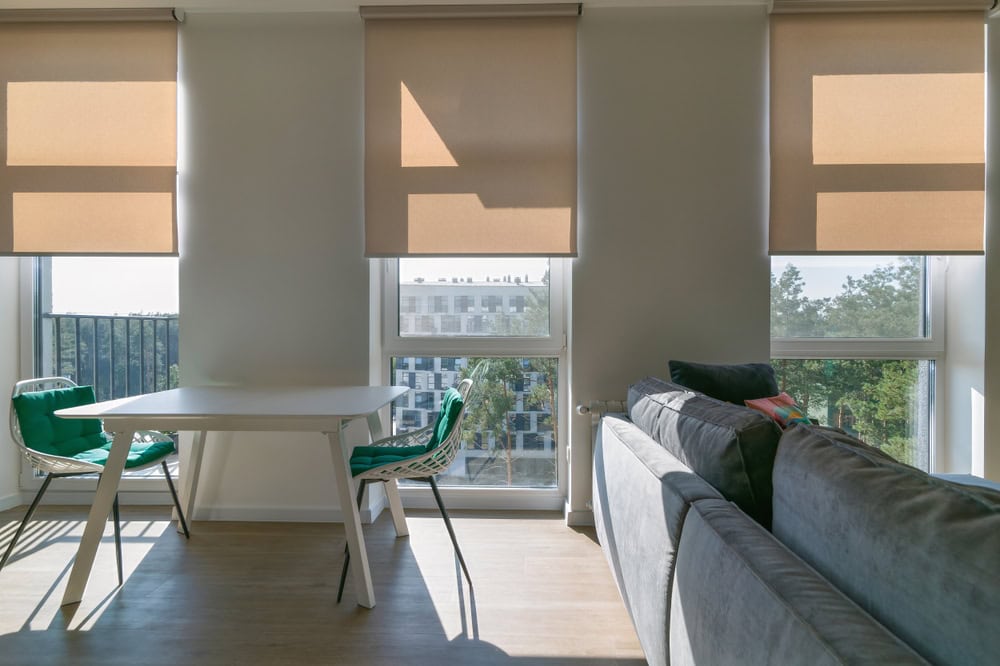
The main living area — whether that’s a great room, a family room, or a combined kitchen and living space is where Tarrant County homeowners feel the Texas heat most acutely. West-facing living rooms are the most common complaint we hear. By mid-afternoon in summer, the sun is driving directly through those windows, and the room temperature climbs noticeably even with the AC running. Manual blinds help, but only if someone closes them at the right time.
The scheduling argument is strongest here. Most people aren’t home during the worst heat window — roughly 1 to 5 PM on a summer afternoon. A power shade set to close at 12:55 PM every day manages that heat passively, without anyone needing to be present. When you get home at 6 PM, the room is cooler than it would have been. That’s not a small thing when you’re running your AC through a five-month cooling season.

Tarrant County’s newer construction — particularly in areas like Southlake, Colleyville, and the master-planned communities around North Richland Hills — is full of windows that look stunning and function terribly from a manual-operation standpoint. Two-story window walls in great rooms. Transom windows above front doors. Windows above kitchen cabinets. Skylights. These windows are often left bare entirely because there’s no practical way to hang a treatment you’d ever actually adjust.
A power shade is frequently the only realistic solution for these windows. Not a luxury option — the only option. A motorized shade installed on a vaulted window can be opened and closed from a remote, a wall switch, or a smartphone app without a ladder, without a long pull cord strung down the wall, and without the safety concerns that come with trying to reach a two-story window manually. For homeowners who have simply given up on covering certain windows, this is the conversation that changes the decision.
We install both interior and exterior power shades, and for south- and west-facing windows in particular, exterior shades deserve a mention here. An exterior roller shade stops solar radiation before it reaches the glass — which means it stops heat before it enters the room at all, rather than intercepting it after it’s already passed through. For a two-story window on the south side of a Tarrant County home that bakes all afternoon, an exterior motorized shade is often the more effective solution. It’s a differentiator most local providers don’t offer, and one that makes a measurable difference in rooms that have historically been impossible to cool comfortably.
Smart home integration makes the hard-to-reach window case even stronger. A window above a staircase that’s connected to your Alexa or Google Home routine can open with the morning scene and close with the evening scene — no ladder, no remote, no thought required. We integrate with Amazon Alexa, Google Home, and Apple HomeKit, so if you already have those devices running in your home, your shades can fold into the system you already use.
Most of the conversation around power shades in Texas focuses on heat — and for good reason. But Tarrant County winters are a real factor too, and February 2021 made that clear to anyone who lived through it. A motorized shade with a scheduled close at sunset does something quiet but meaningful in cold weather: it creates an insulating barrier between the cold glass and the interior of the room, reducing overnight heat loss at exactly the time it matters most.
Window coverings to keep cold out work on the same principle as shades that block summer heat — the goal is to reduce what passes through the glass in either direction. Cellular shades and insulating roller shades are particularly effective for this application because of their air-pocket construction, which adds a layer of thermal resistance that flat blinds don’t provide. A scheduled automation that closes them at dusk in December and opens them at sunrise in January — letting in passive solar warmth during daylight hours — is doing real energy work without any daily effort from you.
This is the year-round argument for power shades that doesn’t get made often enough. It’s not just a summer product. In a market like Tarrant County, where the cooling season runs from May through October and cold snaps can arrive suddenly in November or January, a shade that’s working on a smart schedule is managing your home’s thermal performance across all twelve months. The upfront investment looks different when you’re thinking about it that way — not as a summer convenience, but as a year-round energy management tool that happens to also run quietly, last ten to fifteen years with proper care, and require almost no ongoing attention from you.
Homeowners in Arlington, Mansfield, and the Fort Worth suburbs who are already running smart thermostats often find that adding scheduled shades is the natural next step — the two systems work together, with the shades reducing the load on the HVAC before it even has to respond.
You don’t need to automate every window in your home to get real value from power shades. For most Tarrant County homeowners, starting with the bedroom, the main living space, and any windows that are genuinely hard to reach covers the majority of the daily benefit — and gives you a clear sense of how the technology fits into your home before expanding.
The rooms where you manually adjust shades multiple times a day, the rooms that are uncomfortable in the afternoon, and the windows you’ve never been able to cover practically — those are your highest-priority candidates. Everything else can wait.
If you’re ready to figure out where to start, A Plus Shutters & Shades offers free in-home consultations throughout Tarrant County. We’ll look at your specific windows, your sun exposure, and your smart home setup — and give you a straight answer about where automation will actually make a difference.
Article details:
Share:
Continue learning: