If your blinds aren't helping with the heat, there's a reason. Here's what cellular shades do differently — and why it shows up on your energy bill.
Share:

You already have blinds. They close, they block some light, and they look fine. So why does your west-facing living room still feel like a furnace at 3 PM in July?
The short answer: blinds block light. They don’t block heat. And in Tarrant County, where summers regularly push past 100°F and 99% of homes carry a Severe Heat Factor® rating, that distinction costs real money every month on your Oncor bill.
Cellular shades work differently — and the difference isn’t just marketing language. There’s a physical reason they outperform standard blinds on energy, and it’s worth understanding before you make any decisions about your windows.
Yes — completely. “Cellular shades” and “honeycomb shades” refer to the same product. The word “cellular” describes the air-pocket structure built into the fabric. The word “honeycomb” describes the shape of those pockets when you look at the shade from the side — hexagonal, like a beehive. Manufacturers, retailers, and customers use both terms interchangeably, so if you’ve been searching for one and finding results for the other, you haven’t been looking at two different products.
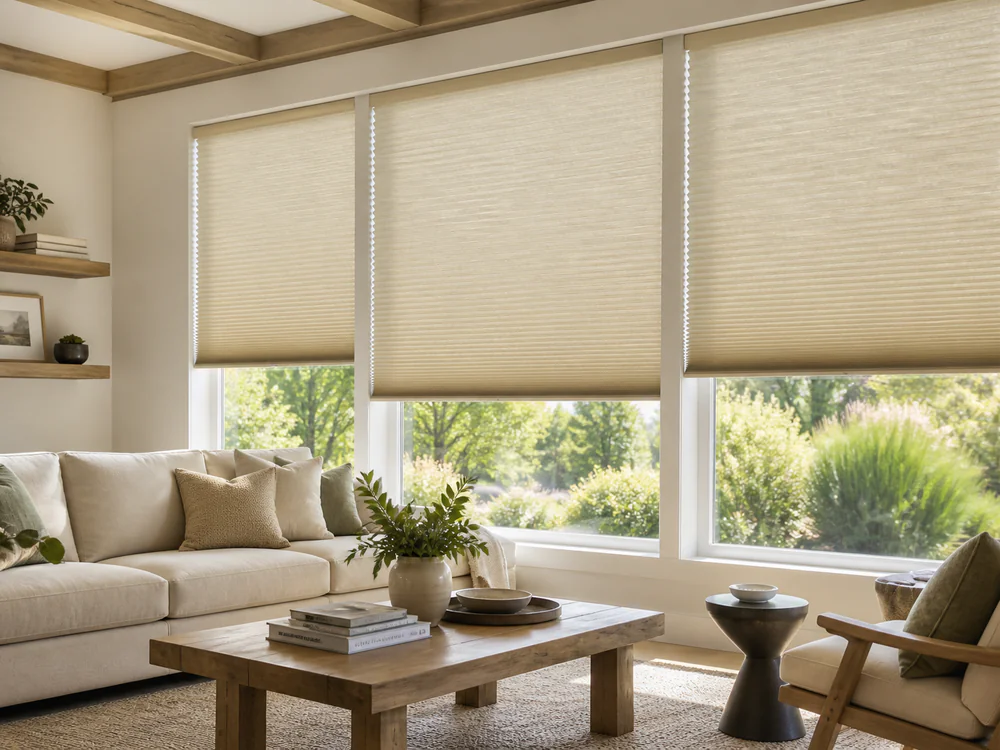
What makes these shades unique is that air pocket. Unlike a flat roller shade or a slatted blind, a cellular shade traps a column of still air between the window glass and your room. Still air is a natural insulator. That’s the entire mechanism — and it’s why the energy savings are real rather than theoretical.

Here’s the physics in plain terms. The U.S. Department of Energy has documented that approximately 76% of the sunlight hitting a standard double-pane window enters your home as heat. Your window glass isn’t stopping it — it’s conducting it. Standard blinds, even when fully closed, don’t create a meaningful barrier to that process. Heat radiates through the glass, convects through the gaps between slats, and enters the room. The blinds block some of the visible light, but the thermal energy keeps moving.
A cellular shade interrupts that process. The trapped air inside each cell acts as a buffer layer between the glass and your living space. Heat still hits the window, but it has to work through that insulating air column before it reaches the room. That’s not a small difference. The DOE states that tightly installed cellular shades can reduce summer heat gain by up to 60% and cut winter heat loss by up to 40%.
The R-value comparison makes the gap concrete. A standard double-pane window carries an R-value of roughly 1.8 — meaning it provides modest resistance to heat transfer on its own. Standard metal or vinyl blinds add less than R-1.0 on top of that. A properly fitted double-cell cellular shade can bring the combined window R-value to 4.0 or higher. You’re more than doubling the thermal resistance of the window without touching the glass.
Single-cell shades sit at the entry level, typically around R-2.0 to R-2.5. Double-cell shades — the standard recommendation for most rooms — reach R-3.25 to R-5.0 depending on fabric and opacity. For west-facing rooms in a Tarrant County home that take direct afternoon sun from June through September, double-cell is the appropriate choice. The upgrade in performance is meaningful, not marginal.
One thing worth saying clearly: the R-value on the label only materializes if the shade is properly fitted. A cellular shade with gaps at the edges loses the air barrier that makes it work. The insulation depends on the seal. That’s why professional measurement matters — not as a sales pitch, but as a functional reality.
Most people think of window shades as a binary choice: open or closed. Top-down/bottom-up cellular shades change that entirely. These shades have two independently operable rails. The top rail can be lowered from above while the bottom rail stays raised, which means you can block the direct sun hitting the upper portion of your window — where the most intense heat enters — while keeping the lower portion open for airflow, natural light, and a view of the yard.
In a Tarrant County home, that matters more than it might sound. The afternoon sun in North Texas hits west-facing glass at a steep, direct angle. By 2 PM in July, a west-facing room without any heat management becomes genuinely uncomfortable. Closing the shade entirely solves the heat problem but turns the room dark. A top-down configuration lets you manage the sun angle without giving up the room.
When you add PowerView motorization, this becomes something you can actually automate. We offer PowerView automation on cellular shades with full integration for Alexa, Google Home, and app control. You can schedule the shade to lower from the top before the afternoon heat peak — the system handles it while you’re at work, running errands, or simply not thinking about it. Your HVAC isn’t fighting a losing battle against a glass wall baking in direct sun. The shade does the work quietly before the heat builds.
Battery-powered and hardwired options are both available, so motorization doesn’t require rewiring your home. For new construction in areas like Mansfield, Southlake, or Haslet, hardwired integration during the build is straightforward. For existing homes in Arlington or Fort Worth, battery-powered motors are a clean retrofit with no wall work required.
This combination — the thermal performance of double-cell honeycomb fabric, the flexibility of top-down/bottom-up operation, and the automation of PowerView — is the most complete answer to the west-facing window problem in Tarrant County. It’s not a feature list. It’s a practical solution to a problem that shows up on your bill every August.
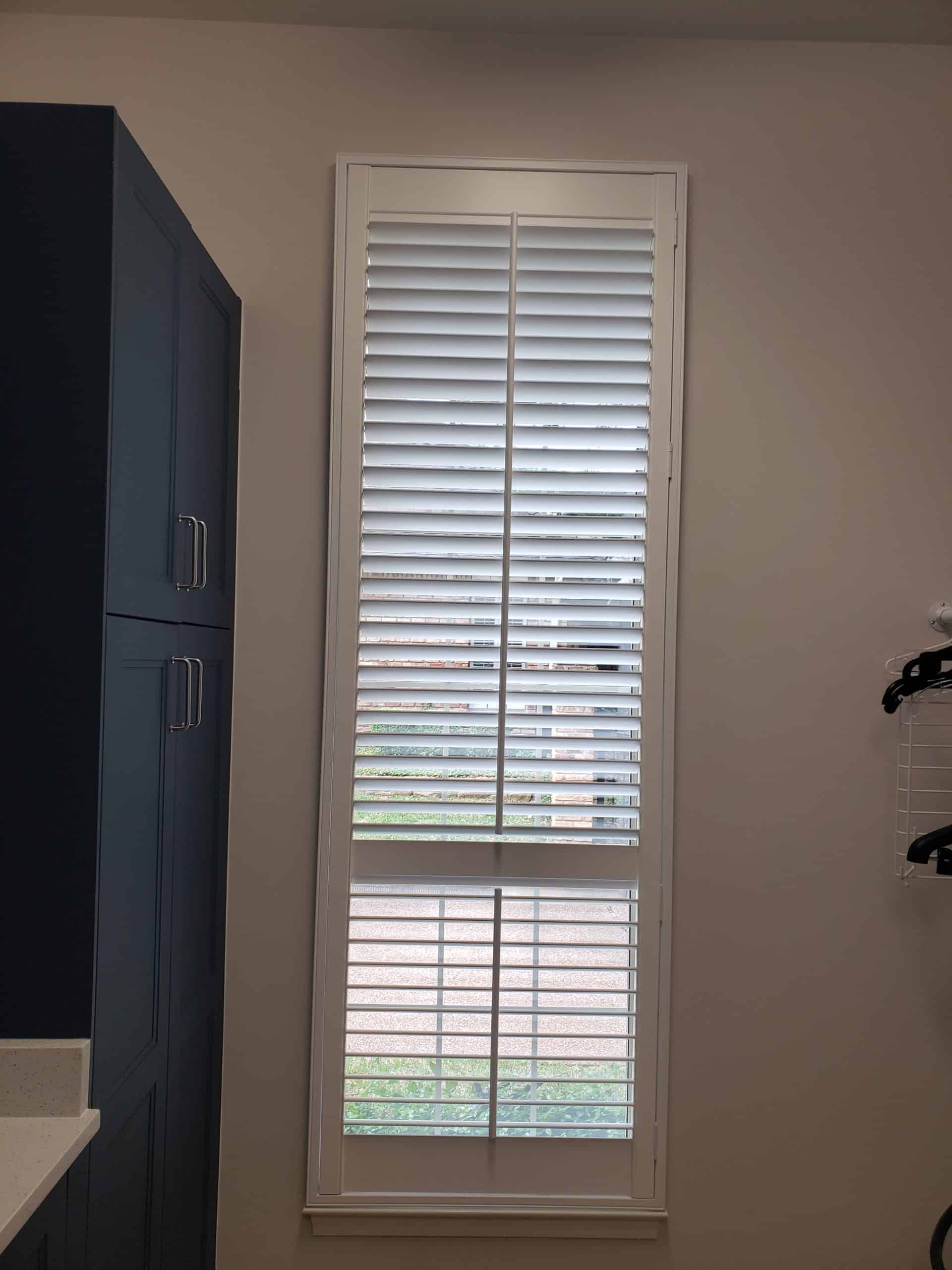
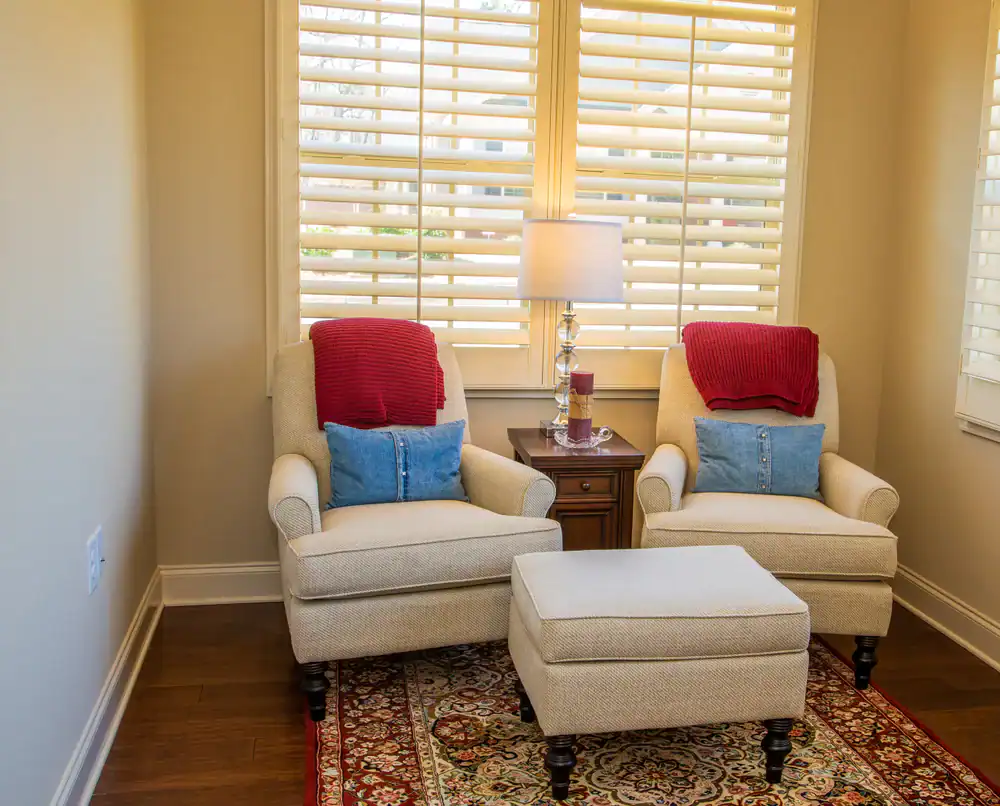
Faux wood blinds are everywhere in North Texas, and for good reason. They hold up in heat and humidity where real wood warps and cracks. They look clean, they’re easy to operate, and they’re widely available. If durability is the goal, faux wood is a smart choice over real wood in this climate.
But durability and insulation are different things. Faux wood blinds are a solid slat product. Even when fully closed, the slats don’t form a sealed barrier — heat convects freely through the gaps. There’s no air pocket, no thermal buffer, no meaningful R-value added to the window. Choosing faux wood over cellular shades is a reasonable durability decision. It is not an energy efficiency decision.
The confusion here is understandable. Faux wood blinds close completely, they look substantial, and they block visible light effectively. It’s reasonable to assume they’re doing something about the heat. They’re not — at least not in any meaningful way.
The mechanism behind cellular shades’ energy performance is the trapped air column. That air doesn’t move, so it can’t conduct heat the way a solid material does. Faux wood slats are solid PVC or composite — good at resisting moisture and UV degradation, not good at insulating. When 76% of the sunlight hitting your window is converting to heat inside the glass, a closed faux wood blind is not stopping that process. It’s blocking the light you can see while the thermal energy moves right through and around it.
For older homes in Arlington and Fort Worth — and there’s a lot of older housing stock in both cities — this matters more than it does in newer builds. Windows in homes from the 1970s and 1980s are often slightly out of square, and the gap between the frame and a standard blind can be larger than expected. A cellular shade, when measured and installed correctly to account for those real-world tolerances, creates a much tighter fit against the frame. That fit is what activates the insulating performance.
We grew out of A Plus Home Remodel, a construction company with over a decade of experience in North Texas. That background isn’t incidental — it means our installers understand how homes are actually built, how window frames behave in Texas heat cycles, and how to compensate for the small imperfections that are normal in any house that’s been standing for thirty years. The difference between a cellular shade that performs at its rated R-value and one that doesn’t often comes down to whether the person measuring it understood the frame before they measured it.
The honest summary: faux wood blinds are a durable, practical choice for light control. If you want a window treatment that actually reduces your cooling load in a Tarrant County summer, cellular shades are the product designed for that job. They’re not competing on the same criteria.
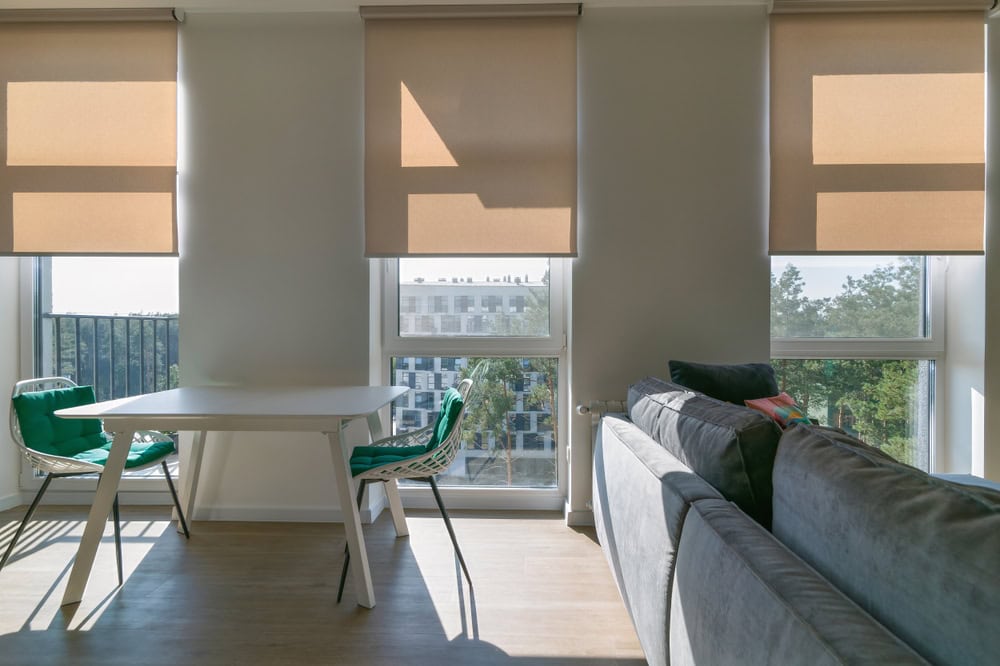
Zebra shades — also called banded or dual-layer shades — have become one of the most popular window treatment choices in North Texas over the last several years. The look is modern and clean. The alternating sheer and solid fabric bands give you adjustable light control without the mechanical feel of traditional blinds. They’re genuinely attractive, and that’s a legitimate reason to choose them for certain rooms.
What they don’t have is a honeycomb. The dual-fabric design provides no air-pocket insulation structure. Zebra shades filter light and offer some privacy control, but their thermal resistance is negligible compared to cellular shades. If you’re choosing between zebra shades and cellular shades for a room where energy performance matters — a west-facing bedroom, a home office that bakes in the afternoon, a living room with large south-facing glass — you’re making a style decision, not an energy decision, if you go with zebra.
That’s not a knock on zebra shades. They do what they’re designed to do. But buyers in Tarrant County sometimes assume that any modern, layered window treatment offers comparable insulation to cellular shades, and that assumption is worth correcting before the purchase is made.
The practical approach for many homes is to use the right product for each room’s actual priority. A formal dining room that faces north and gets indirect light all day is a reasonable place for zebra shades if the aesthetic is the priority. The master bedroom with a west-facing window that turns the room into an oven every afternoon is the room where double-cell cellular shades earn their cost back. Tarrant County’s climate is extreme enough that the distinction matters financially — the DOE estimates that tightly installed cellular shades can reduce summer heat gain by up to 60%, and Oak Ridge National Laboratory has documented 24% heating savings compared to regular blinds. That’s the kind of performance gap that shows up on your Oncor bill over the course of a full Texas summer.
Cellular shades also reduce noise — the same air pocket structure that insulates against heat absorbs sound. For homes near busy roads or in denser parts of Fort Worth and Arlington, that’s a secondary benefit worth noting.
The comparison between cellular shades and blinds isn’t really close when energy performance is the primary concern. Standard blinds — faux wood, aluminum, vinyl — are light control products. They do that job well. Cellular shades are insulation products that also control light. In a county where 99% of homes carry a Severe Heat Factor® rating and August Oncor bills can spike dramatically, that distinction has a dollar value attached to it.
Faux wood blinds make sense in rooms where durability and light control are the priorities and heat management is secondary. Zebra shades make sense where modern aesthetics matter more than thermal performance. But for the west-facing rooms, the sun-heavy living spaces, and the bedrooms that are genuinely uncomfortable by mid-afternoon in July — cellular shades are the product built for that problem.
If you’re ready to figure out what makes sense for your specific home and windows, A Plus Shutters & Shades is the place to start. We measure, we install, and we stand behind the work — no subcontractors, no gap between what we quote and what shows up.
Article details:
Share:
Continue learning: