Tarrant County summers are relentless. Here's how custom outdoor roller shades actually solve the heat, glare, and energy bill problems — and what to look for before you buy.
Share:

Most Tarrant County homeowners don’t think about outdoor roller shades until they’ve already suffered through a summer. The patio they paid good money for sits empty from noon until sunset. The electric bill climbs past $300, then $400. The outdoor furniture that looked great in April starts fading by July. If any of that sounds familiar, you’re not dealing with a minor inconvenience — you’re dealing with a solvable problem. Custom outdoor roller shades are one of the most effective tools available for stopping heat and UV before they ever reach your living space. Here’s what you actually need to know.
An outdoor roller shade isn’t just a decorative screen. It’s a barrier that intercepts solar heat gain before it hits your windows or living area — which is a fundamentally different job than what any interior shade does. Interior treatments filter light after it’s already inside. Exterior roller shades stop it at the source.
In Tarrant County, where summer UV index regularly reaches 10 to 11 and 100-degree days run from June through September, that distinction matters more than it does almost anywhere else. Fort Worth averages around 229 sunny days a year. That’s a lot of direct sun hammering west- and south-facing patios, and a lot of afternoon hours when outdoor spaces become genuinely unusable without proper shading.
The right exterior roller shade — custom-built, properly installed — can drop the temperature in a covered patio area by up to 30 degrees. That’s the difference between a space you avoid and one you actually use. When your summer electric bill is already pushing $400, homeowners with exterior shading in place typically see 20 to 30 percent reductions in cooling costs in the rooms behind those shades. That adds up quickly.

There’s a reason so many homeowners end up replacing their outdoor shades after one season. Most shades sold at big-box retailers aren’t engineered for 104-degree heat and relentless UV exposure. The fabrics fade. The hardware warps or corrodes. The fit is close but not exact, which means gaps where heat and light infiltrate anyway. By August, the shade that seemed fine in April is sagging and doing almost nothing.
Custom outdoor roller shades are a different product category entirely. The fabric is solution-dyed, meaning the color is embedded in the fiber during manufacturing — not coated on the surface where it can wash or bake off. The hardware is commercial-grade aluminum. The shade is built to your exact opening dimensions, not the nearest standard size.
That precision matters especially in Tarrant County’s older housing stock. Many homes in Arlington and Fort Worth — built in the 1970s, 80s, and 90s — have irregular window configurations and openings that aren’t perfectly square. A standard-size shade from a catalog won’t seal those gaps. A custom-built shade, measured and installed by someone who understands home construction, will.
Quality outdoor roller shades, properly installed, last 7 to 10 years — and some well beyond that. The initial investment pays for itself faster than most homeowners expect, both in comfort and in reduced cooling costs.
This is one of the most common questions we hear, and it’s worth answering clearly because the answer affects both performance and appearance. An inside mount means the shade installs within the window frame. An outside mount means it mounts on the wall or ceiling above the frame, extending beyond it on each side.
For interior window treatments — roller shades, blinds, cellular shades — inside mount is often preferred for a cleaner, more built-in look. But for outdoor roller shades used on patios, pergolas, and covered outdoor spaces, outside mount is almost always the right call. You’re not fitting into a window frame; you’re covering a large opening, often an entire side of a covered patio. The shade needs to extend far enough to block sun at low angles and seal the sides adequately.
The mounting decision also affects wind performance. Outdoor roller shades in North Texas need to handle sudden severe storms — the kind that come out of nowhere on a July afternoon and bring 50-mile-per-hour gusts with them. Proper outside mounting with side tracks or cable guides keeps the shade from flapping, which reduces stress on the hardware and extends the life of the fabric significantly. This is where installation expertise genuinely matters. Knowing how a structure is built — where the load-bearing points are, how to anchor into different materials, how to account for a pergola that isn’t perfectly level — is the difference between a shade that holds up and one that tears loose in the first storm.
For homeowners asking about blinds inside vs. outside mount in the context of interior windows, the answer is more nuanced. Inside mount offers a sleeker appearance and works well when the window depth is sufficient. Outside mount makes a window appear larger, hides imperfect framing, and gives you more light-blocking coverage at the edges. Either can work well — the right choice depends on your window depth, the look you want, and how much light control you need.
Manual outdoor roller shades work fine. But if your patio is large, the shade is mounted high, or you simply want the convenience of not getting up every time the afternoon sun shifts, motorization is worth understanding.
Motorized patio shades can be programmed to lower automatically when temperatures rise, set on daily schedules, and controlled from your phone while you’re still at the office. Platforms like Hunter Douglas PowerView integrate with Alexa, Google Home, and Apple HomeKit, which means your outdoor shades can be part of the same smart home ecosystem as your thermostat and lights.
For Tarrant County homeowners who’ve invested in outdoor kitchens, covered entertainment spaces, or pergolas in communities like Southlake or Colleyville, motorization turns a good shading solution into a genuinely seamless one. You can lower shades automatically during peak afternoon heat without thinking about it, then raise them as the sun moves.
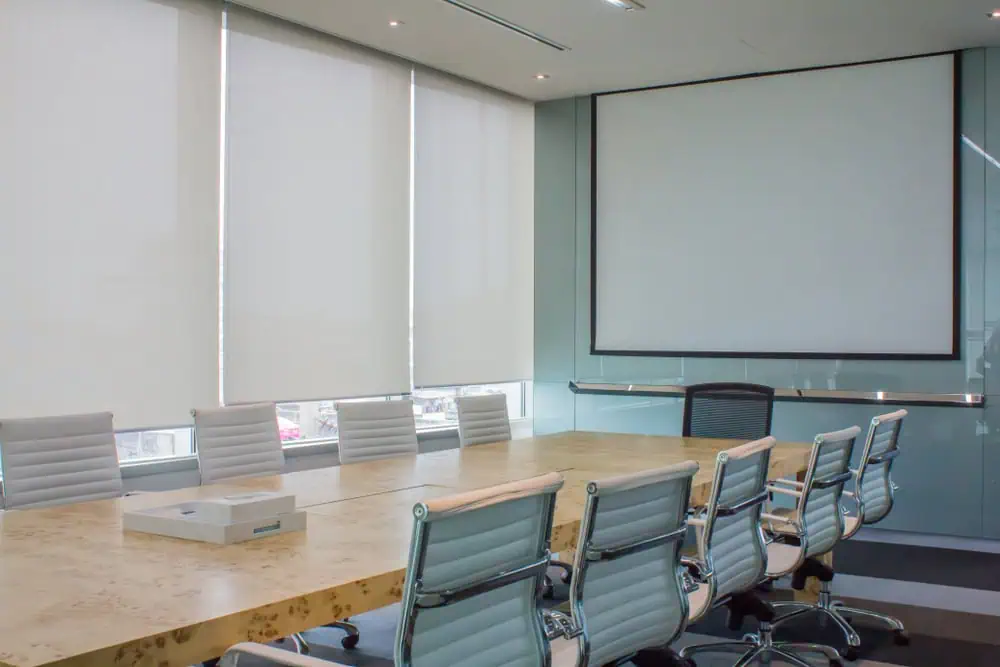
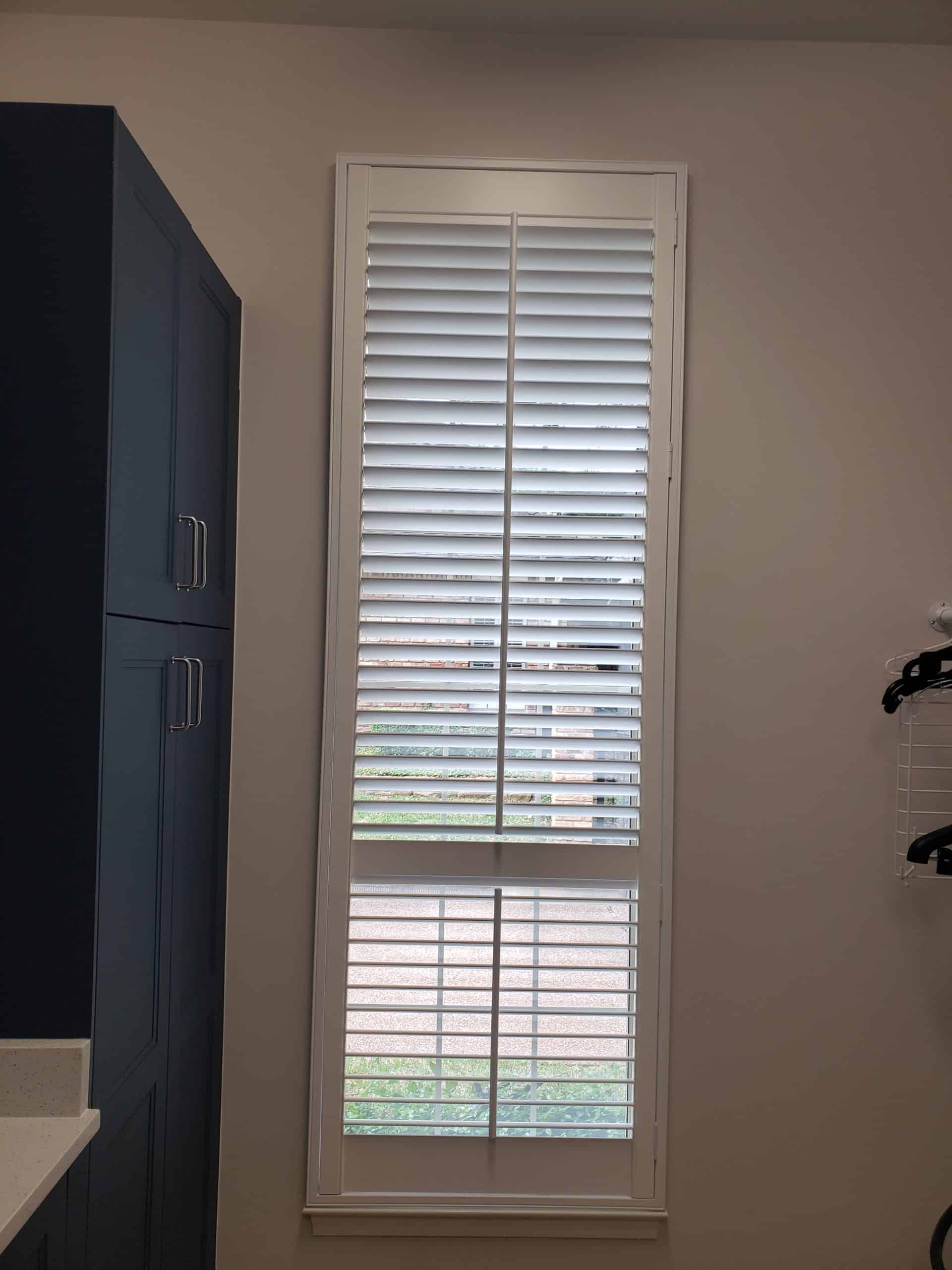
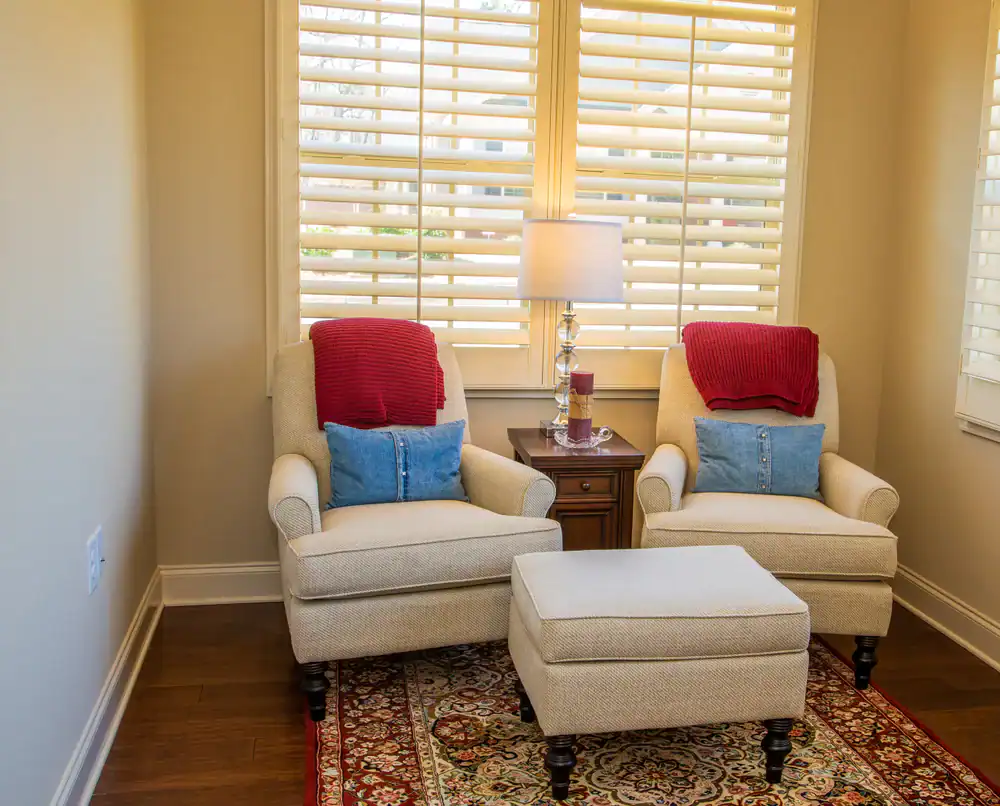
The terms “shades” and “blinds” get used interchangeably, but they’re not the same product. Blinds are made of rigid slats — wood, faux wood, aluminum — that tilt to control light and privacy. Shades are made of a continuous piece of fabric that raises and lowers as a single panel. That distinction shapes everything from how they look to how they perform.
For outdoor applications, shades are almost universally the better choice. There are no slats to rattle in the wind, no gaps between angled pieces that let heat and glare through, and no small mechanical components exposed to rain and UV degradation. A single piece of solution-dyed, UV-stabilized fabric is simply more durable in an outdoor environment than any slatted blind.
For interior windows, the choice between shades and blinds comes down to the look you want, the level of light control you need, and the room’s function. Blinds offer precise light adjustment — you can tilt the slats to direct light without fully opening or closing the covering. Shades offer cleaner lines and a softer appearance, with options ranging from sheer to blackout depending on the fabric. Neither is universally better. They serve different purposes, and in many homes, both have a place.
The difference between blinds and shades also shows up in maintenance. Blinds collect dust between the slats and require more detailed cleaning. Fabric shades are easier to wipe down but need to be handled carefully to avoid creasing or damaging the material. For outdoor roller shades specifically, most quality fabrics can be cleaned with mild soap and water — a significant practical advantage over any slatted alternative.
Once you move inside, the fabric options multiply quickly — and the terminology isn’t always consistent across brands. Here’s a clear breakdown of what the main categories actually mean.
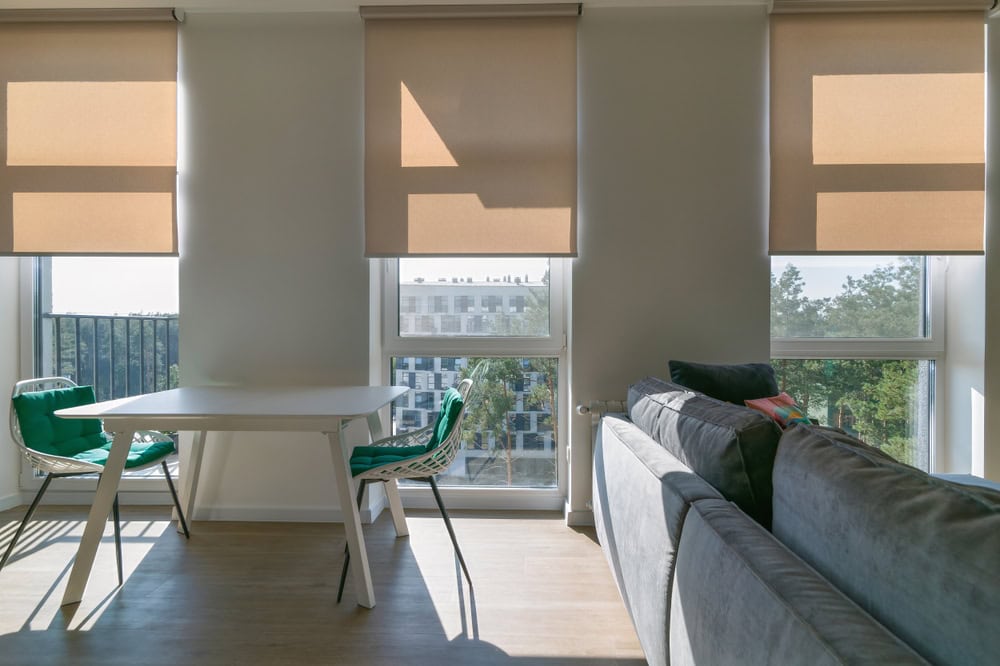
Solar shades are designed for windows where you want to reduce glare and UV exposure without losing your view. The fabric is an open weave — typically with an openness factor of 3%, 5%, or 10% — that filters light while still allowing you to see outside. A 3% openness factor provides more shade and UV blockage but limits how clearly you can see through. A 10% openness factor lets in more light and preserves the view better, but provides less heat control. For Tarrant County rooms with south- or west-facing windows, 3% to 5% is generally the right range.
Light filtering shades diffuse natural light without blocking it entirely. They soften harsh sunlight and provide daytime privacy without making a room feel dark. They’re a common choice for living rooms and kitchens where you want brightness without glare.
Room darkening shades block most light — typically 95% or more — but aren’t completely opaque. Some light may come through around the edges or at the seams. They’re a practical choice for bedrooms where you want to sleep later without investing in full blackout.
Blackout shades are the most complete light-blocking option. The fabric has a backing that prevents any light penetration, and when paired with a proper mount that minimizes edge gaps, they create near-total darkness. They’re the standard recommendation for nurseries, home theaters, and bedrooms where sleep quality is a priority. The key difference between room darkening shades and blackout is that blackout fabrics are designed to eliminate light almost entirely, while room darkening fabrics reduce it significantly but not completely.
Knowing which category you need before you shop saves a lot of confusion. The right answer usually comes from the room’s function, the direction it faces, and how much natural light you want to work with versus block out.
Custom outdoor roller shades aren’t a luxury add-on for Tarrant County homes — they’re a practical response to a real climate problem. When your patio is unusable four months a year and your electric bill reflects it, the right exterior shading solution pays for itself in comfort and energy savings faster than most homeowners expect.
The key is getting the product, the fabric, and the installation right the first time. That means custom sizing, solution-dyed fabrics built for Texas UV, commercial-grade hardware, and an installer who understands how homes are actually built — not just how shades are hung.
If you’re ready to stop losing your outdoor space to the Texas sun, A Plus Shutters & Shades offers free in-home consultations across Tarrant County. We’ll measure your space, walk you through the fabric options, and give you a straight answer on what will actually work for your home.
Article details:
Share:
Continue learning: