Store-bought blinds seem like the easy call — until they don't fit, fade fast, or do nothing for your energy bill. Here's what custom actually means.
Share:

You’ve probably stood in a big-box aisle, grabbed a box of blinds that looked close enough to your window size, and figured you’d make it work. Maybe you did. Maybe the gaps on the sides still bother you two years later, or the slats warp every summer when the heat index climbs past 105°F. That’s the store-bought experience in a nutshell — close, but not quite right. Custom window treatments are built differently, literally. We measure your exact window, fabricate the product to perform in your specific conditions, and install it with accountability. This page explains the full picture so you can decide what actually makes sense for your home or business in Tarrant County.
The word “custom” gets used loosely in this industry. Some retailers slap it on anything that isn’t a fixed standard size. But real custom window blinds and shades start with us measuring your actual window opening — not the nearest inch, not a rough estimate — and end with a product fabricated specifically for that opening.
That distinction matters more than most people realize. Windows in Tarrant County homes aren’t always perfectly square, especially in older neighborhoods like Fairmount or Ryan Place in Fort Worth, where decades of foundation movement have left frames slightly out of plumb. New construction in Mansfield or Keller often swings the other direction — oversized windows, two-story openings, and sliding glass doors that standard box-store sizes simply don’t cover. Custom window coverings are built for the actual window in front of you, not the average window somewhere.

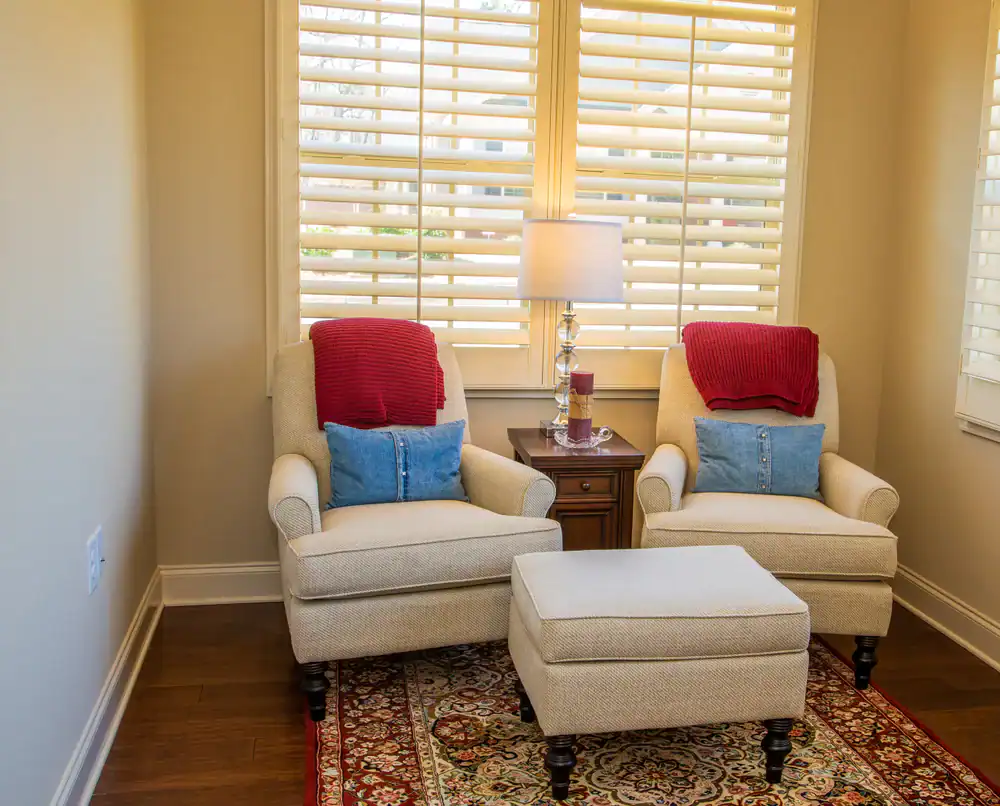
Wood blinds are one of the most requested products we see in Tarrant County homes, and the real-versus-faux-wood question comes up in almost every consultation. Real wood blinds offer a warm, natural look that photographs beautifully and works well in living rooms, dining areas, and bedrooms where humidity stays relatively controlled. The grain and texture read as genuinely high-end in a way that’s hard to replicate.
Faux wood blinds — typically made from PVC or a composite material — are the more practical choice for kitchens, bathrooms, and any room that sees temperature swings or moisture exposure. In a Texas summer, where a south-facing room can heat up significantly even with the AC running, faux wood holds its shape better than real wood over time. It won’t warp, crack, or bow the way natural wood can when it’s repeatedly exposed to heat and humidity cycles.
From a cost standpoint, faux wood is generally more affordable and easier to clean, which is why it’s become the dominant choice for whole-home projects. Real wood tends to get reserved for the rooms where the aesthetic payoff justifies the premium. The right answer depends on where the blinds are going and what conditions they’ll face — which is exactly the kind of thing worth sorting out during a free in-home consultation before you commit to anything.
For custom blinds specifically, both materials can be fabricated to precise measurements. The sizing precision is the same either way; the material choice is about performance and preference. If you’re outfitting a new build in Burleson or Crowley and want consistency across 20-plus windows, faux wood custom blinds often make the most practical and cost-effective sense for the majority of the home, with real wood reserved for one or two showcase spaces.
Bedrooms are where the performance requirements get specific fast. You need real darkness if you want to sleep past sunrise, genuine privacy so neighbors can’t see silhouettes from the street, and something that doesn’t look clinical or industrial while doing both jobs. That’s a tighter brief than most store-bought options can meet.
Room-darkening and blackout treatments are the go-to for bedrooms, but there’s a meaningful difference between the two. Room-darkening shades reduce light significantly but allow a small amount of light to bleed around the edges and through the fabric. Blackout shades — especially when combined with side channels or a close-fit mount — block almost all incoming light. For shift workers, parents of young children, or anyone in a home where east-facing bedroom windows catch the full force of a 6 AM Texas sunrise, that difference is felt every morning.
Privacy is its own consideration. Light-filtering blinds soften and diffuse incoming light beautifully during the day, but at night, when your interior lights are on and it’s dark outside, they can allow your silhouette to be visible from outside. This surprises a lot of people. If privacy after dark matters — and in Tarrant County’s denser suburban neighborhoods, where homes sit closer together than they did a generation ago, it often does — you need a room-darkening or opaque treatment, not just a light-filtering one.
Custom bedroom window treatments also open up options that store-bought can’t provide: top-down bottom-up shades motorized that let you bring in natural light from the upper portion of the window while keeping the lower half private, motorized shades that close automatically at a set time each evening, and blackout Roman shades that look elegant rather than utilitarian. These aren’t luxury add-ons reserved for high-end homes — they’re practical solutions to real daily problems, and they’re available at a range of price points when you’re working with us.
In most parts of the country, energy-efficient window treatments are a nice-to-have. In Tarrant County, they’re closer to a necessity. Summer highs routinely hit 95 to 100°F from June through August, and the cooling season stretches well past six months. West- and south-facing windows take the hardest beating — afternoon sun pours through them and loads your AC system in a way that shows up directly on your electric bill.
The U.S. Department of Energy estimates that window treatments can reduce solar heat gain through glass by up to 77%. That’s not a marginal improvement. Cellular shades, solar shades, and properly fitted blackout treatments each approach the heat problem differently, but all three can make a measurable difference in how hard your HVAC system has to work during a Tarrant County summer.

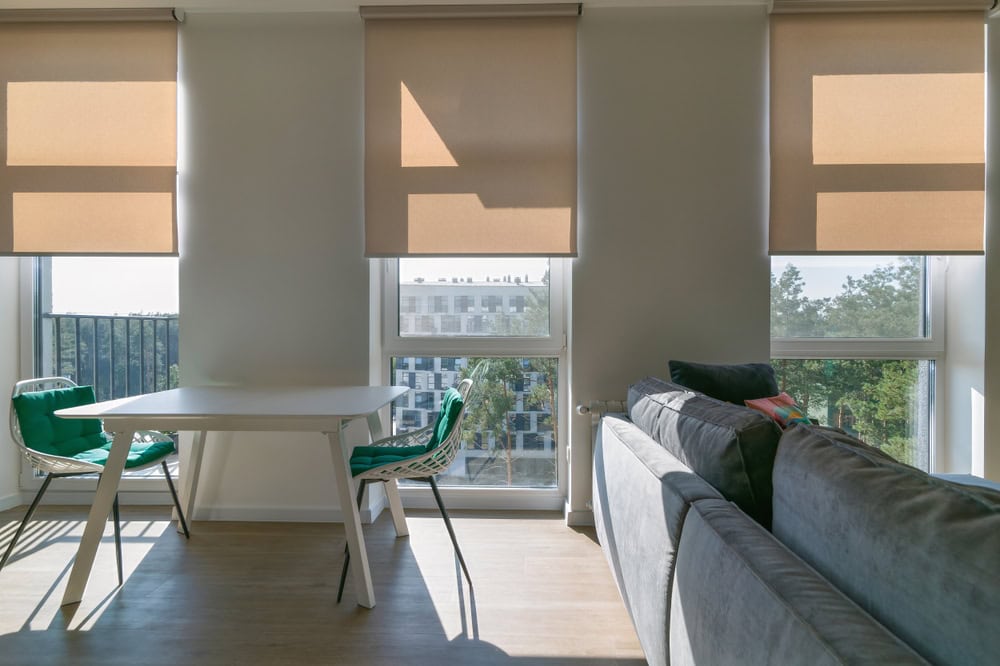
Solar shades are the most direct answer to the heat problem. They’re designed specifically to block solar radiation and reduce glare without eliminating your view or turning the room dark. The key spec to pay attention to is the openness factor — a lower percentage means less light and heat transmission, a higher percentage preserves more of your view but blocks less. For west-facing windows in Arlington, Fort Worth, or Mansfield that take direct afternoon sun, a tighter openness factor (around 3 to 5 percent) typically performs best.
Cellular shades — also called honeycomb shades — work differently. Their insulating value comes from the air pockets trapped inside the honeycomb cells, which create a thermal barrier between the window glass and the room. Single-cell shades provide a basic level of insulation; double- and triple-cell shades add progressively more. For rooms where you want both insulation and light control, cellular shades are hard to beat.
Exterior roller shades take a different approach entirely — and it’s one that most local competitors don’t offer. By blocking solar heat before it ever reaches the glass, exterior shades outperform interior treatments on raw thermal performance. This is especially relevant for covered patios, pergolas, and outdoor living spaces, which are standard features in Tarrant County’s suburban homes. We offer both interior and exterior roller blinds, which means you can address heat gain from the outside in for the most demanding exposures while handling interior light control and privacy with the appropriate interior treatment.
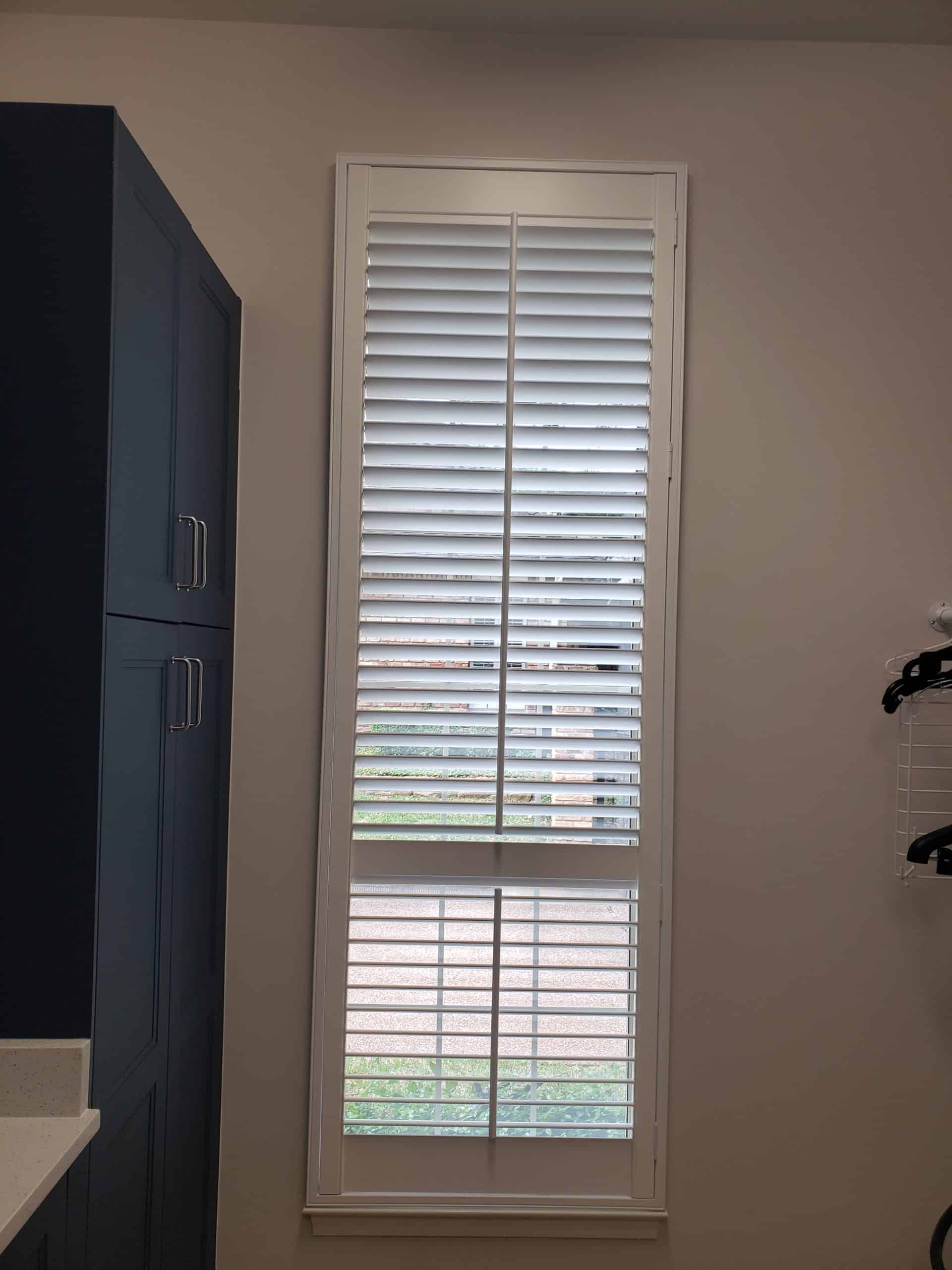
Plantation shutters also perform well thermally when closed, creating an air gap between the shutter and the glass that adds insulation value. They’re not primarily an energy product, but their contribution to light control and insulation is real — and in a home where you’re running the AC for six months straight, every layer helps.
Motorized window treatments have moved well past the “luxury feature” category. About 69 percent of U.S. households now own at least one smart home device, and the expectation that window coverings can integrate with those systems has followed. The practical case for motorization is straightforward: if you have high windows, hard-to-reach openings, or a two-story great room — all common in Tarrant County’s newer builds — motorized treatments let you adjust every shade in the room without a ladder or a struggle with a cord.
Remote blinds are the entry point. A handheld remote or wall switch controls the shade motor without any smart home integration required. It’s a simple, reliable upgrade that works well for single rooms or for clients who want the convenience without the tech complexity. Battery powered blinds make this even more accessible — no wiring, no electrician, no wall patching. The motors run on rechargeable or replaceable batteries and perform reliably for months between charges.
Automatic shades take things further. You can program shades to open and close on a schedule — raising them at sunrise, lowering them during peak afternoon heat, closing them at dusk for privacy. This kind of automated routine is genuinely useful in Texas, where the difference between shades being open or closed during the 2 to 5 PM window can translate directly into lower cooling costs.
Smart window blinds and shades that integrate with Alexa, Google Home, or Apple HomeKit are the top of that range. Alexa controlled blinds let you adjust every shade in a room with a voice command, or group them by floor, by room, or by sun exposure for coordinated control. Motorized Roman shades, motorized roller blinds, electric venetian blinds, and even motorized vertical blinds for sliding glass doors are all available in smart-home-compatible configurations. Arched window blinds motorized are also possible for the specialty openings that show up frequently in Fort Worth-area architecture — a category that most local competitors either can’t address or don’t mention.
The question of electric blinds cost comes up early in most consultations, and the honest answer is that it varies by product type, window count, and whether you’re choosing battery-powered or hardwired motors. What we can tell you is that the gap between motorized and manual has narrowed considerably, and for high-use windows or hard-to-reach openings, the convenience case is strong enough that most clients who add motorization to one room end up extending it to others.
Store-bought blinds solve a problem temporarily. Custom window treatments solve it for good — and in a market where summers are brutal, homes range from century-old Fort Worth bungalows to brand-new builds in Keller and Crowley, and the outdoor living space is as important as the living room, “close enough” rarely is.
The right starting point is a free in-home consultation where you can see actual samples in your own light, get accurate measurements, and talk through what each product will actually do in your specific rooms. No guessing, no ordering online and hoping for the best.
If you’re ready to stop working around windows that don’t quite work, reach out to A Plus Shutters & Shades. We’re based in Pantego and serve homeowners and businesses throughout Tarrant County — and we’ll bring the showroom to you.
—
**What is the average cost of window treatments?** Custom window treatment costs vary based on product type, window count, material, and whether motorization is included. Because we measure and fabricate every project specifically for your windows, the best way to get an accurate number is through a free in-home estimate. What we can tell you is that when you factor in the re-orders, installation costs, and shorter lifespan that often come with store-bought treatments, the gap between custom and off-the-shelf is smaller than most people expect — and the performance difference is significant, especially in Tarrant County’s heat.
**What is the difference between light-filtering blinds vs. room-darkening?** Light-filtering blinds soften and diffuse incoming daylight, reducing glare while keeping the room bright and airy. They’re great for living rooms and common areas. Room-darkening shades block the majority of light and are the right choice for bedrooms, media rooms, or any space where you need real darkness. One important note for Tarrant County homeowners: light-filtering blinds can allow silhouettes to be visible from outside at night when interior lights are on. If privacy after dark matters — and in the denser suburban neighborhoods around Arlington and Fort Worth, it usually does — room-darkening is the safer choice.
**How much do electric blinds cost?** The cost of motorized or electric shades depends on the motor type (battery-powered vs. hardwired), the product category (motorized roller blinds, motorized Roman shades, electric venetian blinds, etc.), and the number of windows being covered. Battery powered blinds are typically more affordable to install since no electrical work is required. For a specific number that reflects your home and your windows in Tarrant County, a free in-home consultation is the right first step — that’s the only way to give you a figure that actually means something.
Article details:
Share:
Continue learning: