Interior or exterior shutters — which one actually makes sense for your home? Here's a clear, honest breakdown built for Texas homeowners.
Share:
Most homeowners in Tarrant County start their shutter search with a simple question: what’s actually going to work for my home? Then they fall into a rabbit hole of materials, styles, mount types, and conflicting advice. Interior shutters, exterior shutters, plantation style, café style — it adds up fast.
This guide cuts through it. We’ll walk you through how interior and exterior shutters actually differ, what makes each one worth considering in the Texas climate, and why the window shape in your entryway or great room matters more than most people realize. By the end, you’ll know exactly what questions to ask — and what to look for when you’re ready to move forward.
The short answer: interior shutters live inside your home and function like a permanent architectural feature. Exterior shutters — either traditional hinged panels or roller shades — mount on the outside of the window and deal with the elements directly.
Both serve a purpose. But they don’t serve the same one. Interior shutters are primarily about light control, privacy, insulation, and the finished look of a room. Exterior shutters — especially roller shades — are about blocking heat before it ever enters the glass, protecting outdoor living spaces, and handling weather exposure. In Tarrant County, where July afternoons can push past 100°F and west-facing windows turn living rooms into greenhouses, that distinction matters a lot.

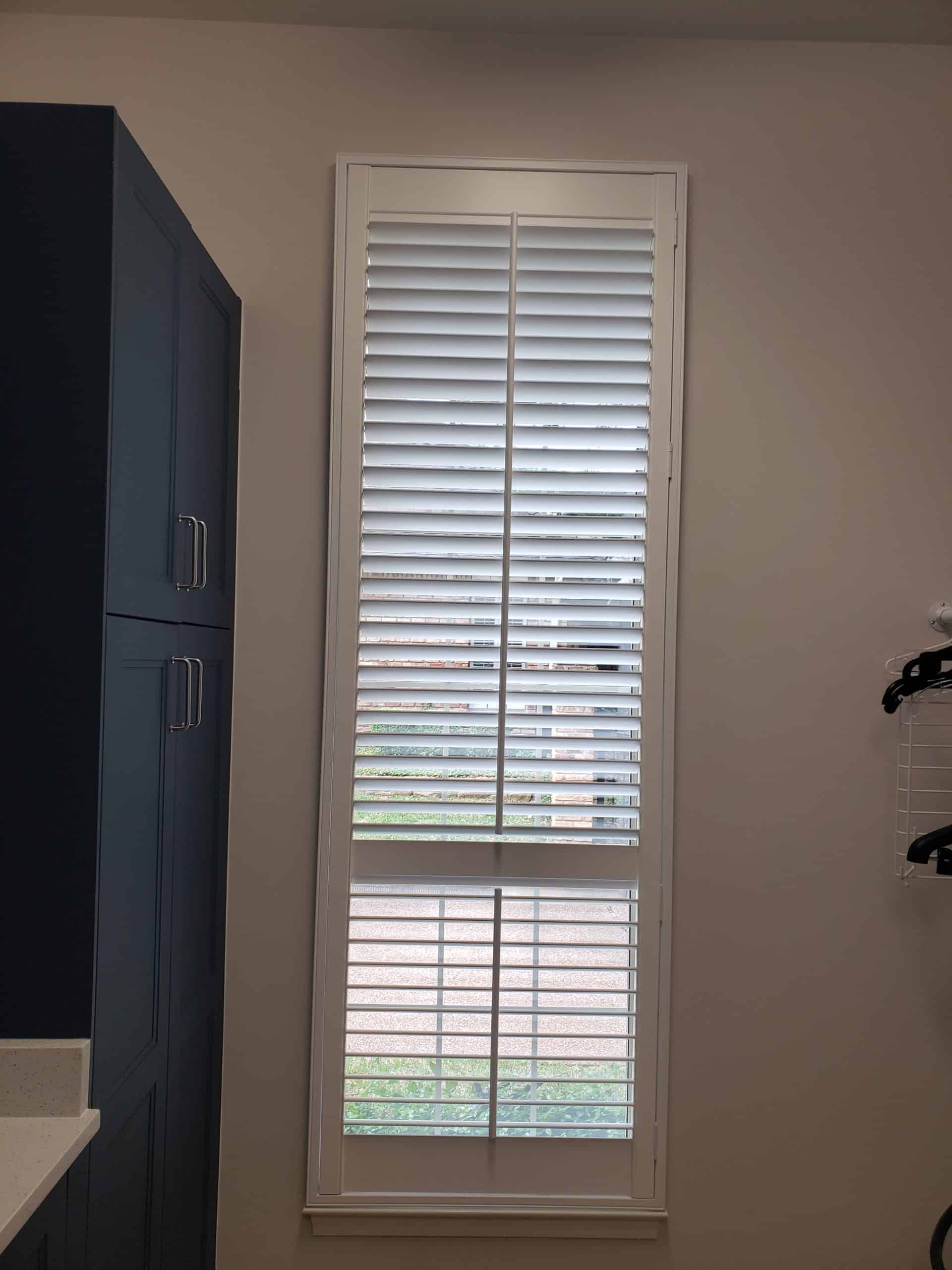
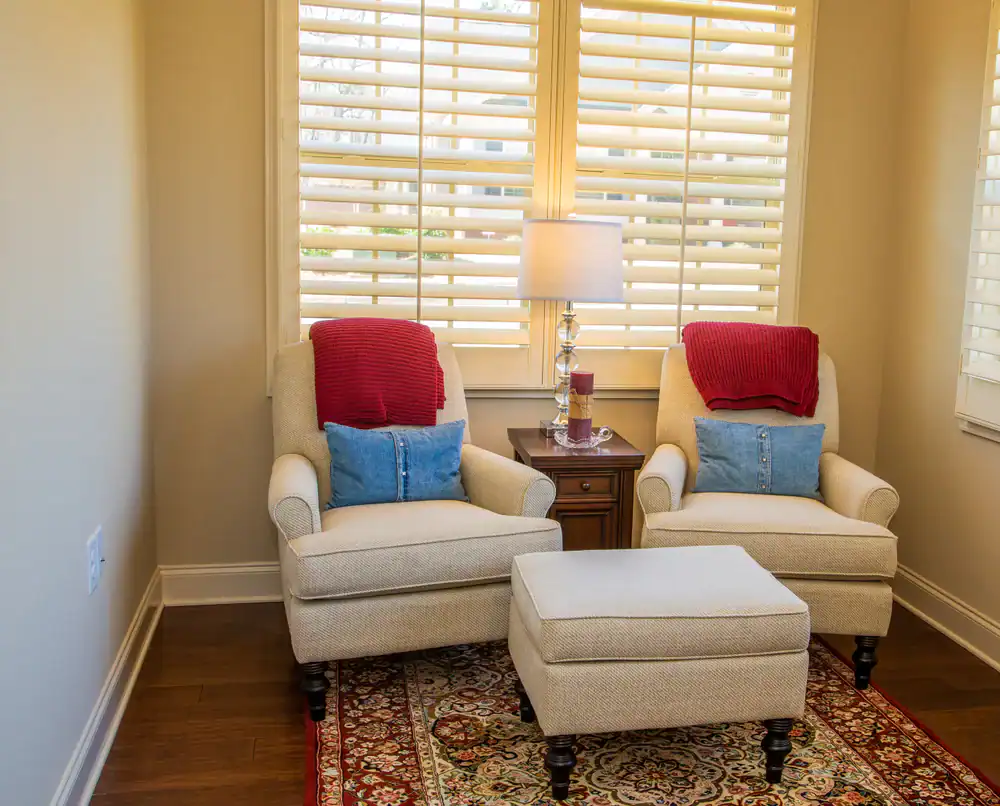
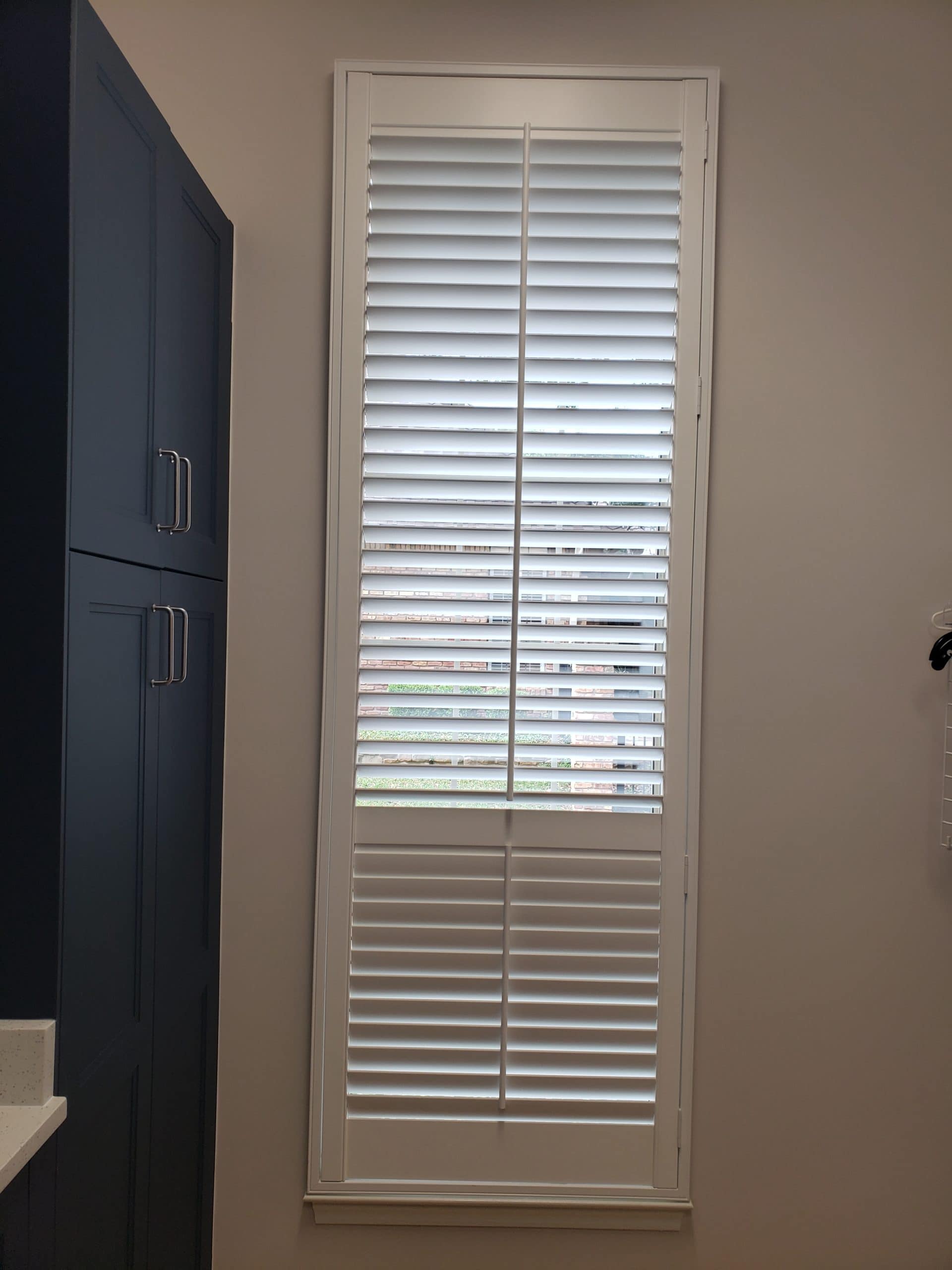
Interior shutters are mounted directly to the window frame — either inside the casing or over it. The frame holds hinged panels, and each panel holds a set of horizontal louvers you can tilt open or closed to adjust light and privacy. When you want the window fully open, the panels swing to the side.
What makes them different from blinds is permanence. A quality interior shutter is built into the window the way trim is built into a wall. It doesn’t rattle in the wind, it doesn’t fade in two years, and it doesn’t need to be replaced when you repaint the room. Well-made shutters — particularly those built from basswood or a high-grade polywood composite — can last up to 20 years with nothing more than an occasional wipe-down.
Louver size plays a bigger role than most people expect. Smaller louvers, around 2.5 inches, give a more traditional look and work well in older homes or spaces where you want a classic feel. Larger louvers — 3.5 or 4.5 inches — are the standard in most Tarrant County homes today. They let in more light when open, offer a cleaner sightline to the outside, and suit the scale of the larger windows you’ll find in newer builds in places like Mansfield, Southlake, and the growing communities along Fort Worth’s western corridor.
Material selection is where a lot of buyers get tripped up. Real wood shutters look beautiful and are the premium choice for living rooms, bedrooms, and formal spaces. But in bathrooms, laundry rooms, or any space with humidity fluctuation, wood can warp over time. That’s where polywood and composite shutters earn their place — they’re engineered to hold their shape in moisture-heavy environments without sacrificing the look of real wood. We walk you through which material belongs where before anything gets ordered.
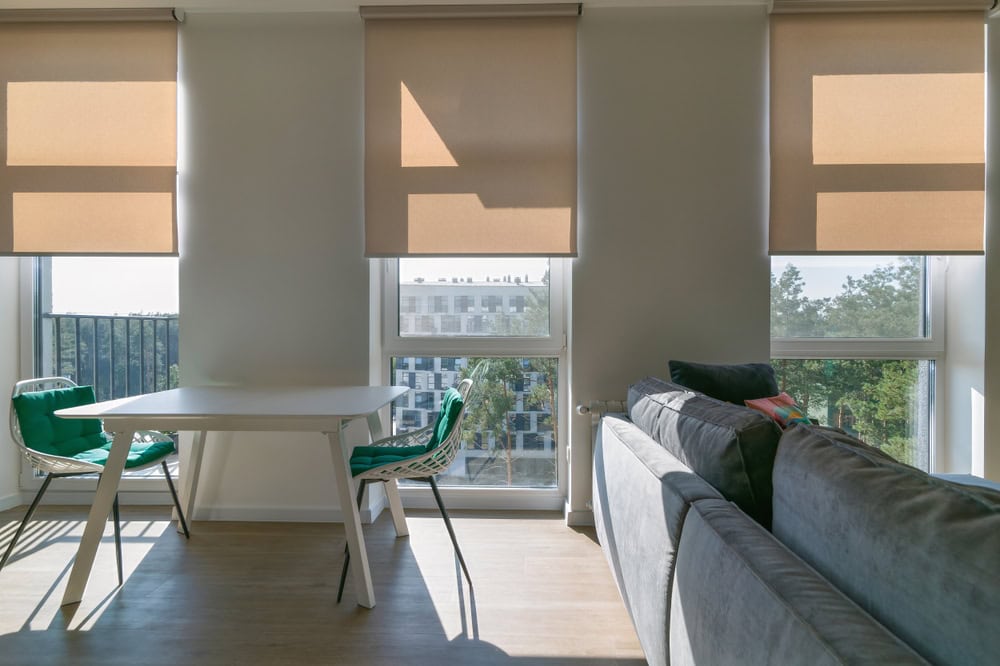
Exterior shutters come in two main forms: traditional hinged panels that flank the window on the outside, and exterior roller shades that mount above the window and roll down to cover it. In Texas, the roller shade version has become the more functional of the two — particularly for patios, covered outdoor living spaces, and windows that take a beating from afternoon sun.
Here’s the physics of it: once sunlight passes through glass, the heat is already inside your home. Interior shutters can slow down how quickly that heat spreads through the room, but they can’t stop it from entering. An exterior shade blocks the solar energy before it ever hits the glass, which is genuinely more effective at reducing indoor temperatures on a south or west-facing wall. For homeowners in Arlington, Grand Prairie, or Cedar Hill with large windows facing the afternoon sun, that difference shows up on the utility bill.
Exterior roller shades have also become the go-to solution for covered patios and pergolas across Tarrant County. The outdoor living culture here is real — people invest in outdoor kitchens, seating areas, and shade structures — and exterior roller shades let you actually use those spaces during the summer by blocking direct sun and cutting the radiant heat. They’re motorized, durable, and built to handle UV exposure, wind, and the temperature swings North Texas delivers between seasons.
Traditional decorative exterior shutters — the kind that flank a window as an architectural accent — are worth mentioning, though most of what you see on newer homes is non-functional. They’re there for aesthetics, not performance. If your goal is heat management, privacy, or weather protection, a functional exterior roller shade is the product that actually delivers.
If your home was built in the last 15 years anywhere in Tarrant County — Southlake, Mansfield, Keller, the newer sections of Fort Worth — there’s a good chance you have at least one window that isn’t a standard rectangle. Arched entryways, Palladian windows in great rooms, transom windows above doors, oversized picture windows that span most of a wall. These are the architectural features that define newer Texas construction, and they’re exactly the configurations that off-the-shelf shutters can’t handle.
We fabricate custom interior shutters to the exact measurements of your specific window — not cut down from a standard size and shimmed to fit. That difference is significant. A shutter that’s built to your window looks like it was always meant to be there. One that’s been adapted from a stock size usually shows it.

The arch window above a front door or in a two-story entryway is one of the most common architectural features in Tarrant County’s master-planned communities — and one of the most frequently left uncovered because homeowners assume shutters can’t work on curved windows. They can. It just takes someone who knows how to build them.
Custom arch window shutters are fabricated to follow the curve of the window opening exactly. The most common approach is a fixed arch panel — a shaped shutter built to fill the arch portion of the window — paired with operable panels below that you can open and close normally. The arch panel is typically set at a fixed louver angle that lets in diffused light while maintaining the visual continuity of the shutter across the full window. For a full arch window, the entire panel is shaped to the curve, and the louvers are cut and set to fit within it.
What makes arch shutters tricky isn’t the design — it’s the measurement. A window that looks symmetrical often isn’t, particularly in homes where settling has occurred or where the original framing wasn’t perfectly square. Getting the measurements right before fabrication is the entire job. If the measurements are off, the arch shutter won’t sit flush, the gaps will be visible, and there’s no easy fix once the product has been made. This is where our team’s construction knowledge — not just window treatment experience — makes a real difference. Understanding how a window frame is built, how to account for out-of-square openings, and how to compensate in the fabrication spec is what separates a shutter that looks built-in from one that looks bolted on.
Beyond arches, the same principle applies to bay windows, angled windows in bonus rooms, and the oversized picture windows that are standard in many Southlake and Mansfield custom builds. Every one of those configurations requires a custom approach to both measurement and installation — and every one of them is solvable with the right expertise.
This is the part of the conversation most window treatment companies skip, so it’s worth being direct about it. A lot of companies in the DFW market sell shutters and then hand the installation off to a third-party subcontractor. The homeowner doesn’t always know this is happening. The subcontractor may be perfectly competent — or they may be a general handyman who’s installed shutters a handful of times. The company that sold you the shutters often has limited accountability for what happens during the install.
We use our own installation team — people who work for us, who measured your windows themselves, and who are accountable to our reputation on every job. If something isn’t sitting right, we fix it before we leave. If a frame is slightly out of square and the shutter needs to be shimmed and adjusted, we know how to do it without creating gaps or misalignment. The finished result looks the way it’s supposed to look.
Warranty coverage is the other piece of this. Manufacturer warranties on quality shutters are often strong — some cover the product for its lifetime. But those warranties typically apply to the product itself, not the installation. Installation workmanship warranties are only as good as the company that stands behind them. A subcontractor who’s moved on to the next job has no stake in coming back to adjust a panel that’s sagging six months later. Our team that cares about our reputation does.
This matters especially in Tarrant County’s new construction market, where homes are being built quickly and window frames sometimes reflect that pace. Out-of-square openings, slightly irregular arches, frames that weren’t finished with window treatments in mind — these are common, and handling them correctly requires both construction knowledge and accountability. The installer who understands framing is going to produce a better result than the one who just hangs shutters and moves on.
Interior or exterior, wood or polywood, standard rectangle or custom arch — the right answer depends on your specific windows, your home’s exposure to the Texas sun, and what you actually want the shutters to do. There’s no universal answer, but there is a right answer for your house.
What makes the decision easier is talking to someone who’s seen it before — the west-facing great room in a Mansfield new build, the arched entryway in a Southlake custom home, the patio in Arlington that’s unusable from June through September without some kind of shade solution. The details of your situation are what drive the recommendation, not a product catalog.
We offer free in-home consultations across Tarrant County. We bring samples, take precise measurements, and walk you through exactly what will work — before anything gets ordered or installed.
Article details:
Share:
Continue learning: