Real pricing, honest comparisons, and Tarrant County-specific answers for anyone researching motorized blinds — before you spend a dollar.
Share:
You’ve probably already seen the national cost guides. One says $300 per window, another says $2,500, and none of them tell you anything useful about what this actually costs in Fort Worth or Arlington. That’s the problem with recycled averages — they’re built for everywhere, which means they’re useful for nowhere.
Tarrant County has its own reality: summers that push past 100°F for months, west-facing windows that turn rooms into ovens by 2 PM, and electric bills that spike hard from June through September. Motorized blinds aren’t a luxury upgrade here — for a lot of homeowners, they’re a practical answer to a daily problem. Here’s what they actually cost, and what’s worth paying for.
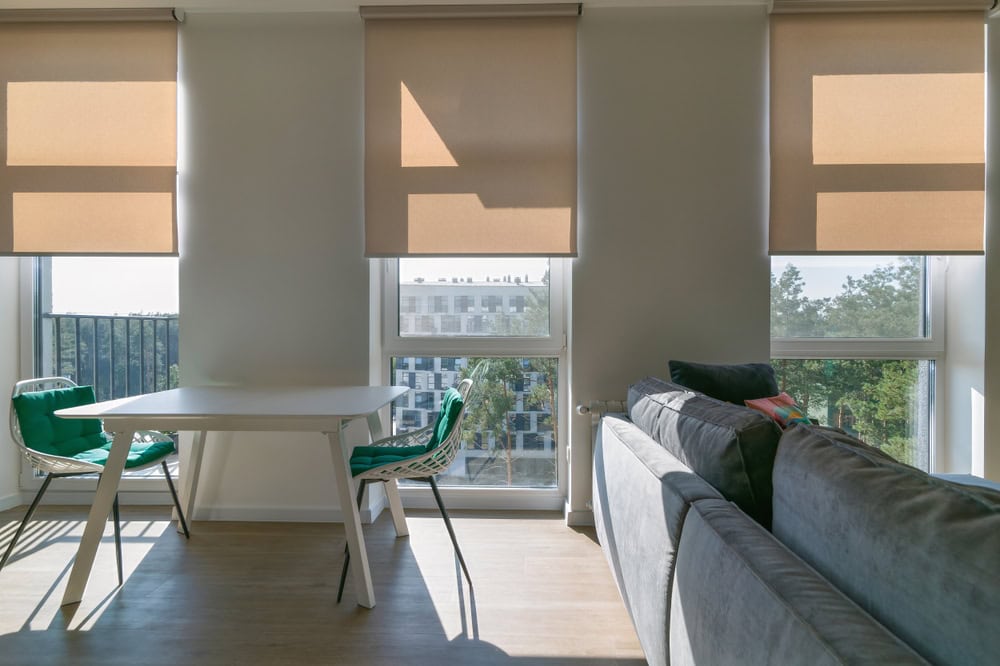
Let’s start with the numbers. In the DFW market, custom roller shades typically run $150 to $500 per window depending on size and material. Motorization adds roughly $150 to $250 per window on top of that, depending on the system. So for a single motorized window, you’re generally looking at $300 to $750 before smart home add-ons.
That range shifts depending on what you’re working with. A basic bedroom window is different from a large picture window in a Southlake living room. Fabric choice, window dimensions, and motor type all move the number. What doesn’t change is that custom motorized blinds — measured precisely and installed professionally — cost more than what you’d pull off a shelf at a big-box store. The question is whether that difference is justified. It usually is, and the next two sections explain why.

For the majority of Tarrant County homeowners in existing homes, battery-powered motorized blinds are the practical answer. There’s no electrical work required, no permits, no opening up walls. The motor is built into the headrail, and the whole system runs on a rechargeable lithium-ion battery that you charge via magnetic USB — not a drawer full of AA batteries you’re swapping out every few months.
That last point matters more than people realize. Cheap motorized blinds you find online often run on disposable batteries that need replacing every four to six months, which means climbing a ladder twice a year per window just to keep the thing working. Quality rechargeable systems last several months per charge and take about as much effort as plugging in your phone.
Battery-powered is also the right call when you want motorization in a room where running new wiring would be disruptive or expensive. Bedrooms, living rooms, home offices — anywhere in a finished home where the walls are already closed. You get the full smart home experience without the construction headache.
The trade-off is real but manageable: you will need to charge the motors periodically. For most households, that’s a minor inconvenience compared to the alternative of hiring an electrician to run new circuits through finished drywall. If you’re in an older Fort Worth neighborhood with a home that was built before smart home technology was a consideration, battery-powered motorization is almost always the right starting point.
One thing worth knowing: the motor quality matters enormously here. A well-engineered system operates at under 38 decibels — roughly the volume of a whispered conversation. A poorly made retrofit motor sounds like a small appliance malfunctioning. If you’ve ever heard a motorized blind that sounded like it was struggling, that’s a motor that wasn’t built into the headrail — it was clipped on afterward. That’s a different product category entirely, and it’s one of the main reasons people end up frustrated with off-the-shelf motorized options.
Hardwired motorization is the cleaner long-term solution — no charging, no batteries, no maintenance beyond occasional dusting. The motor draws power directly from your home’s electrical system, which means it’s always ready and you never think about it again. For a whole-home motorization project in a new build or a major renovation where the walls are already open, hardwired is the right call.
The catch is cost and timing. Hardwired systems require a licensed electrician, and in a finished home, running new wiring through closed walls adds real money to the project. That’s why the timing matters so much. If you’re building new — and Tarrant County has been adding new construction in every direction — specifying hardwired motorization before the drywall goes up is straightforward and cost-effective. If you’re retrofitting an existing home, battery-powered usually makes more financial sense unless you’re already doing a significant renovation.
Communities like Southlake, Colleyville, and Keller tend to see more whole-home hardwired projects, partly because home values support the investment and partly because buyers in those markets are often furnishing new builds where the infrastructure conversation happens early. If you’re in that situation, it’s worth having the hardwired conversation before the walls close — it’s a much easier installation at that stage.
For existing homes in Arlington, Mansfield, or Grand Prairie, battery-powered motorization handles the same daily automation tasks without the electrical work. Scheduled closing before the afternoon sun hits your west-facing windows, sunrise opening, voice control through your existing smart home setup — all of it works the same way. The power source is different; the experience is nearly identical.
The honest answer is that most Tarrant County homeowners end up with a mix: battery-powered in the rooms where wiring would be disruptive, and hardwired in spaces where the electrical access was already there or the renovation made it practical.
This is the comparison most buyers are quietly running in their heads. You’ve seen motorized blinds at Home Depot or on Amazon for a fraction of what a custom installation costs. It’s a fair thing to notice. But the price gap reflects a real difference in what you’re getting, and understanding it helps you make the right call for your home.
Off-the-shelf motorized blinds are cut to standard sizes. Your windows almost certainly aren’t standard. The result is light gaps — strips of light along the sides and bottom that undermine the whole point of having blinds in the first place. In Tarrant County, where west-facing windows in the afternoon can make a room feel like a greenhouse, a light gap isn’t just aesthetically annoying. It’s a failure of the product’s core function.
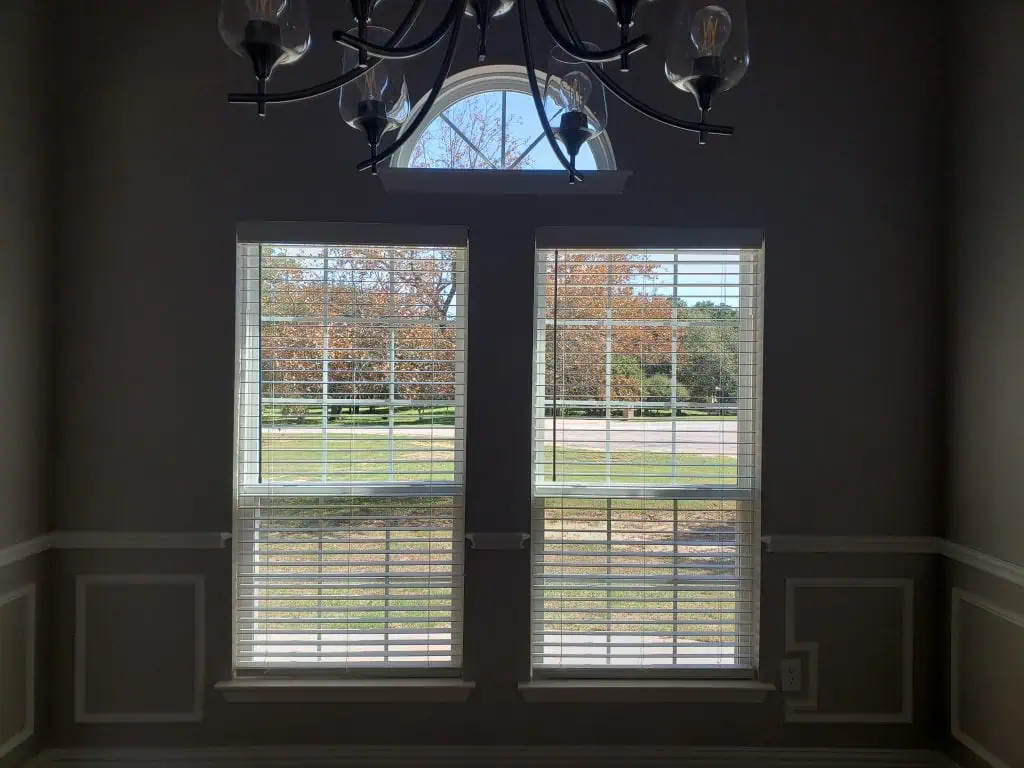
Smart home integration is one of the main reasons people invest in motorized blinds, and it’s also where the cost picture gets a little more detailed. The motorized shades themselves are one line item. The smart home ecosystem that controls them is another.
For PowerView motorization — the system we install — the Gateway (the hub that connects your shades to your smart home network) runs $180 to $285. A Pebble remote, if you want a dedicated physical controller in addition to voice control, is $75 to $80. These are one-time costs that cover your entire home, not per-window charges. When you’re motorizing ten or fifteen windows, the per-window cost of the hub becomes almost negligible.
Once the Gateway is installed and paired, your shades work through whatever smart home platform you’re already using — Alexa, Google Home, or Apple HomeKit. You don’t need a separate app. You don’t need to learn a new system. You say “close the living room shades” and it happens. For buyers who already have a smart thermostat, smart lights, or a smart doorbell, motorized blinds are the piece that completes the picture.
The integration also enables scheduling, which is where the practical value really shows up for Tarrant County homeowners. Tarrant County sees over 70 days above 90°F per year, and afternoon solar gain through west-facing windows drives a significant portion of summer cooling costs. A typical Fort Worth home’s electric bill runs around $112 in March and climbs to $237 in August — that’s a $125 monthly swing driven almost entirely by air conditioning. Scheduled automation that closes your shades before peak heat hours, without you having to remember to do it, is a genuine energy management tool. Forgetting to close your shades at 2 PM can add $50 to your electric bill. Automation means you don’t forget.
We handle complete smart home pairing before we leave your home. That means your shades are connected, your schedules are set, and your voice commands are working — not left for you to figure out from a manual. That’s a meaningful part of what you’re paying for, and it’s the piece that most DIY motorized blind setups fail at entirely.
Most buyers start by thinking about one or two windows. By the time they’ve had a consultation, they’re usually thinking about the whole house — and that shift in scope actually works in their favor financially.
Here’s why: the fixed costs of a motorized system (the Gateway, the smart home pairing, the installation setup) are spread across however many windows you’re doing. A ten-window project is significantly more cost-efficient per window than a two-window project. The per-window motorization cost stays in the $150 to $250 range, but the overhead costs — the hub, the consultation, the installation visit — don’t multiply with each window.
A whole-home treatment project in the $3,000 to $4,000 range pays for itself in roughly six to eight years in energy savings alone, based on the reduction in cooling costs from automated solar management. That’s before you factor in the convenience, the child safety benefit (motorized blinds eliminate the cord hazard that the CPSC has documented as injuring approximately nine children per year), or the home value consideration.
The timeline for a custom motorized blind project is typically two to three weeks from consultation to installation. That’s not a long wait when you’re talking about precision-measured, custom-fabricated window treatments — but it’s worth knowing upfront if you’re working against a move-in date or a renovation schedule.
We grew out of A Plus Home Remodel, which has been working in the DFW market for over a decade. That construction background means we handle the situations that stop other installers: arched windows, non-standard openings, older homes in established Fort Worth neighborhoods where nothing is perfectly square. The products we install are manufactured in Denton, TX, built for North Texas heat and UV intensity, not calibrated for a milder climate and shipped from a generic warehouse.
For most Tarrant County homeowners, the answer is yes — but the details matter. Battery-powered motorization works well in existing homes without electrical access. Hardwired makes sense for new builds or major renovations. Custom installation eliminates the light gap and pairing problems that make off-the-shelf motorized blinds frustrating. And smart home integration, once it’s set up properly, runs quietly in the background and handles the daily work of managing your home’s temperature and light.
The numbers are real: $150 to $500 per window for the shade, $150 to $250 for motorization, and a one-time hub cost that covers your whole home. For a project that pays back in energy savings and adds lasting value to a home in a market where median prices have risen significantly year over year, it’s a straightforward investment to evaluate.
If you’re ready to get an honest look at what this costs for your specific home and windows, we at A Plus Shutters & Shades offer a free in-home consultation — no pressure, no vague estimates. Just a clear picture of what you’re working with and what it’ll take to get it done right.
Article details:
Share:
Continue learning: