Trying to figure out inside mount vs. outside mount window shades? Here's what actually matters — and what most guides get wrong.
Share:

You found a shade you like. You measured the window. You placed the order. Then the installer shows up and says the frame is too shallow for inside mount — and now you’re starting over.
It happens more than you’d think, especially in Tarrant County’s newer neighborhoods. The inside vs. outside mount question isn’t just a style preference. For a lot of homes here, it’s a structural reality that determines what will actually work. This guide walks you through the difference, how to tell which one your windows need, and why outside mount is often the better choice — not the backup plan.
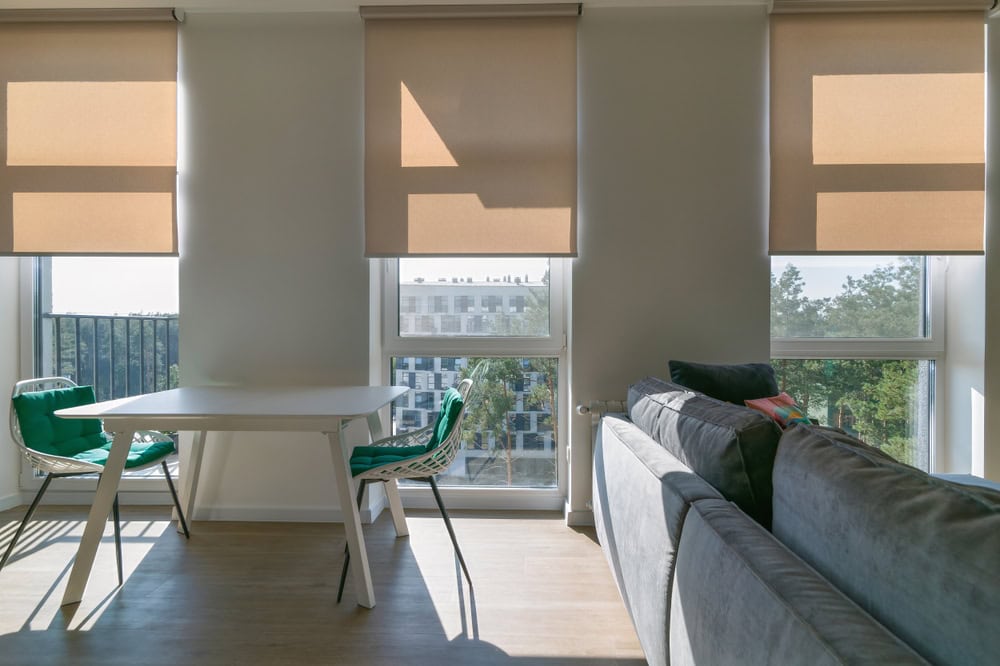
Inside mount means the shade installs inside the window frame — tucked into the opening so it sits flush with the wall. It gives a clean, built-in look that a lot of people prefer when the frame is deep enough to pull it off. Outside mount means the headrail mounts above the window frame, on the wall or trim, and the shade covers the entire opening from the outside.
Neither one is automatically better. The right choice depends on your window’s depth, what’s on or around the frame, and what you’re trying to accomplish with the shade. In a lot of cases, the window itself makes the call.

The deciding factor for inside mount is frame depth. Most roller shades with a cassette valance need at least 3 to 3.5 inches of clear depth inside the frame to mount properly without the hardware sticking out. If your frame is shallower than that, inside mount isn’t going to work — full stop.
This comes up constantly in Tarrant County. The rapid growth in areas like Keller, Haslet, North Fort Worth, and Mansfield has produced thousands of homes where builders prioritized clean aesthetics and cost efficiency over window depth. A lot of those frames come in at 2 to 3 inches — just enough to look like inside mount should work, but not quite enough to actually do it.
Homeowners order shades, the installer arrives, and the conversation shifts to outside mount. It’s not a problem. It’s just the reality of how a lot of Texas new construction is built.
To check your own windows, grab a steel tape measure — not cloth, which stretches and throws off your numbers — and measure the depth of the frame from the front edge to the glass. If you’re under 3 inches, plan for outside mount. If you’re over 3.5 inches, inside mount is likely viable. Somewhere in between, it depends on the specific product.
There are other reasons outside mount becomes necessary even when depth isn’t the issue. Casement windows and crank-style windows common in mid-century Fort Worth and Arlington homes often have handles or hardware that protrudes into the frame. An inside-mounted shade will hit that hardware every time it moves. Outside mount clears the obstruction entirely because the shade never enters the frame at all.
Windows that aren’t perfectly square are another common scenario. Older homes settle. Framing shifts. A window that looks square might be off by a quarter inch or more — enough to cause an inside-mounted shade to bind, gap, or sit crooked. Outside mount sidesteps the problem because it mounts to the flat wall surface above the window, where squareness doesn’t matter.
There’s a perception that outside mount is the less attractive option — something you settle for when inside mount doesn’t work out. That’s worth pushing back on, because it misses what outside mount actually does well.
Inside mount shades require a small clearance gap on each side of the fabric — typically somewhere between three-eighths and three-quarters of an inch per side — so the shade can operate without rubbing against the frame. That gap lets light in around the edges. In a bedroom or a media room, that strip of light on each side can be genuinely disruptive, especially if you’re using a blackout fabric specifically to eliminate it.
Outside mount shades, when sized correctly with at least 1.5 inches of overlap on each side beyond the window opening, eliminate that gap entirely. The shade covers the edge of the frame and then some. For anyone dealing with the kind of afternoon sun that comes through a west-facing room in Arlington or Mansfield between 2 and 7 PM, that extra coverage matters.
Outside mount also makes windows appear larger. Mounting the headrail 2 to 4 inches above the frame and extending the shade beyond each side creates a visual frame around the window that draws the eye upward and outward. Interior designers use this intentionally — it’s not a workaround, it’s a technique. If you have builder-grade trim you’d rather not look at, outside mount covers that too. The shade becomes the visual element, and the trim disappears behind it.
For anyone considering motorized shades, outside mount is actually the easier configuration. There are no depth calculations to worry about, no clearance constraints for the motor housing. Battery-powered motorized systems go up cleanly, and smart home integration — Alexa, Google Assistant, Samsung SmartThings — works exactly the same way it does in any other configuration. The mount type doesn’t limit what the shade can do.
Here’s something that rarely gets said clearly: if you’re looking at exterior roller shades for a covered patio, pergola, or west-facing wall, you’re already looking at outside mount. That’s not a configuration option — it’s the only way exterior shades work. They mount to the structure above the opening and roll down to cover it from the outside.
This matters for Tarrant County homeowners because outdoor living spaces are standard here, and the heat problem they’re trying to solve is real. Summers regularly push past 100°F, and a covered patio without shade on the west side is barely usable from early afternoon onward.
The reason exterior shades outperform interior ones on heat isn’t complicated. Interior shades — even good blackout ones — stop light after it’s already passed through the glass. The heat from that solar energy has already entered the room. An interior shade traps it between the fabric and the window, which slows heat transfer somewhat but doesn’t eliminate it.
Exterior roller shades stop that solar energy before it ever reaches the glass. The fabric intercepts the heat on the outside of the home, where it can dissipate into the air rather than transferring into your living space. That’s why the numbers are meaningful: exterior shades can reduce surface temperatures near windows and on patios by 15 to 20 degrees Fahrenheit, and homeowners with proper exterior shading regularly see cooling costs drop by 15 to 30 percent during the summer months.
The fabric itself matters. Exterior roller shade fabrics are engineered for outdoor use — UV-resistant, heat-stable, and rated to handle North Texas weather including the wind that comes with spring and summer storm systems. Interior fabrics used outdoors will warp, fade, and fail within a season.
When we install exterior roller shades in Tarrant County, we select fabrics based on the specific exposure of the installation — south-facing and west-facing applications get different recommendations than north-facing ones.
Solar fabric openness factor is the other variable worth understanding. A tighter weave — say, a 1 to 3 percent openness factor — blocks more UV and heat but reduces your ability to see through the shade. A looser weave at 5 to 10 percent lets more light and view through while still blocking a significant portion of UV radiation. For a covered patio where you want to see the yard, a higher openness factor usually makes sense. For a west-facing bedroom window, you probably want the tighter option.
Measuring for outside mount is straightforward once you understand what you’re actually measuring. Unlike inside mount — where you measure the window opening itself — outside mount requires you to measure the coverage area you want the shade to fill.
Start with width. Measure the window opening from one side of the trim to the other, then add at least 1.5 inches on each side. That gives you 3 inches of total overlap beyond the opening, which is the minimum for solid light control and a clean finished appearance. If you’re dealing with a window that gets direct afternoon sun and you want maximum coverage, you can extend that overlap further. There’s no rule that says you have to stop at 1.5 inches per side.
For height, measure from where you want the top of the shade to sit — typically 2 to 4 inches above the top of the window frame — down to the sill or wherever you want the shade to land. If you’re mounting significantly higher than the frame to make the window appear taller, account for the stack height: when the shade is fully raised, the rolled fabric needs somewhere to go. Mounting 10 to 12 inches above the frame gives you clearance so the shade doesn’t block the top of the window when it’s open.
Measure every dimension to the nearest one-eighth of an inch. That’s the industry standard, and it exists for a reason — a quarter-inch error in a custom shade order means the shade either gaps or binds. Use a steel tape measure, not a cloth one. And measure width at three points (top, middle, and bottom of the opening) and height at three points (left, center, and right). Windows that look square often aren’t, and catching a variance before you order saves a lot of frustration.
For outside mount brackets specifically, you need at least 2 inches of flat surface above the window frame or on the trim to anchor the hardware properly. If your trim is narrow or the wall above the window has an unusual profile, that’s worth flagging before you order. It’s the kind of thing that’s easy to address during a measurement visit and much harder to deal with after the shade arrives.
The short version: check your frame depth first. If it’s under 3 inches, outside mount is your answer. If your windows have hardware that protrudes into the frame, outside mount. If you’re shading a patio, pergola, or any exterior opening, outside mount — that’s the only option that exists for those applications.
Outside mount isn’t a compromise. For a lot of Tarrant County homes — especially the newer builds spreading across North Fort Worth, Keller, and Mansfield — it’s simply the correct solution. And when it’s done right, with proper overlap, the right fabric, and hardware anchored to handle the wind loads this area sees, it looks sharp and performs better than most inside mount installations on light control alone.
If you’re still working through the decision, or you’d rather have someone come out and measure before you commit to anything, that’s exactly what we do at A Plus Shutters & Shades. Reach out and we’ll take it from there.
Article details:
Share:
Continue learning: